Trikoupis, Deligiannis, modernisation and crisis
Infrastructure, borrowing, bankruptcy and the Greco-Turkish War of 1897.
Audio will be added after final production.
In this episode
Infrastructure, borrowing, bankruptcy and the Greco-Turkish War of 1897.
Full transcript
The complete English transcript of this episode is available to read.
ProjectGreece.
The History of Greece, from 1800 to today.
A series of twenty episodes that narrates the path of modern Greece with sobriety, calm, and documentation.
Sixth episode.
1882–1897: Trikoupis, Delyiannis, modernisation and crisis.
Welcome to another episode of the series “The History of Greece, from 1800 to today.”
In the previous episode, we reached the end of 1881. The principle of the “dedilomeni” (the requirement for the prime minister to have a parliamentary majority) had changed the way governments were formed, and Greece had incorporated the greater part of Thessaly and the region of Arta. Territorial expansion, however, brought new needs with it: administration, roads, railways, defence, taxation, and a difficult property issue.
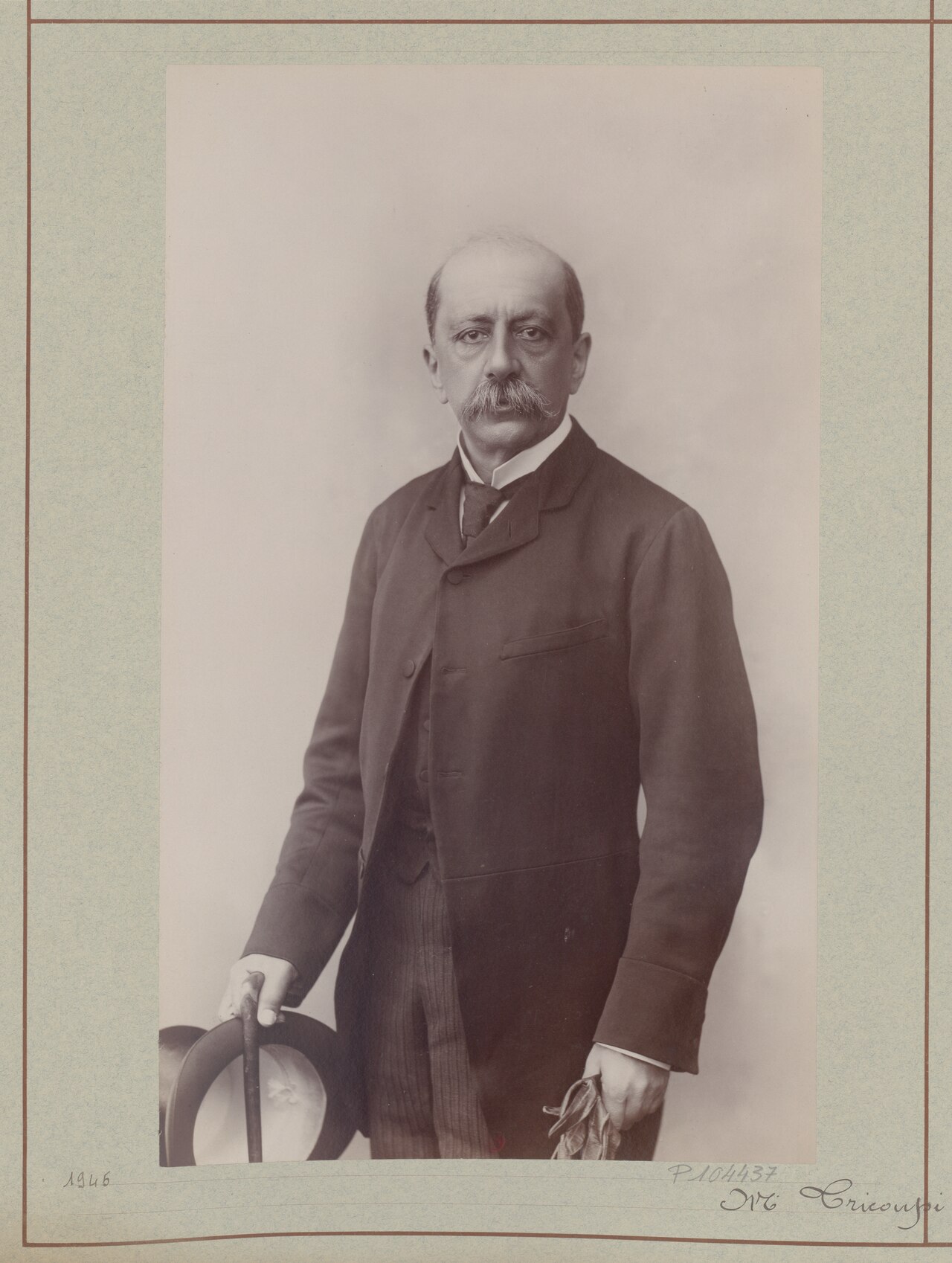
We are now in 1882. The Constitution of 1864 remains in effect, the king remains George I, and the prime minister, during the first months of the year, is Alexandros Koumoundouros. On 3 March (Old Style) or 15 March (New Style), Charilaos Trikoupis forms a government with a strong parliamentary majority. A period begins in which Trikoupis and Theodoros Delyiannis will represent two competing political coalitions, without these yet being mass parties of the twentieth-century type.
Trikoupis’ plan seeks to increase the state’s capacity. It includes the reorganisation of services, the strengthening of the armed forces, the construction of roads, ports, and railways, and the creation of infrastructure that would connect production with markets. The logic is that economic development and administrative efficiency must precede a safer foreign policy.
Implementation begins quickly. In 1882, the Piraeus-Athens-Peloponnese Railway company is founded, and major projects for the Corinth Canal and the drainage of Lake Copais begin. The state grants projects to companies and attracts domestic and expatriate capital, but it also assumes guarantees and financial commitments.
The railways are not constructed as a single network nor are they completed immediately. Different companies develop lines in the Peloponnese, Thessaly, Attica, and western Greece, often with different technical specifications. However, within the decade, Athens is connected to Corinth and subsequently to Argos, Nafplio, and Patras. For communities that until then depended on slow land transport, the change is substantial.
The projects need money. Indirect taxes and tariffs are increased, while the state resorts repeatedly to foreign borrowing. Part of the loans funds infrastructure and military expenditure, while part covers deficits and older obligations. It is not accurate to attribute every loan to waste, but neither should modernisation be presented as free: the cost is distributed unequally and weighs particularly heavily on consumption and the countryside.
In the new Thessalian provinces, the Greek state recognises the land titles protected by the agreement of 1881. Many large estates pass to Greek capitalists, while farmers continue to work under dependent forms of tenancy and challenge the claims of the landowners. The agrarian issue is not created by a single provision nor is it solved during this period, but it becomes a stable social and political problem.
The government majority is eroded by taxation, reactions, and personal conflicts. In the elections of April 1885, Delyiannis’ faction prevails. Trikoupis steps down, and on 19 April (Old Style) or 1 May (New Style), a Delyiannis government is formed.
On 6 September 1885 (Old Style) or 18 September (New Style), Bulgaria announces its union with the autonomous Eastern Rumelia. In Greece, the change is considered an overturning of the Balkan balance of power and strengthens the voices calling for compensation in Epirus and Crete. The Delyiannis government begins mobilisation on 12 September (Old Style).
The mobilisation lasts for months without leading to an organised war. It severely burdens public finances, disrupts production, and keeps thousands of men away from their work. The Great Powers finally recognise the new situation in Eastern Rumelia and demand that Athens demobilise.
In April 1886, the Powers impose a naval blockade on the Greek coasts. The pressure leads to the fall of Delyiannis. On 30 April (Old Style), a short-lived government under Dimitrios Valvis is formed, and on 9 May (Old Style) or 21 May (New Style), Trikoupis returns. On the same day, Greek units cross the border arbitrarily and clash with Ottoman forces. An armistice follows on 12 May, a demobilisation order on the 14th, and the lifting of the blockade on the 24th, all dates according to the Old Style.
The crisis is not simply a dispute between the “pro-war” and the “peace-loving.” Delyiannis attempts to convert military pressure into a diplomatic concession, but he does not control the escalation. Trikoupis believes that the country must first acquire an economic and military foundation. Both, however, operate within a system where the Powers can decisively limit Greek choices.
Trikoupis governs from May 1886 to October 1890. The longer duration offers continuity to the project programme. Railways are expanded, roads and ports are improved, technical services are organised, and attempts are made for more professional operation of the administration and the army.
The picture of modernisation is not uniform. Urban centres, ports, and commercial areas benefit more from new connections. In much of the countryside, daily life continues to be determined by small-scale farming, seasonal labour, limited credit, and heavy indirect taxation. Education is expanded, but opportunities for attendance remain unequal regarding location, income, and gender.
Nor does the administration change with one law. Governments try to limit arbitrary hiring and transfers of civil servants and to strengthen technical services, but members of parliament continue to mediate for positions, tax concessions, and local projects. The parliamentary stability sought by Trikoupis thus coexists with personal networks of dependency. The competition with Delyiannis organises the Parliament more clearly, without yet creating parties with permanent members, a unified ideology, and a national mechanism as seen later in the twentieth century.
During the same period, currants become the country’s main export product. Demand creates income, trade, and new crops, especially in the western Peloponnese. It also creates a great dependence on an international market, however, leaving producers, merchants, creditors, and public revenues vulnerable to a change in demand.
In Crete, another crisis unfolds. In 1889, the unilateral declaration of Union by a segment of the political world leads to Ottoman repression and the effective nullification of many concessions of the Pact of Halepa. Christian inhabitants suffer persecutions and new displacements. The Cretan Question returns, without yet provoking an official Greek military intervention.
In the 1890 elections, Delyiannis wins and forms a government on 24 October (Old Style). The economic situation becomes difficult: international markets become more cautious, the drachma is under pressure, and debt servicing absorbs a large part of revenues. In February 1892, the king dismisses Delyiannis and appoints Konstantinos Konstantopoulos, who lacks a stable parliamentary base.
At the beginning of the 1890s, the decline in demand and prices of currants hits producers, merchants, and public revenues. Economic pressure also affects the movement of the population. People head towards Athens, Piraeus, Patras, and other commercial centres, or seek seasonal work. Transatlantic migration also increases, particularly from rural areas pressured by debt and low prices. Its major peak will come later; here, we see the beginning of an outlet that will change families and local communities.
After the elections, Trikoupis returns on 10 June 1892 (Old Style). He attempts to secure a new loan and limit the deficit, but he resigns in May 1893. He is succeeded by Sotirios Sotiropoulos, with royal support and without a secure parliamentary majority. His government agrees to a particularly unfavourable consolidation loan.
Amidst these political crises, an emblematic project is completed. On 25 July 1893 (Old Style) or 6 August (New Style), the Corinth Canal is inaugurated, after eleven years of work, financing difficulties, and changes of contractors. The canal shortens sea routes, but its completion does not undo the fiscal crisis of the state.
On 30 October (Old Style), Trikoupis returns to government, cancels the consolidation loan, and seeks a new agreement. The creditors, however, demand stronger guarantees, and the available terms do not allow for sustainable financing.
In December 1893, after failing to secure sustainable new borrowing, the government unilaterally reduces the servicing of foreign loans and suspends amortisation. The decision is announced to Parliament on 10 December (Old Style) or 22 December (New Style). It has remained in public memory with the phrase “Unfortunately, we went bankrupt” (“Dystychos eptocheysamen”), but the precise form of the phrase in the minutes and the way it was said are subjects of debate. The certain fact is the partial cessation of payments, not the disappearance of the state or of all economic activity.
The bankruptcy has more than one cause: accumulated debt, chronic deficits, terms of borrowing, military expenditure, a limited tax base, pressure on the drachma, and the currant crisis. The projects contributed to the burden, but they do not alone explain the collapse. At the same time, many of the infrastructure projects will remain and be utilised by the economy of the following decades.
In 1894, difficult negotiations with creditors continue, while the Trikoupis government imposes new austerity measures. His political power is exhausted. In January 1895, he resigns, and a caretaker government under Nikolaos Delyiannis leads the country to elections. In May, Theodoros Delyiannis wins clearly, while Trikoupis himself is not elected in his constituency and retires from active politics.
In Crete, the Metapoliteftiki Committee (Revolutionary Committee) has been requesting autonomy under the suzerainty of the Sultan since September 1895. The demand is not yet for immediate Union; it reflects the effort to find a workable solution after the nullification of the privileges of Halepa.
On 18 March 1896 (Old Style) or 30 March (New Style), Charilaos Trikoupis dies in Cannes. His death closes a political journey, though not the discussion regarding projects, debt, and the relationship between parliamentarism and modernisation.
In the meantime, Athens hosts the first modern international Olympic Games. They take place from 25 March to 3 April 1896 (Old Style) or from 6 to 15 April (New Style). The renovated Panathenaic Stadium, the victory of Spyros Louis in the marathon, and the large turnout create strong public enthusiasm.
The Games are not a continuation of an uninterrupted ancient tradition, but a newer international event that draws symbols from antiquity. The International Olympic Committee reports approximately 241 athletes from 14 countries and 43 events. The numbers differ in other historical records because the concepts of national representation and official participation had not yet been standardised. Women are not admitted to the official games.
In the spring and summer of 1896, conflicts in Crete escalate, with attacks, arsons, and victims in both Christian and Muslim communities. In August, a new Statute is imposed with international guarantees and broader Christian participation in the administration. The agreement temporarily reduces tension, but it is not implemented consistently.
In early 1897, new acts of violence in Crete and the collapse of the administration trigger an uprising and foreign intervention. The Delyiannis government, pressured by public opinion, the opposition, officers, and the National Society, sends a fleet and approximately 1,500 soldiers under Colonel Timoleon Vassos. In early February, the forces land in Crete, and Vassos announces that he is occupying the island in the name of the king.
The Porte rejects the action. The six Powers also do not recognise the Union; they land their own detachments, impose a naval blockade, and propose the autonomy of Crete under Ottoman suzerainty. European public opinion is not always aligned with its governments, while in Crete itself, the Christian rebels and the Muslim communities approach the proposed solutions differently and often with fear.
At the same time, the secret National Society organises armed bands and infiltrations towards Ottoman Macedonia. The government knows of and tolerates part of the activity without fully controlling its consequences. On 5 April 1897 (Old Style) or 17 April (New Style), the Ottoman Empire severs diplomatic relations and war is declared. Border clashes had already begun.
The Greek army possesses courage at the unit level, but suffers from inadequate staff organisation, supply, training, and clear command. In Thessaly, the better-organised Ottoman forces under Ethem Pasha break through the Greek positions. The Greek army retreats from Larissa towards Pharsala and then towards Domokos. In Epirus, individual successes and failures occur, without overturning the overall outcome.
The defeat triggers a government crisis. On 18 April (Old Style) or 30 April (New Style), Delyiannis resigns and is succeeded by Dimitrios Rallis. With the intervention of the Powers, an armistice is agreed upon on 8 May (Old Style) or 20 May (New Style). The war has lasted a few weeks, but the military, economic, and psychological consequences are significant. The numbers of dead and wounded differ by source and should not be merged into a certain total account.
The Powers prevent the loss of the whole of Thessaly, but Greece is forced to accept small border adjustments in favour of the Ottoman Empire and a war indemnity of 4 million Ottoman liras. The withdrawal of Ottoman troops is linked to the securing of the loan that will cover the indemnity. In September, Alexandros Zaimis succeeds Rallis.
On 22 November 1897 (Old Style) or 4 December (New Style), the final peace treaty is signed in Constantinople. It confirms the indemnity, the border adjustment, and the process of withdrawal from Thessaly. Crete is not united with Greece. Its internationally supervised autonomy will be shaped in the next phase.
The period 1882–1897 does not fit into a simple dilemma between the “moderniser” Trikoupis and the “old-party” Delyiannis. Trikoupis left behind projects and administrative changes, but also a heavy financing scheme. Delyiannis expressed real social reactions to taxation and dependence on creditors, but the mobilisation of 1885–86 and the policy of 1897 had a high cost. Both moved within constraints set by the small tax base, the throne, personal parties, and the international balance of power.
At the end of 1897, Greece has more railways, roads, and technical infrastructure than in 1882. However, it is in a state of default, militarily defeated, and obligated to accept international oversight in order to borrow. This contradiction—material modernisation alongside fiscal and military crisis—will determine the regrouping of the following years.
In the next episode, we move on to the years 1898–1908: to the International Financial Commission, the autonomous Cretan State, the Macedonian Struggle, and the effort to regroup after the defeat.
Find all episodes at ProjectGreece.gr, along with references, additional material, explanations, sources, and bibliography.
All episodes of the series are available for free on Spotify, Apple Podcasts, and YouTube Music.
ProjectGreece.
So the story can continue.
Sources & bibliography
This episode is linked to 30 documentation and rights records.
- Βουλή των Ελλήνων, «Συνταγματική Ιστορία», ενότητα 1864–1909: https://www.hellenicparliament.gr/Vouli-ton-Ellinon/To-Politevma/Syntagmatiki-IstoriaOFFICIAL_LINK_ONLYOpen source
- Βουλή των Ελλήνων, Πρακτικά 1862–1910: https://library.parliament.gr/Συλλογές/Κοινοβουλευτική-Συλλογή/πρακτικά-βουλής-1862-1910PD_TEXT / SCAN_LINK_ONLYOpen source
- Βουλή των Ελλήνων, πίνακας εκλογών 1822–1935: https://www.hellenicparliament.gr/UserFiles/f3c70a23-7696-49db-9148-f24dce6a27c8/1822-1935.pdfOFFICIAL_LINK_ONLYOpen source
- Βουλή, Πρακτικά περιόδου 1891–92, συνεδρία 18 Φεβρουαρίου 1892: https://www.hellenicparliament.gr/UserFiles/f3c70a23-7696-49db-9148-f24dce6a27c8/ΠΡΒ%20ΠΕΡ.ΙΒ%20ΣΥΝ.Β%201891-1892.pdfPD_TEXT / SCAN_LINK_ONLYOpen source
- ΓΑΚ, Αρχείο Χαριλάου Τρικούπη, Συλλογή 494: https://greekarchivesinventory.gak.gr/index.php/3x5n-m2kd-qcwtCITATION_ONLYOpen source
- ASCSA, Stephanos Dragoumis Papers, Series II: https://www.ascsa.edu.gr/index.php/archives/stephanos-dragoumis-series-iiCITATION_ONLYOpen source
- ASCSA, Stephanos Dragoumis Papers, Content List: https://www.ascsa.edu.gr/index.php/archives/stephanos-dragoumis-content-listCITATION_ONLYOpen source
- Τράπεζα της Ελλάδος, *Museum Catalogue — Permanent Exhibition*, ενότητα “From Suspension of Convertibility to Bankruptcy, 1885–1897”: https://www.bankofgreece.gr/Publications/museum-catalogue-permanent-exhibition-en.pdfOFFICIAL_LINK_ONLYOpen source
- Τράπεζα της Ελλάδος, *Economic Bulletin* 22 (2004), p.44: https://www.bankofgreece.gr/Publications/econbull200401.pdfOFFICIAL_LINK_ONLYOpen source
- ΙΜΕ, Charilaos Trikoupis / Economy: https://www.ime.gr/chronos/12/en/1833_1897/economy/people/02.htmlCITATION_ONLYOpen source
- ΙΜΕ, Infrastructure: https://www.ime.gr/chronos/12/gr/1833_1897/economy/choros/04.htmlCITATION_ONLYOpen source
- ΙΜΕ, Fiscal crisis and bankruptcy: https://www.ime.gr/chronos/12/en/1833_1897/economy/facts/08.htmlCITATION_ONLYOpen source
- Διώρυγα Κορίνθου Α.Ε., «Ιστορία της Διώρυγας»: https://corinthcanal.com/η-διώρυγα/ιστορία-της-διώρυγας/CITATION_ONLYOpen source
- ΕΑΔΔ, «Η προσάρτηση της Θεσσαλίας. Η πρώτη φάση… 1881–1885»: https://www.didaktorika.gr/eadd/handle/10442/1152CITATION_ONLYOpen source
- Gounaris, Basil C., study on Greek railway policy, *Balkan Studies*: https://ojs.lib.uom.gr/index.php/BalkanStudies/article/view/2212/2236CITATION_ONLYOpen source
- Alogoskoufis, George, *Historical Cycles of the Greek Economy*, pp.13–20: https://www.dept.aueb.gr/sites/default/files/allWP-01-21-Alogoskoufis-10-2-21-Historical%20Cycles%20%281%29.pdfCITATION_ONLYOpen source
- LSE Hellenic Observatory, GreeSE Paper 164, pp.13–15, 33–36, 53: https://www.lse.ac.uk/Hellenic-Observatory/Assets/Documents/Publications/GreeSE-Papers/GreeSE-No164.pdfCITATION_ONLYOpen source
- ΙΜΕ, Ανατολική Ρωμυλία και κρίση 1885–86: https://www.ime.gr/chronos/12/gr/1833_1897/foreign_policy/facts/07.htmlCITATION_ONLYOpen source
- ΙΜΕ, Κρητικό Ζήτημα 1889–97: https://www.ime.gr/chronos/12/en/1833_1897/foreign_policy/facts/04.htmlCITATION_ONLYOpen source
- ΙΜΕ, Πόλεμος 1897: https://www.ime.gr/chronos/12/gr/1833_1897/foreign_policy/facts/08.htmlCITATION_ONLYOpen source
- Πλοηγός Ιστορίας Κρήτης, timeline: https://www.crete-modernhistory.gr/en/timeline/CITATION_ONLYOpen source
- Tatsios, Theodore George. *The Megali Idea and the Greek-Turkish War of 1897*. East European Monographs, 1984.CITATION_ONLY
- FRUS 1897, diplomatic papers on Greece and Turkey: https://history.state.gov/historicaldocuments/frus1897PUBLIC_DOMAIN_USGOVOpen source
- FRUS 1898, doc.1136, definitive peace treaty and protocols: https://history.state.gov/historicaldocuments/frus1898/d1136PUBLIC_DOMAIN_USGOVOpen source
- Hertslet, Edward. *The Map of Europe by Treaty*, late nineteenth-century instruments. Columbia digital collection: https://www.columbia.edu/cu/lweb/digital/collections/cul/texts/ldpd_7229668_000/CITATION_ONLYOpen source
- IOC Historical Archives, *Athens 1896 — Games of the I Olympiad*, fonds `CH CIO-AH C-J01-1896`: https://library.olympics.com/Default/basicfilesdownload.ashx?itemGuid=2ECE9BE9-EA5F-4F0F-97DF-84C75B6BC60ACITATION_ONLYOpen source
- IOC Olympic Studies Centre, official report and historical collections: https://library.olympics.com/CITATION_ONLYOpen source
- Koliopoulos, John S., and Thanos M. Veremis. *Modern Greece: A History since 1821*. Wiley-Blackwell, chapters on the Trikoupis era and 1897.CITATION_ONLY
- Gallant, Thomas W. *Modern Greece: From the War of Independence to the Present*. Bloomsbury, chapter on nineteenth-century state building.CITATION_ONLY
- Dakin, Douglas. *The Unification of Greece, 1770–1923*. Benn, sections on 1881–97.CITATION_ONLY