Asia Minor Campaign, Catastrophe and regime change
The Asia Minor Campaign, the Catastrophe, mass displacement and the transition to a republic.
Audio will be added after final production.
In this episode
The Asia Minor Campaign, the Catastrophe, mass displacement and the transition to a republic.
Full transcript
The complete English transcript of this episode is available to read.
ProjectGreece.
The History of Greece, from 1800 to today.
A twenty-episode series that narrates the journey of modern Greece with sobriety, composure, and documentation.
Tenth episode.
1919–1924: The Asia Minor Campaign, the Catastrophe, and constitutional change.
Welcome to another episode of the series "The History of Greece, from 1800 to today."
In the previous episode, we reached the end of 1918. Greece had entered the First World War united on the side of the Entente, but the National Schism remained an open political wound. With the end of the war, Eleftherios Venizelos arrived at the Paris Peace Conference as the prime minister of a victorious nation, claiming territories in Thrace and western Asia Minor.
The Greek claims were based on the Megali Idea, the presence of numerous Orthodox populations, and the Allied victory. However, the demographic picture differs depending on the boundaries chosen and whether one relies on Ottoman, Greek, or foreign statistics. Smyrna was a multilingual and multi-religious city; in the wider hinterland, Muslim populations were in the majority in many areas.
On 2 May 1919 (Old Style), or 15 May (New Style), Greek forces landed in Smyrna by decision of the Supreme Allied Council. The mandate was presented as a temporary occupation for the maintenance of order, not as a recognized annexation. For many Greeks in the city, it was a moment of liberation. For many Muslim inhabitants, it was a foreign military occupation.
From the first day, there were reports of shootings, murders, abuses, and looting. The Inter-Allied Commission of Inquiry was unable to ascertain who fired first, but it did record arbitrary arrests, the abuse and murder of Muslims by soldiers and members of the Greek crowd, as well as a delayed reaction by the Greek administration. It also recorded attacks by Turkish armed men against Greek civilians. Its figures are estimates, not a complete accounting.
The Greek zone expanded, and the administration was organized under High Commissioner Aristeidis Stergiadis. At the same time, the nationalist movement rallying around Mustafa Kemal rejected the partition of the Ottoman Empire. Ankara would develop into a center of political and military power distinct from the Sultan’s government in Constantinople.
In November, the Treaty of Neuilly and a separate Greco-Bulgarian convention regulated the borders with Bulgaria and provided for a reciprocal, formally voluntary migration of minorities. Western Thrace would eventually pass to Greece in 1920. The movement of populations did not begin in 1922; wars and international agreements had already created refugees, exchangeable properties, and new minorities.
In the summer of 1920, with Allied approval, the Greek army advanced beyond the original Smyrna zone and occupied Eastern Thrace. The operation faced forces of the Turkish nationalist movement, while the Constantinople government had limited real control. Greece was now in an extensive war, even though the definitive international status had not yet been applied.
On 10 August, the Treaty of Sèvres was signed. Greece acquired Eastern Thrace and assumed the administration of the Smyrna region. Sovereignty over the zone remained formally Ottoman, and after five years, a provision was made for the possibility of a decision regarding its union with Greece. The treaty seemed to bring the country close to its greatest territorial extent.
The Sèvres treaty, however, would neither be ratified nor implemented by the Turkish nationalist movement. Italy and France gradually distanced themselves from the Greek operation, while British policy remained more favorable without dispatching an army to enforce the treaty. Greece was thus called upon to support an expanding occupation with its own resources against an opponent that was organizing and strengthening itself.
On 12 October (Old Style), or 25 October (New Style), King Alexander died suddenly. A brief regency under Pavlos Kountouriotis followed. In the elections of 1 November (Old Style), or 14 November (New Style), the Liberals were defeated and Venizelos departed from Greece. Dimitrios Rallis became prime minister and Queen Olga became regent.
The referendum of 22 November (Old Style), or 5 December (New Style), brought Constantine back. The process took place within the climate of the Schism and without a substantial opposing ballot. The return of the king, whom the Allies associated with the neutrality of the First World War, worsened Greece's international position. The new government, however, did not terminate the campaign.
At the beginning of 1921, the governments of Rallis and Nikolaos Kalogeropoulos continued the war. After the operations toward Inönü, the Turkish nationalist army showed that it was no longer a collection of irregular bodies. The government of Dimitrios Gounaris, from March onward, chose a new major offensive, hoping that a military victory would secure a favorable peace.
In June and July, the Greek army occupied Kütahya and Eskişehir. The Turkish forces, however, retreated in an organized manner further east and were not destroyed. The Greek leadership decided to continue toward Ankara. As the army moved away from the coast, supply lines were stretched across an arid and difficult hinterland.
From 23 August to 13 September (New Style), the Battle of the Sakarya took place. The Greek forces approached Ankara but did not definitively break the Turkish defense. With heavy losses and exhausted supplies, they returned to the Eskişehir–Afyon line. The battle ended the Greek advance, but not the war.
The losses of both armies were high, but the charts do not always use the same categories. A soldier killed in battle is one thing; one who dies later from a wound or disease is another; a missing person is another, and a prisoner is yet another. The missing might later be recorded as dead or as prisoners. For this reason, we do not add different charts into a supposedly certain number of deaths.
The war also struck civilians in succession. Greek units and armed groups committed murders, looting, and arson of Muslim settlements, particularly during clearing operations and during retreats. Turkish nationalist forces and irregulars engaged in murders, rapes, looting, forced displacements, and death marches against Greek and Armenian communities. The recording of all victims does not mean that every act had the same scale, organization, or goal.
In the Pontus and in areas outside Greek military control, Orthodox populations were subjected to conscription into labor battalions, deportation to the interior, executions, and the destruction of communities. This persecution had begun before 1919 and peaked during the war years. The terms, the total numbers, and the periodization are a field of intense historiographical and political controversy; the individual persecutions, however, are documented by many independent sources.
In Greek public memory and in part of the international literature, these persecutions are described as the “Genocide of the Greeks of Pontus.” The term was institutionally recognized by the Hellenic Parliament, which established 19 May as a day of remembrance through Law 2193/1994, and it has received international scholarly recognition, including through a 2007 resolution of the International Association of Genocide Scholars. International legal and diplomatic recognition is not universal, however, and the use of the term remains a subject of historiographical and political debate.
In the winter of 1921 to 1922, the front remained stationary. Greece maintained a large army hundreds of kilometers from the main ports, while its international supporters dwindled. France approached Ankara, and Italy had already limited its involvement. In Greece, taxation, inflation, conscription, and the absence of men burdened families and production.
In the spring of 1922, the government imposed a forced loan. Banknotes were halved: one half retained half its nominal value and the other was exchanged for a government bond. The measure yielded approximately 1.3 billion drachmae, but it revealed how difficult the financing of the war had become and how directly the cost affected daily life.
Within a few months, Gounaris was succeeded by Nikolaos Stratos and then by Petros Protopapadakis. Diplomatic efforts secured neither a sustainable peace nor new Allied military support. The Army of Asia Minor held an excessively extended front, while the Turkish administration concentrated forces for the final offensive.
On 13 August (Old Style), or 26 August (New Style), the Turkish Great Offensive began in the Afyon sector. The front was broken. On 30 August (New Style), the Battle of Dumlupınar completed the defeat of the main Greek forces. General Nikolaos Trikoupis was captured, and the Greek units retreated toward the coast, often without unified command.
For the entire campaign, official Greek records list separately those killed in battle, deaths from wounds or disease, the wounded, the missing, and the prisoners. Subsequent publications do not always agree on the numbers and the overlaps. A safe conclusion is that military losses numbered in the tens of thousands. We do not automatically convert the missing or all prisoners into the dead.
During the retreat, Greek units set fire to towns and villages and committed acts of violence against Muslim civilians. Many Orthodox and Armenian residents followed the army, fearing reprisals. Behind the line of the advance, Turkish troops and irregulars killed, robbed, and abused Christian civilians. Western Asia Minor was turned into a space of military collapse and mass persecution.
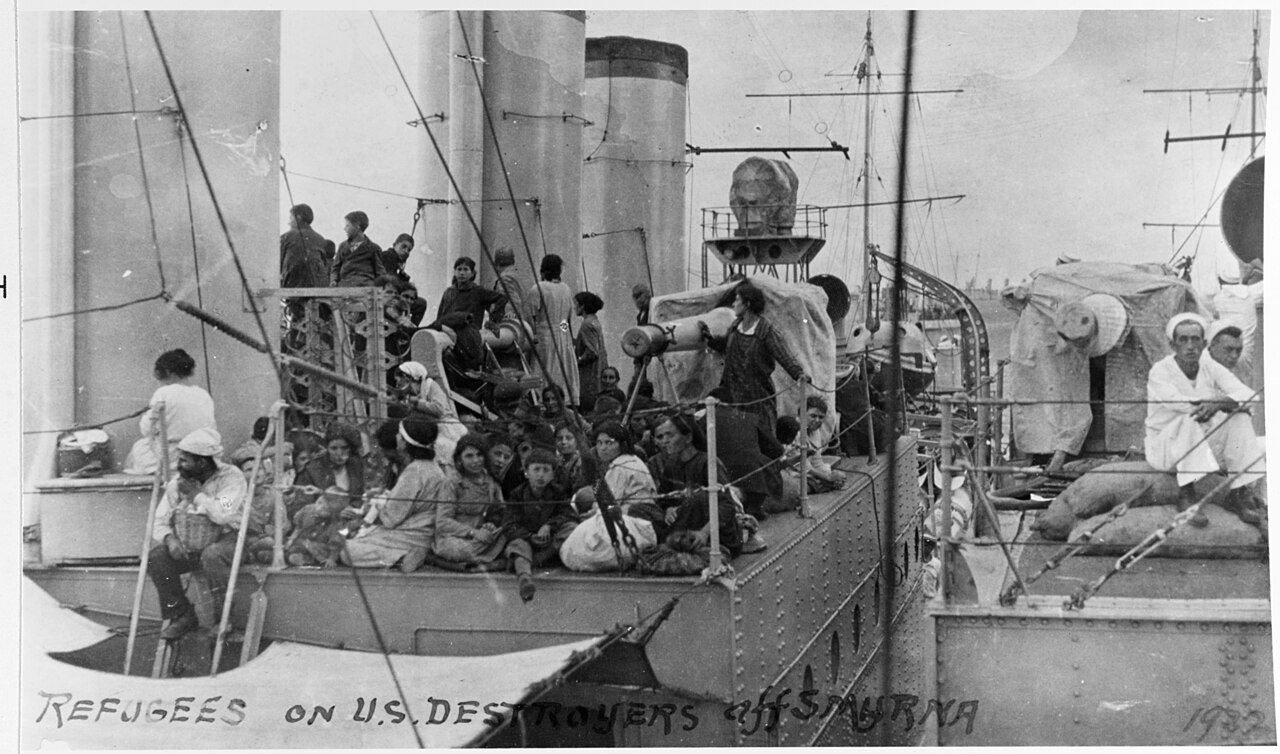
On 9 September (New Style), the Turkish army entered Smyrna. Murders, looting, arrests, and sexual violence followed against Greeks and Armenians. Metropolitan Chrysostomos was handed over to the crowd and killed. Thousands of people gathered on the waterfront, caught between the fire, the sea, and the Allied warships.
The Great Fire began on 13 September and destroyed mainly the Armenian and Greek quarters. Its origin remains a subject of competing national narratives. An official American report from that time stated that the arsonist had not been identified, but attributed to the Turkish authorities responsibility for the failure to maintain order. Many later studies, based on testimonies, attribute the start to Turkish military units. The exact number of the dead is unknown.
The evacuation from Smyrna and other ports lasted weeks. Some were saved by ships, others were killed or lost, and many men were led into captivity or into labor battalions in the interior. The terms "dead," "missing," "prisoners," and "refugees" are not interchangeable. Nor were all those who arrived in Greece in 1922 later subjected to the mandatory exchange in the same way.
On 11 September (Old Style), or 24 September (New Style), a military movement under Nikolaos Plastiras and Stylianos Gonatas prevailed in Greece. Constantine abdicated for the second time and was succeeded by George II. After the brief government of Nikolaos Triantafyllakos, the government of Sotirios Krokidas was formed under the control of the Revolutionary Committee.
The Armistice of Mudanya, on 11 October, ended the operations and provided for the withdrawal of the Greek army from Eastern Thrace. Greece acceded to the terms three days later. Along with the army, almost the entire Orthodox population of the region departed. This was a new refugee exodus before the convention of mandatory exchange had even been signed.
On 15 November (Old Style), or 28 November (New Style), an extraordinary court-martial tried eight politicians and military officers for the defeat. Six, including former prime ministers Gounaris, Protopapadakis, and Stratos, and the commander-in-chief Georgios Hatzanestis, were sentenced and executed immediately. The Trial of the Six vented the demand for punishment, but it was conducted with summary procedures and deepened the Schism. It does not constitute a neutral historical verdict on all the causes of the Catastrophe.
In the first winter after the Catastrophe, ports, warehouses, schools, camps, and makeshift settlements filled with refugees. Housing, clean water, food, and healthcare were insufficient. Epidemics, malaria, and malnutrition caused further deaths, which should not be confused with those who were killed in battle or in acts of violence. The state, international organizations, charitable networks, and the refugees themselves organized survival.
On 30 January 1923, Greece and Turkey signed a convention of mandatory exchange in Lausanne. The criterion was religion: Turkish nationals of the Greek Orthodox religion and Greek nationals of the Muslim religion. Excluded were the Greeks of Constantinople established before the end of October 1918 and the Muslims of Western Thrace. The convention legalized and organized an uprooting that, for most Orthodox of Asia Minor, had already occurred.
The numbers require distinction. Those who fled violently in 1922 are one group, those who moved later based on the convention are another, and those who had arrived from earlier persecutions are yet another. The 1928 census recorded approximately 1,220,000 refugees in Greece, not all the dead or missing of the period. Hundreds of thousands of Muslims also departed from Greece for Turkey, also suffering the loss of homeland, property, and local ties.
On 24 July, the Treaty of Lausanne was signed. It replaced the unworkable system of Sèvres, recognized the new Turkey, and finalized the Greco-Turkish borders on the Evros. Eastern Thrace, Imbros, and Tenedos remained with Turkey. The exchange and the minority clauses turned religious identity into a basic criterion for international protection, exemption, or forced relocation.
On 29 September, the Refugee Settlement Commission was established by a protocol of the League of Nations. The Greek state committed to providing at least 500,000 hectares and to seeking an international loan. The Commission was an autonomous organization with Greek and international participation. Its goal was not only temporary relief, but the settlement of refugees on land and in productive labor.
Women and children made up a large part of the refugee population. Many families had lost men in battle, in deportations, in labor battalions, or in captivity; others were still unaware of their fate. Women managed households alone, worked in tobacco factories, textile mills, workshops, domestic service, and agricultural facilities. Work provided survival, but often with low wages, precariousness, and social stigma.
In the elections of 16 December 1923, the anti-Venizelist forces abstained and the Liberals prevailed. Three days later, George II departed from the country and Pavlos Kountouriotis assumed the position of regent. Stylianos Gonatas handed over power in January 1924 to Venizelos, who was succeeded within a few months by Georgios Kafantaris and Alexandros Papanastasiou.
On 25 March 1924, the Fourth Constituent Assembly declared the dynasty deposed and proclaimed a republic without a king. The referendum of 13 April approved the change by approximately 70%. On 1 May, Kountouriotis was sworn in as provisional President. The new regime was born through electoral confirmation, but also under the heavy influence of the 1922 Revolution and the military.
By the end of 1924, Papanastasiou was succeeded by Themistoklis Sophoulis and Andreas Michalakopoulos. Refugee settlement proceeded with international funding, expropriations, new agricultural holdings, and makeshift urban settlements. It created work and production, but also conflicts over land, houses, and wages between refugees and the native population. Social integration was not completed with a treaty or a loan.
Within six years, Greece passed from the position of the 1918 victor to military defeat, the loss of Eastern Thrace and the Asia Minor zone, the arrival of a massive refugee population, and the abolition of the monarchy. For Turkey, the same conflict was the victorious War of Independence. For the uprooted Orthodox and Muslims, it was the definitive loss of worlds that had been shaped for centuries.
In the next episode, we move to the years 1925–1934: to the instability of the Second Hellenic Republic, the dictatorship of Pangalos, the return of Venizelos, and the social and economic changes of the interwar period.
Find all episodes at ProjectGreece.gr, along with references, additional material, explanations, sources, and bibliography.
All episodes of the series are available for free on Spotify, Apple Podcasts, and YouTube Music.
ProjectGreece.
So the story can continue.
Sources & bibliography
This episode is linked to 63 documentation and rights records.
- Δεν παράγεται «συνολικός αριθμός νεκρών» από άθροισμα πινάκων με διαφορετική ημερομηνία, γεωγραφία ή ορισμό.CITATION_ONLY
- Οι αγνοούμενοι δεν μετατρέπονται αυτόματα σε νεκρούς και οι αιχμάλωτοι δεν προστίθενται στους αγνοούμενους χωρίς έλεγχο επικάλυψης.CITATION_ONLY
- Σμύρνη: δεν δίνεται αριθμός νεκρών στο audio. Οι εκτιμήσεις της εποχής αποκλίνουν δραματικά και συχνά συγχέουν φωτιά, σφαγές, πνιγμούς και εξαφανίσεις.CITATION_ONLY
- Πόντος: δεν δίνεται ενιαίος απόλυτος αριθμός ούτε επιλύεται ορολογικά η ιστοριογραφική/πολιτική διαμάχη μέσα στο επεισόδιο. Δηλώνονται οι τεκμηριωμένοι μηχανισμοί δίωξης.CITATION_ONLY
- Απογραφή 1928: το **1.221.849** είναι ο αριθμός προσφύγων που καταγράφηκαν στην Ελλάδα και περιλαμβάνει διαφορετικούς χρόνους και τόπους προέλευσης. Δεν είναι αριθμός όσων έφυγαν μόνο το 1922, ούτε αριθμός όλων των ανταλλαξίμων.CITATION_ONLY
- Η αποχώρηση μουσουλμάνων από την Ελλάδα αποδίδεται ως «εκατοντάδες χιλιάδες» στο audio έως ότου επιλεγεί μία σειρά με σαφή ορισμό, γεωγραφία και ημερομηνία.CITATION_ONLY
- Οι επίσημοι ελληνικοί πίνακες απωλειών στις pp.486–488 της ΔΙΣ παραμένουν **research-only** μέχρι να γίνει απευθείας table-level επαλήθευση της έκδοσης, των υποκατηγοριών και των επικαλύψεων. Το v0.9 χρησιμοποιεί μόνο «δεκάδες χιλιάδες».CITATION_ONLY
- Γενική Γραμματεία Νομικών και Κοινοβουλευτικών Θεμάτων, «Κυβέρνηση Ελευθερίου Βενιζέλου»: https://gslegal.gov.gr/government/venizelou-eleftheriou-2/CITATION_ONLYOpen source
- ΓΓΝΚΘ, «Κυβέρνηση Δημητρίου Ράλλη»: https://gslegal.gov.gr/government/ralli-dimitriou-2/CITATION_ONLYOpen source
- ΓΓΝΚΘ, «Κυβέρνηση Νικολάου Καλογερόπουλου»: https://gslegal.gov.gr/government/kalogeropoulou-nikolaou-2-2/CITATION_ONLYOpen source
- ΓΓΝΚΘ, «Κυβερνήσεις Δημητρίου Γούναρη»: https://gslegal.gov.gr/government/gounari-dimitriou-2-2/ και https://gslegal.gov.gr/en/government/gounari-dimitriou-3/CITATION_ONLYOpen source
- ΓΓΝΚΘ, «Κυβέρνηση Νικολάου Στράτου»: https://gslegal.gov.gr/government/stratou-nikolaou-2/CITATION_ONLYOpen source
- ΓΓΝΚΘ, «Κυβέρνηση Πέτρου Πρωτοπαπαδάκη»: https://gslegal.gov.gr/en/government/protopapadaki-petrou/CITATION_ONLYOpen source
- ΓΓΝΚΘ, «Κυβέρνηση Νικολάου Τριανταφυλλάκου»: https://gslegal.gov.gr/government/triantafyllakou-nikolaou-2/CITATION_ONLYOpen source
- ΓΓΝΚΘ, «Κυβέρνηση Σωτηρίου Κροκιδά»: https://gslegal.gov.gr/government/krokida-sotiriou-2/CITATION_ONLYOpen source
- ΓΓΝΚΘ, «Κυβέρνηση Στυλιανού Γονατά»: https://gslegal.gov.gr/en/government/gonata-stylianou/CITATION_ONLYOpen source
- ΓΓΝΚΘ, «Κυβέρνηση Ελευθερίου Βενιζέλου 1924»: https://gslegal.gov.gr/government/venizelou-eleftheriou-3/CITATION_ONLYOpen source
- ΓΓΝΚΘ, «Κυβέρνηση Γεωργίου Καφαντάρη»: https://gslegal.gov.gr/government/kafantari-georgiou-2/CITATION_ONLYOpen source
- ΓΓΝΚΘ, «Κυβέρνηση Αλεξάνδρου Παπαναστασίου»: https://gslegal.gov.gr/en/government/papanastasiou-alexandrou/CITATION_ONLYOpen source
- ΓΓΝΚΘ, «Κυβέρνηση Θεμιστοκλή Σοφούλη»: https://gslegal.gov.gr/government/sofouli-themistokleous-7/CITATION_ONLYOpen source
- ΓΓΝΚΘ, «Κυβέρνηση Ανδρέα Μιχαλακόπουλου»: https://gslegal.gov.gr/government/michalakopoulou-andrea-2/CITATION_ONLYOpen source
- ΓΓΝΚΘ, ευρετήριο «Ιστορικά στοιχεία»: https://gslegal.gov.gr/kyvernisi/istorika-stoixeia/CITATION_ONLYOpen source
- Βουλή των Ελλήνων, «Συνταγματική Ιστορία», ενότητα 1924–1935: https://www.hellenicparliament.gr/Vouli-ton-Ellinon/To-Politevma/Syntagmatiki-IstoriaOFFICIAL_LINK_ONLYOpen source
- Βουλή των Ελλήνων, *Τα Συντάγματα της Ελλάδας*, ενότητα πράξεων 1924, printed pp.87–94: https://www.hellenicparliament.gr/UserFiles/8c3e9046-78fb-48f4-bd82-bbba28ca1ef5/SYNTAGMATA.PDFOFFICIAL_LINK_ONLYOpen source
- Βουλή των Ελλήνων, *Το κτήριο της Βουλής των Ελλήνων*, ενότητα 1924: https://www.hellenicparliament.gr/UserFiles/f3c70a23-7696-49db-9148-f24dce6a27c8/katalogos_ktirio.pdfOFFICIAL_LINK_ONLYOpen source
- Βουλή των Ελλήνων, τεκμήριο «Περί καθορισμού του τίτλου του Ελληνικού Κράτους ως Ελληνική Δημοκρατία», 19.5.1924: https://digitallibrary.parliament.gr/records/items/77f2d2b6-5464-4aaa-8544-3da15cbd6919OFFICIAL_LINK_ONLYOpen source
- FRUS 1920, vol. II, doc.593: https://history.state.gov/historicaldocuments/frus1920v02/d593PUBLIC_DOMAIN_USGOVOpen source
- FRUS 1921, vol. II, doc.120: https://history.state.gov/historicaldocuments/frus1921v02/d120PUBLIC_DOMAIN_USGOVOpen source
- Inter-Allied Commission of Inquiry, report on Smyrna and Aydın, *FRUS, Paris Peace Conference 1919*, vol. IX, doc.3, printed pp.47–68: https://history.state.gov/historicaldocuments/frus1919Parisv09/d3PUBLIC_DOMAIN_USGOVOpen source
- Convention Respecting Reciprocal Emigration between Greece and Bulgaria, 27.11.1919, *LNTS* vol.1, No.9, printed pp.67–72, arts 1–4: https://treaties.un.org/doc/Publication/UNTS/LON/Volume%201/v1.pdfPD_TEXT / SCAN_LINK_ONLYOpen source
- Treaty of Sèvres, 10.8.1920, arts 65–83, 84–87: https://en.wikisource.org/wiki/Treaty_of_S%C3%A8vres/Part_IIIPD_TEXT / SCAN_LINK_ONLYOpen source
- Convention Concerning the Exchange of Greek and Turkish Populations, 30.1.1923, *LNTS* vol.32, No.807, printed pp.75–87, arts 1–4, 8–11, 16, 19: https://treaties.un.org/doc/Publication/UNTS/LON/Volume%2032/v32.pdfPD_TEXT / SCAN_LINK_ONLYOpen source
- Treaty of Peace with Turkey, Lausanne, 24.7.1923, *LNTS* vol.28, printed pp.11–113, arts 2, 6, 12, 14, 37–45, 58–59: https://treaties.un.org/doc/publication/unts/lon/volume%2028/v28.pdfPD_TEXT / SCAN_LINK_ONLYOpen source
- Protocol relating to the Settlement of Refugees in Greece and Organic Statutes of the Refugee Settlement Commission, 29.9.1923, *LNTS* vol.20, No.503, printed pp.29–39, Protocol arts I, II, IV, IX: https://treaties.un.org/doc/Publication/UNTS/LON/Volume%2020/v20.pdfCITATION_ONLYOpen source
- Psomiades, Harry J. “Thrace and the Armistice of Mudanya: October 3–11, 1922.” *Δελτίο Κέντρου Μικρασιατικών Σπουδών* 12, pp.213–254, ιδίως 236–251: https://ejournals.epublishing.ekt.gr/index.php/deltiokms/article/download/2464/2229.pdfCITATION_ONLYOpen source
- Διεύθυνση Ιστορίας Στρατού. *Επίτομος Ιστορία της Εκστρατείας εις Μικράν Ασίαν 1919–1922*. Αθήνα, 2001, ιδίως pp.486–488. Κατάλογος ΔΙΣ: https://dis.army.gr/wp-content/uploads/2023/01/%CE%9A%CE%91%CE%A4%CE%91%CE%9B%CE%9F%CE%93%CE%9F%CE%A3.pdfCITATION_ONLYOpen source
- Hellenic Army Academy / DIS. *A Concise History of the Campaign in Asia Minor, 1919–1922*: https://sse.army.gr/books/a-concise-history-of-the-campaign-in-asia-minor-1919-1922/CITATION_ONLYOpen source
- Σχολή Πεζικού. *Η Ιστορία του Πεζικού*, §8 «Απώλειες στη Μικρασιατική Εκστρατεία»: https://spz.army.gr/wp-content/uploads/2022/06/3.-SK-900-21-H-ISTORIA-TOY-PEZIKOY.pdfCITATION_ONLYOpen source
- Llewellyn Smith, Michael. *Ionian Vision: Greece in Asia Minor, 1919–1922*. Revised ed., Hurst, 1998, chs 3–16.CITATION_ONLY
- Zürcher, Erik Jan. *Turkey: A Modern History*. 4th ed., I.B. Tauris, 2017, pp.133–170.CITATION_ONLY
- Gingeras, Ryan. *Sorrowful Shores: Violence, Ethnicity, and the End of the Ottoman Empire, 1912–1923*. Oxford UP, 2009, chs 4–6.CITATION_ONLY
- “Collective Sexual Violence in Turkey, 1894–1924: What We Know and How We Know It.” *Law and History Review*, section “Turkish War of Independence”: https://www.cambridge.org/core/journals/law-and-history-review/article/collective-sexual-violence-in-turkey-18941924-what-we-know-and-how-we-know-it/B667ACF3622E4A08B39764E12A48DE7DCITATION_ONLYOpen source
- FRUS 1922, vol. II, doc.373, report on Smyrna, 30.9.1922: https://history.state.gov/historicaldocuments/frus1922v02/d373PUBLIC_DOMAIN_USGOVOpen source
- Kolluoğlu Kırlı, Biray. “Forgetting the Smyrna Fire.” *History Workshop Journal* 60 (2005), 25–44. DOI: https://doi.org/10.1093/hwj/dbi005CITATION_ONLYOpen source
- Γενικά Αρχεία του Κράτους, θεματική πύλη «1919–1922»: https://archives1922.gak.gr/index.php/1919-1922CITATION_ONLYOpen source
- ΕΡΤ Αρχείο, «Η Δίκη των Έξι — 31 Οκτωβρίου 1922»: https://www.ert.gr/ert-arxeio/i-diki-ton-exi-31-oktovrioy-1922/CITATION_ONLYOpen source
- ΕΡΤ Αρχείο, «Η εκτέλεση των 6 … 15 Νοεμβρίου 1922»: https://www.ertnews.gr/anadromes/i-ektelesi-ton-6-gia-ti-mikrasiatiki-katastrofi-stis-15-noemvriou-1922/CITATION_ONLYOpen source
- Ελληνική Στατιστική Αρχή. *Απογραφή προσφύγων 1923 / ιστορικά απογραφικά στοιχεία*, πίνακας «Πρόσφυγες κατά χρόνο αφίξεως»: https://www.statistics.gr/documents/20181/17937223/ELSTAT_Apografi_Prosfyges_1923.pdf/558c2a4e-e20e-bdba-ff79-1042d56eb3c6OFFICIAL_LINK_ONLYOpen source
- ΕΛΣΤΑΤ, Ψηφιακή Βιβλιοθήκη, *Απογραφή πληθυσμού 1928 — Πραγματικός και νόμιμος πληθυσμός / Πρόσφυγες*: https://dlib.statistics.gr/portal/page/portal/lang-el/ESYE/showdetails?p_derive=book&p_id=10095546&p_topic=10007862OFFICIAL_LINK_ONLYOpen source
- Hirschon, Renée, ed. *Crossing the Aegean: An Appraisal of the 1923 Compulsory Population Exchange between Greece and Turkey*. Berghahn, 2003, introduction, pp.3–20.CITATION_ONLY
- Yildirim, Onur. *Diplomacy and Displacement: Reconsidering the Turco-Greek Exchange of Populations, 1922–1934*. Routledge, 2006, chs 3–5.CITATION_ONLY
- Pentzopoulos, Dimitri. *The Balkan Exchange of Minorities and Its Impact upon Greece*. Hurst, 2002, pp.55–139.CITATION_ONLY
- Klapsis, Antonis. “Violent Uprooting and Forced Migration: A Demographic Analysis of the Greek Populations of Asia Minor, Pontus and Eastern Thrace.” pp.631–635: https://www.researchgate.net/publication/262774352_Violent_Uprooting_and_Forced_Migration_A_Demographic_Analysis_of_the_Greek_Populations_of_AsiaMinor_Pontus_and_Eastern_ThraceCITATION_ONLYOpen source
- Bournova, Eugenia, and Haris Serafimidis. Study on refugees and urban labour, *The Historical Review/La Revue Historique* 21, 151–187: https://ejournals.epublishing.ekt.gr/index.php/historicalReview/article/view/43834CITATION_ONLYOpen source
- National Hellenic Research Foundation, *Refugees of the 1923 Population Exchange between Turkey and Greece*: https://helios.eie.gr/helios/bitstream/10442/17988/1/E15_Refugees%20of%20the%201923%20population%20exchange%20between%20Turkey%20and%20Greece.pdfCITATION_ONLYOpen source
- American School of Classical Studies at Athens, *The Humanitarian Response to the Asia Minor Disaster*, pp.28–44: https://www.ascsa.edu.gr/uploads/media/AsiaMinorDisaster_eBook.pdfCITATION_ONLYOpen source
- FRUS 1923, vol. II, docs 262–263: https://history.state.gov/historicaldocuments/frus1923v02/d262 and https://history.state.gov/historicaldocuments/frus1923v02/d263PUBLIC_DOMAIN_USGOVOpen source
- Τράπεζα της Ελλάδος, *Museum Catalogue: Permanent Exhibition*, ενότητα “The defeat in the Asia Minor campaign and the drachma / The 1922 forced loan”: https://www.bankofgreece.gr/Publications/museum-catalogue-permanent-exhibition-en.pdfOFFICIAL_LINK_ONLYOpen source
- Mazower, Mark. *Greece and the Inter-war Economic Crisis*. Clarendon Press, 1991, introduction and ch.1.CITATION_ONLY
- Oxford Academic, study on the Greek calendar reform, chapter abstract noting the 16.2.1923 transition: https://academic.oup.com/book/43071/chapter-abstract/361512604CITATION_ONLYOpen source
- Υπουργείο Παιδείας, Ψηφιακό Σχολείο, ενότητα για την αλλαγή ημερολογίου: https://lb1.ebooks.edu.gr/ebooks/v/html/8547/5204/Istoria_G-Gymnasiou_html-empl/index8_39.htmlOFFICIAL_LINK_ONLYOpen source
- Βουλή των Ελλήνων, «Ημέρα Μνήμης της Γενοκτονίας των Ελλήνων του Πόντου»: αναφορά στην ομόφωνη καθιέρωση της 19ης Μαΐου με τον Ν. 2193/1994.OFFICIAL_LINK_ONLY · Ν. 2193/1994, ΦΕΚ 32/Α/11.3.1994Open source
- International Association of Genocide Scholars, “Resolution on Genocides Committed by the Ottoman Empire against Christian Minorities,” 2007.CITATION_ONLY · Resolution adopted December 2007Open source