Constantine I, Venizelos and the National Schism
The First World War, the conflict between king and Venizelos, and the country’s deep political division.
Audio will be added after final production.
In this episode
The First World War, the conflict between king and Venizelos, and the country’s deep political division.
Full transcript
The complete English transcript of this episode is available to read.
ProjectGreece.
The History of Greece, from 1800 to today.
A twenty-episode series that narrates the journey of modern Greece with sobriety, composure, and documentation.
Ninth episode.
1914–1918: Constantine I, Venizelos, and the National Schism.
Welcome to another episode of the series "The History of Greece, from 1800 to today."
In the previous episode, we reached the end of 1913. The Balkan Wars had almost doubled the territory and the population of the Greek state. Macedonia, Epirus, Crete, and islands of the Aegean had been integrated or placed under Greek control, George I had been assassinated in Thessaloniki, and Constantine I had ascended to the throne. The victory, however, left borders open, international issues pending, and a society that had to integrate new regions and different populations.
From 1914 to 1918, Greece did not follow a straight path from neutrality to war. Two centres of power would lay claim to legitimacy, foreign troops would operate on Greek soil, and the army, the administration, and the citizens would be divided. The term "National Schism" describes something broader than a personal conflict between Constantine and Venizelos: a conflict over the Constitution, the international direction of the country, the control of the army, and ultimately, over who has the right to govern.
On 15 July (Old Style) or 28 July (New Style), Austria-Hungary declared war on Serbia. Within a few days, the European crisis became a world war. Greece declared neutrality. The Greek-Serbian treaty of 1913 had been designed primarily for an attack by Bulgaria and did not provide an automatic response to an Austro-Serbian war.
Eleftherios Venizelos believed that the long-term interests of Greece lay with Britain, France, and Russia. Constantine, as head of state and supreme commander of the army, insisted on neutrality. His German military education and his family ties with the Kaiser influenced his image, but his position did not equate to a formal plan for an alliance with Germany. He valued German military power, feared Bulgaria, and believed that the Greek army needed rest after the Balkan Wars.
In the same year, Greek-Ottoman relations were tested by persecutions, coercion, and the displacement of Greek Orthodox populations in Eastern Thrace and on the coast of Asia Minor. Athens and Constantinople even discussed an organised exchange of populations, which was not completed due to the war. Estimates regarding the displaced differ because sources count different regions, time phases, and forms of movement. We do not provide a single number as definitive.
At the beginning of 1915, the Entente planned the operation at the Dardanelles and requested Greek assistance. Venizelos recommended participation, expecting political and territorial rewards. Constantine and the military leadership were opposed. They doubted the chances of success, feared a Bulgarian attack, and disagreed over who had the final say in foreign policy and war.
The conflict led to the first resignation of Venizelos on 25 February (Old Style) or 10 March (New Style). Dimitrios Gounaris became Prime Minister. In the elections of 31 May (Old Style) or 13 June (New Style), the Liberals won the majority. Venizelos returned to the government on 10 August (Old Style) or 23 August (New Style).
In September, Bulgaria mobilised and prepared to attack Serbia. Venizelos argued that the Greek-Serbian obligation was activated and agreed to the arrival of Entente forces in Thessaloniki. The first Anglo-French units landed on 22 September (Old Style) or 5 October (New Style). The landing took place with government consent, but in a country that formally remained neutral and without a common position between the Prime Minister and the King.
Two days later, on 24 September (Old Style) or 7 October (New Style), Constantine effectively dismissed Venizelos, who resigned for a second time. Alexandros Zaimis followed and, from 25 October (Old Style) or 7 November (New Style), Stephanos Skouloudis.
On 5 October (Old Style) or 17 October (New Style), after Venizelos had already resigned, the British government formally offered Cyprus to the government of Alexandros Zaimis on condition that Greece provide full and immediate military support to Serbia against Bulgaria. The Greek government declined on 8 October (Old Style) or 21 October (New Style), judging that intervention would not save Serbia and would expose Greece to grave military risks. The offer, therefore, was made not to Venizelos and was not an unconditional transfer of Cyprus; it was expressly tied to immediate military action.
On 6 December (Old Style) or 19 December (New Style), new elections were held. The Liberals abstained, considering the dissolution of the previous Parliament unconstitutional. The new Parliament was dominated by anti-Venizelist forces, but its political legitimacy was challenged by a large part of the electorate. The disagreement was no longer just governmental; it acquired parallel versions of constitutional legitimacy.
At the beginning of 1916, the Army of the Orient fortified the Macedonian Front around Thessaloniki. The presence of the Entente restricted Greek sovereignty in the region, while the Athens government attempted to maintain neutrality under constantly increasing pressure. Neutrality, in practice, no longer protected the territory from the warring alliances.
On 13 May (Old Style) or 26 May (New Style), the Roupel Fort was surrendered to German-Bulgarian forces following an order not to offer resistance. Their advance into Eastern Macedonia followed. Athens maintained that it was avoiding a futile conflict and that it had received guarantees. For the Venizelists, the surrender proved that neutrality left the country exposed, particularly towards Bulgaria.
In June, Skouloudis resigned. He was succeeded by Alexandros Zaimis, then Nikolaos Kalogeropoulos, and on 27 September (Old Style) or 10 October (New Style), by Spyridon Lambros. The rapid changes did not signify a different popular mandate; they were governments appointed under a regime of royal initiative, wartime pressure, and deep political division.
In August, German-Bulgarian forces occupied Kavala. The Greek Fourth Army Corps, cut off and under orders not to resist, was transferred in September to Görlitz in Germany. Its men are often described as "guests" or "voluntarily interned," yet their transfer took place under conditions of military coercion and limited options. It was not an ordinary capture after a battle, nor was it a free touristic departure.
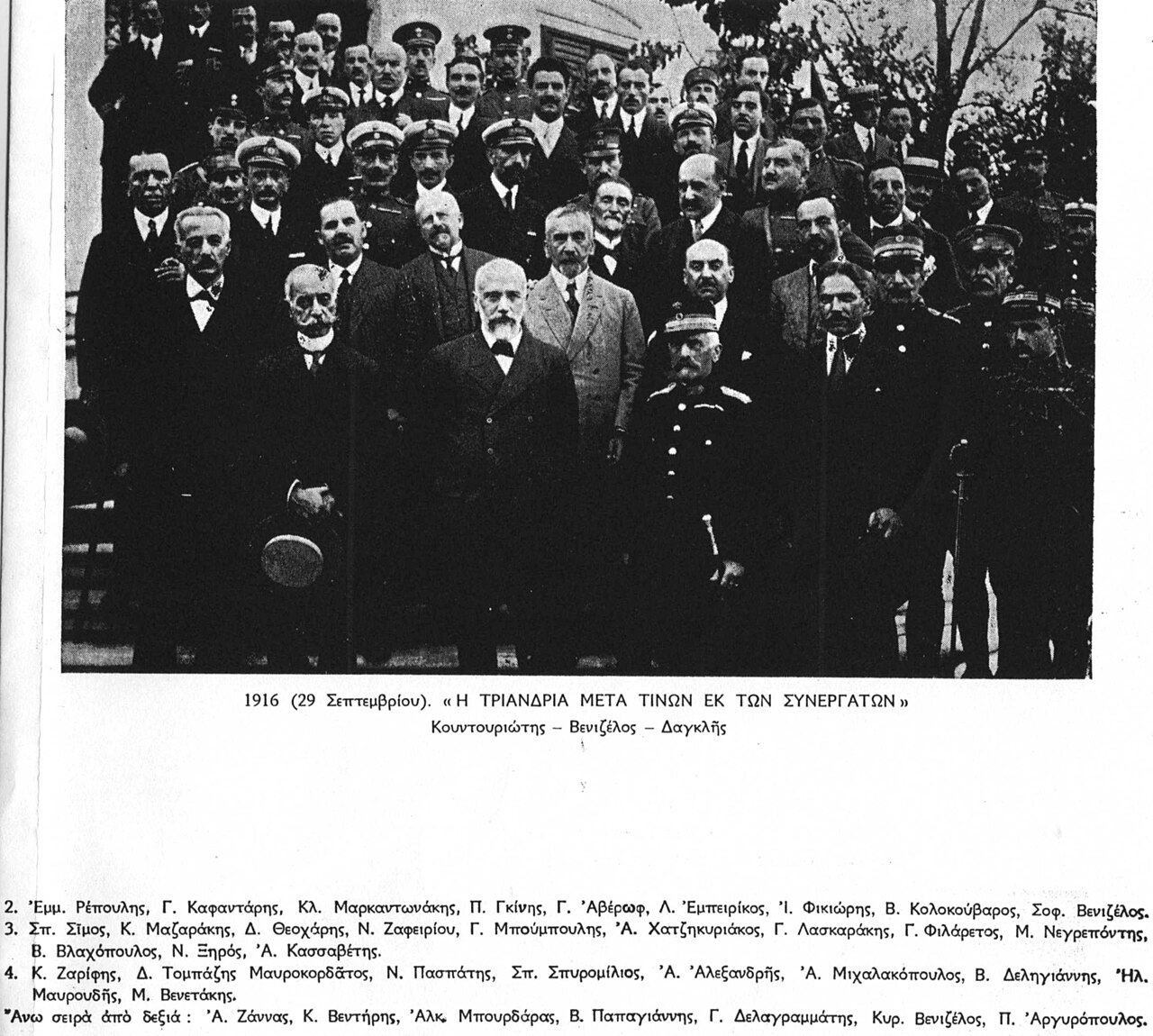
In Thessaloniki, on 17 August (Old Style) or 30 August (New Style), the National Defence movement was launched by Venizelist officers and citizens, with the support of the Entente forces. Venizelos left Athens, passed through Crete, and arrived in Thessaloniki together with Admiral Pavlos Kountouriotis and General Panagiotis Danglis.
On 26 September (Old Style) or 9 October (New Style), the Provisional Government of National Defence was formed. It did not immediately replace the Athens government internationally and territorially. With the support of the Entente, it gradually controlled Thessaloniki, Crete, islands, and parts of the New Lands, while the government of Lambros and Constantine controlled Old Greece. The country now possessed two competing governments, unevenly recognised and with shifting boundaries of control.
The provisional government organised its own army and at the end of November declared war on Germany and Bulgaria. This act bound the territory it controlled, not yet the unified Greek state. For its supporters, it was the defence of Macedonia and the fulfilment of the alliance with Serbia. For its opponents, it was a mutiny supported by foreign bayonets.
The confrontation culminated in Athens on 18 November (Old Style) or 1 December (New Style). Allied detachments landed to enforce the surrender of Greek military equipment. They clashed with units loyal to the government and with the Reservists, while Allied ships fired on positions in the capital. After the departure of the Allies, persecutions, arrests, looting, and violence against Venizelists followed.
For the events of November, there is no secure, generally accepted number of victims. Reports separate the dead and wounded of the Allied detachments, the Greek army, the Reservists, and civilians differently, and some are statements from the participants themselves. For this reason, we do not add up incompatible categories and do not turn a partisan report into a definitive account.
The Entente imposed a stricter naval blockade on the Greece controlled by Athens and demanded demobilisation and the transfer of troops to the Peloponnese. Food and fuel shortages worsened. The blockade was a central cause, but not the only one: the war had already disrupted shipping, imports, prices, and distribution networks. The pressure fell unevenly on the inhabitants and deepened the hatred between the two camps.
The Schism became an experience of daily life. Newspapers were closed or censored, public servants and officers were judged by their political stance, and families and local communities were divided. In December 1916, "anathema" ceremonies against Venizelos were organised in Athens and provincial cities. In the regions of National Defence, anti-Venizelists also faced pressure and dismissals. Political identity ceased to be a simple electoral preference and became a criterion of loyalty to the state.
In the spring of 1917, with Russia in revolution and the Entente determined to secure the Macedonian Front, the pressure on Constantine turned into an ultimatum. On 30 May (Old Style) or 12 June (New Style), he was forced to abandon the throne and the country without a formal act of abdication. The Allies also excluded the Crown Prince, George. The second son, Alexander, became King.
Zaimis remained Prime Minister for a few days. On 14 June (Old Style) or 27 June (New Style), Venizelos took over the government in Athens again. The Provisional Government ceased to operate separately, and the state was administratively reunified. The union, however, was not a political reconciliation. Anti-Venizelist officers, judges, and public servants were removed, while others were exiled or imprisoned.
The Parliament that had been elected in May 1915 was reconvened on 29 June (Old Style) or 12 July (New Style), and became known as the "Parliament of the Lazaruses." The government considered its dissolution in 1915 to have been unconstitutional. Its opponents viewed the restoration of an old Parliament without new elections as an act of imposition. Both narratives show the same problem: institutions were now functioning within a regime of winners and losers.
At the end of June, the unified government considered Greece to be in a state of war with Germany and Bulgaria, legally continuing the acts of the provisional government, and broke off relations with the other Central Powers. Sources provide different exact dates because they refer to different acts: taking office, recognition of the pre-existing declaration of war, or the severance of diplomatic relations. The safe formulation is that a unified Greece entered the war on the side of the Entente at the end of June 1917.
Large-scale mobilisation, training, and reorganisation began. The process encountered shortages in equipment and personnel, administrative difficulties, and reactions in areas where the royalist faction remained strong. The integration of the army into the Allied command was not instantaneous. By 1918, however, Greek divisions would constitute a significant part of the Army of the Orient.
On 5 August (Old Style) or 18 August (New Style), a large fire destroyed the historical and commercial centre of Thessaloniki. Approximately 70,000 people were left homeless. The majority were Jews, but Christian and Muslim residents were also affected. Estimates vary depending on the source; we do not present a number as a precise census. The disaster changed the city and opened up conflicts over reconstruction, property, and its character.
Thessaloniki was simultaneously a city of refugees, Allied troops, hospitals, and a wartime economy. The housing needs after the fire were addressed by the Greek administration, the Allied authorities, community organisations, and relief agencies. Aid was not always distributed equally, while the temporary relocation of thousands of residents turned into a permanent departure for some. The war and the fire changed not only the map, but also the composition of the city.
In May 1918, the National Defence Army Corps launched an attack on the Bulgarian fortifications of Skra di Legen. On 17 May (Old Style) or 30 May (New Style), the Archipelago, Crete, and Serres Divisions, with French artillery and infantry support, captured the main positions. The victory demonstrated the operational improvement of the reorganised Greek army.
The losses at Skra were heavy. Official military histories separate the dead, wounded, and missing, but different presentations alter the scope and the time period of the count. In this narrative, we avoid a spectacular total number. The safe conclusion is that the success was achieved at a great human cost and through combined Greek and French action.
On 2 September (Old Style) or 15 September (New Style), the final Allied offensive on the Macedonian Front began. Serbian and French forces broke through the front at Dobro Polje, while British and Greek units attacked in the area of Doiran. There, the attacks suffered heavy losses and did not achieve the same tactical breakthrough. The overall retreat of the Bulgarian army resulted from a multinational operation, exhaustion, and the collapse of the front, not from a single national victory.
On 17 September (Old Style) or 30 September (New Style), the armistice with Bulgaria came into effect. The Armistice of Mudros with the Ottoman Empire followed on 30 October, Austria-Hungary on 3 November, and Germany on 11 November, all according to the New Style. The war ended, but the terms of peace and the borders had not yet been decided.
At the same time, the influenza wave of 1918 struck soldiers and civilians alike. For Greece, there is no safe national account: the nationwide series of death registration statistics began later, and local studies cannot be mechanically added together. We can document high mortality in communities and military populations, but not a definitive number for the whole country.
In 1918, the General Confederation of Greek Workers and the Socialist Labour Party of Greece were also founded. The appearance of organised nationwide labour and socialist representation is a reminder that the era was not exhausted by the dispute between two leaders. The shortages, the mobilisation, the working conditions, and the international revolutionary movement created new social demands.
On 31 December 1918, Greece found itself in the camp of the victors, with Alexander on the throne and Venizelos as Prime Minister. Its army remained mobilised, and the government prepared to present territorial claims at the Peace Conference. The National Schism, however, had not ended. The state unification of 1917 left behind persecutions, exiles, and two competing memories of legitimacy.
The period 1914–1918 is not a history of an inevitable "right side." Venizelos correctly perceived which alliance would win and linked his choice to the expansion of the country, but his policy also relied on foreign military pressure. Constantine expressed a real fear regarding an exhausted army and Bulgaria, but his insistence on the personal exercise of foreign policy sharpened the constitutional crisis. The Entente defended its front with a blockade and intervention; the Central Powers, and especially Bulgaria, occupied Greek territory. These truths coexist.
In the next episode, from 1919 to 1924, Greece will pass from the Paris Peace Conference and the landing in Smyrna to the Asia Minor Catastrophe, the exchange of populations, and the proclamation of the Republic.
Find all the episodes at ProjectGreece.gr,
along with references, additional material, explanations,
sources, and bibliography.
All episodes of the series are available for free
on Spotify, Apple Podcasts, and YouTube Music.
ProjectGreece.
So the story can continue.
Sources & bibliography
This episode is linked to 34 documentation and rights records.
- Γενική Γραμματεία Νομικών και Κοινοβουλευτικών Θεμάτων, «Οι Κυβερνήσεις από το 1909 έως σήμερα», εγγραφές Βενιζέλου, Γούναρη, Ζαΐμη, Σκουλούδη, Καλογερόπουλου, Λάμπρου: https://gslegal.gov.gr/kyvernisi/istorika-stoixeia/CITATION_ONLYOpen source
- Βουλή των Ελλήνων, *Τα Συντάγματα της Ελλάδας*, κεφάλαιο «Το Σύνταγμα του 1911 και ο Εθνικός Διχασμός», έντυπες pp.77–81: https://www.hellenicparliament.gr/UserFiles/8c3e9046-78fb-48f4-bd82-bbba28ca1ef5/SYNTAGMATA.PDFPD_TEXT / SCAN_LINK_ONLYOpen source
- Βουλή των Ελλήνων, πίνακας εκλογών και κοινοβουλευτικών περιόδων 1822–1935, entries 1915–1920: https://www.hellenicparliament.gr/userfiles/f3c70a23-7696-49db-9148-f24dce6a27c8/1822-1935.pdfOFFICIAL_LINK_ONLYOpen source
- U.S. Department of State, *Foreign Relations of the United States, 1916, Supplement, The World War*, section “The Contest in Greece,” docs.49–50, 70–91, 92–116 and Greece country TOC: https://history.state.gov/historicaldocuments/frus1916Supp/toc-countriesPUBLIC_DOMAIN_USGOVOpen source
- U.S. Department of State, *FRUS 1917, Supplement 1, The World War*, vol.I, doc.40, Greek official account and U.S. diplomatic caveat: https://history.state.gov/historicaldocuments/frus1917Supp01v01/d40PUBLIC_DOMAIN_USGOVOpen source
- U.S. Department of State, *FRUS 1917, Supplement 2, The World War*, vol.I, doc.165, Greece at war with Germany/Bulgaria and relations with other Central Powers: https://history.state.gov/historicaldocuments/frus1917Supp02v01/d165PUBLIC_DOMAIN_USGOVOpen source
- Ελληνικό Υπουργείο Εξωτερικών, *Documents diplomatiques 1913–1917: Traité d’alliance gréco-serbe; invasion germano-bulgare en Macédoine (supplément)*, digitized copy, Anemi, document-level locators by treaty/note: https://anemi.lib.uoc.gr/metadata/a/5/d/metadata-tecirrp0mr749kl3cluhkn9vc1_1293107841.tklPD_TEXT / SCAN_LINK_ONLYOpen source
- Γενικά Αρχεία του Κράτους, «Εθνικός Διχασμός, 1915–1920», archival description and series: https://greekarchivesinventory.gak.gr/index.php/gw24-pq6w-6f79CITATION_ONLYOpen source
- ΓΑΚ, Ιστορικό Αρχείο Μακεδονίας, Αρχείο Γενικής Διοίκησης Μακεδονίας, φάκελος 28, έκθεση Διεύθυνσης Πυροπαθών, Φεβρουάριος 1919. Locator through Kyramargiou, pp.66–69.CITATION_ONLY
- Διεύθυνση Ιστορίας Στρατού, *Η Συμμετοχή της Ελλάδος εις τον Πόλεμον 1918*, τόμος Β΄, Αθήνα, 1961, κεφάλαιο Σκρα, ιδίως p.49 και πίνακες απωλειών.CITATION_ONLY
- Γενικό Επιτελείο Στρατού, «Η Μάχη του Σκρα», 17/30 Μαΐου 1918, με παραπομπή στον τόμο της ΔΙΣ: https://stelexi.army.gr/istoriko-gegonos/i-machi-tou-skra/CITATION_ONLYOpen source
- Γενικό Επιτελείο Στρατού, «Η μάχη της Δοϊράνης και η διάσπαση του Μακεδονικού Μετώπου», Σεπτέμβριος 1918: https://stelexi.army.gr/istoriko-gegonos/i-machi-tis-doiranis-kai-i-diaspasi-tou-makedonikou-metopou-i-archi-tou-telous-tou-megalou-polemou-septemvrios-1918/CITATION_ONLYOpen source
- ΓΣΕΕ, «Η Ιστορία μας», ενότητα 1918, ιδρυτικό συνέδριο 21 Οκτωβρίου 1918 Π.Η.: https://www.gsee.gr/i-istoria-masCITATION_ONLYOpen source
- Αρχεία Σύγχρονης Κοινωνικής Ιστορίας, *Αι αρχαί και το πρόγραμμα του ΣΕΚΕ, ψηφισθέν εις το Α΄ Συνέδριον Νοεμβρίου 1918*, catalog record: https://askiarchives.eu/esearch/treasure/xxx?form=100021&list=39643CITATION_ONLYOpen source
- Hassiotis, Loukianos. “Greece.” *1914-1918-online: International Encyclopedia of the First World War*. Berlin, 2014, pp.1–11. DOI: https://doi.org/10.15463/ie1418.10043CITATION_ONLYOpen source
- Lemonidou, Elli. “Venizelos, Eleutherios.” *1914-1918-online*. DOI: https://doi.org/10.15463/ie1418.10078CITATION_ONLYOpen source
- Leon, George B. *Greece and the Great Powers, 1914–1917*. Thessaloniki: Institute for Balkan Studies, 1974, especially chs.1–10 and appendix.CITATION_ONLY
- Leontaritis, George B. *Greece and the First World War: From Neutrality to Intervention, 1917–1918*. Boulder: East European Monographs, 1990, chs.1–8.CITATION_ONLY
- Mavrogordatos, George Th. *1915: Ο Εθνικός Διχασμός*. Αθήνα: Πατάκης, 2015, chs.3–8.CITATION_ONLY
- Mourelos, Yannis G. *L’Intervention de la Grèce dans la Grande Guerre, 1916–1917*. Athens: École française d’Athènes, 1983, diplomatic and military chronology.CITATION_ONLY
- Mourelos, Yannis G. *Τα Νοεμβριανά του 1916*. Αθήνα: Πατάκης, 2007, event chronology and competing casualty reports.CITATION_ONLY
- Mourelos, Yannis G. “The 1914 Persecutions and the First Attempt at an Exchange of Minorities between Greece and Turkey.” *Balkan Studies* 26.2 (1985), 389–413.CITATION_ONLY
- Akçam, Taner. *The Young Turks’ Crime against Humanity*. Princeton UP, 2012, ch.3, pp.63–96. DOI: https://doi.org/10.23943/princeton/9780691153339.003.0003CITATION_ONLYOpen source
- Papaioannou, Christos. “Under Allied Command: The Challenges of Greek Army Mobilisation in the First World War (June 1917–September 1918).” *War & Society* 44 (2025), 430–448. DOI: https://doi.org/10.1080/07292473.2025.2494400CITATION_ONLYOpen source
- Kitchen, James E. “War in the Balkans.” *1914-1918-online*, section on Salonika front and 1918 offensive: https://encyclopedia.1914-1918-online.net/article/war-in-the-balkans-1-1/CITATION_ONLYOpen source
- Kyramargiou, Eleni. “The Refugee Resettlement Policies of the Greek State and the Role of Chief Strategist Alexandros Pallis.” *The Historical Review/La Revue Historique* 20.1 (2023; published online 2025), 59–85, especially 66–67 and nn.18–19. DOI: https://doi.org/10.12681/hr.40055CITATION_ONLYOpen source
- Yerolympos, Alexandra. “A Mediterranean City in Transition: Thessaloniki between the Two World Wars.” *Planning Perspectives* 8.2 (1993), 133–148, especially 134–139.CITATION_ONLY
- Raftakis, Athanasios, and Jonathan Wadsworth. “Silent Pandemic? The 1918–1919 Influenza Pandemic in Greece: Evidence from Hermoupolis, Syros.” *Social History of Medicine* 35.3 (2022), 793–815, methodology and national-data limitation.CITATION_ONLY
- Irmscher, Johannes. “The Internment of the 4th Corps of the Greek Army in Görlitz 1916–1918.” *Balcanica Posnaniensia. Acta et Studia* 6 (1993), 147–154. DOI: https://doi.org/10.14746/bp.1993.6.10CITATION_ONLYOpen source
- Liakos, Antonis. *Εργασία και πολιτική στην Ελλάδα του Μεσοπολέμου: Το Διεθνές Γραφείο Εργασίας και η ανάδυση των κοινωνικών θεσμών*. Αθήνα: Ίδρυμα Έρευνας και Παιδείας Εμπορικής Τράπεζας, 1993, introductory chapters on 1918 labor organization.CITATION_ONLY
- Ίδρυμα Μείζονος Ελληνισμού, *Ελληνική Ιστορία 1897–1922*, chronology and National Schism pages: https://www.ime.gr/chronos/13/gr/general/imerologio/imerologio1.html and https://www.ime.gr/chronos/13/gr/domestic_policy/language/03.htmlCITATION_ONLYOpen source
- UK Parliament, Hansard, “Cyprus (Offer to Greece),” House of Commons, 26 October 1915.OFFICIAL_LINK_ONLY · Statement by Foreign Secretary Sir Edward GreyOpen source
- Stavridis, Stavros T. “Greek-Cypriot Enosis of October 1915: ‘A Lost Opportunity?’” Balkan Studies 37.2 (1996), 289–307.CITATION_ONLY · pp. 289–307Open source
- Yiangou, Anastasia. “The Orthodox Church of Cyprus, Enosis Politics and the British Authorities during the First World War.” Byzantine and Modern Greek Studies 44.1 (2020), 137–153.CITATION_ONLY · pp. 137–153Open source