Goudi, Venizelos and the Balkan Wars
From the Goudi movement and Venizelos’s rise to the Balkan Wars and major territorial expansion.
Audio will be added after final production.
In this episode
From the Goudi movement and Venizelos’s rise to the Balkan Wars and major territorial expansion.
Full transcript
The complete English transcript of this episode is available to read.
ProjectGreece.
The History of Greece, from 1800 to today.
A twenty-episode series that narrates the journey of modern Greece with sobriety, composure, and documentation.
Eighth episode.
1909–1913: Goudi, Venizelos, and the Balkan Wars.
Welcome to another episode of the series “The History of Greece, from 1800 to today.”
In the previous episode, we reached the end of 1908. Greece had passed through the International Financial Control and reorganization following the defeat of 1897, while the Macedonian Struggle and the unilateral declaration of the union of Crete had left serious national and diplomatic issues unresolved.
We enter 1909 with George I as king and Georgios Theotokis as prime minister. Parliamentary order is functioning, but a large part of society and the military believes that the state is unable to respond to either domestic needs or the competition in the Balkans.
In May 1909, the Military League, a secret organization of officers, is founded. Its demands do not constitute a complete political programme. They combine professional claims, the removal of princes from active military command, the strengthening of the army and navy, and a more general, vague demand for the “rectification” of the administration, justice, education, and finance.
Behind the crisis lie different disappointments: the memory of the defeat of 1897, the inability of Athens to enforce the union of Crete, the annexation of Bosnia by Austria-Hungary, and the declaration of Bulgarian independence in 1908. For the officers, all these events prove military and administrative insufficiency. For other social groups, “rectification” means less tax pressure, more effective justice, or the curtailment of clientelist relationships.
In July, Theotokis resigns and is succeeded by Dimitrios Rallis. When the government attempts to curb the League, the officers, led by Colonel Nikolaos Zorbas, gather forces at Goudi in the early hours of 15 August according to the old calendar, 28 August according to the new.
The movement prevails without major armed conflict. It does not abolish the monarchy, does not dissolve parliament, and does not install a formal military dictatorship. It does, however, force the resignation of Rallis and exerts extra-parliamentary pressure on the government of Kyriakoulis Mavromichalis, which assumes power during August.
The large popular gathering of 14 September according to the old calendar shows that the dissatisfaction extends beyond the barracks. This does not mean that military personnel, trade unions, farmers, urban groups, and reformers have a common plan. The word “rectification” accommodates different and often conflicting expectations.
The League is unable to transform its pressure into stable governance and invites Eleftherios Venizelos from Crete as a political advisor. Venizelos arrives in Athens at the end of 1909 and proposes a compromise: a revisionary, not constituent, Assembly; the return of political initiative to parliamentary institutions; and the dissolution of the League.
His selection is not a foregone conclusion. Venizelos has significant political experience in the autonomous Cretan State, but he has not yet governed Greece. He does not immediately become prime minister, nor does he transform the League into a personal party. Initially, he acts as a mediator between the officers, the king, and the old parties.
In January 1910, Stefanos Dragoumis succeeds Mavromichalis. The Parliament approves the proclamation of a revisionary assembly, and in March, the Military League is dissolved. The military intervention has opened the way for political change, but the change now proceeds through elections and parliamentary procedures.
In the elections of 8 August according to the old calendar, the old party formations retain an overall majority. Many independent reformers are elected, and Venizelos, without yet having fully organized a new party, is elected with strong support in Attica-Boeotia.
In September, in a speech at Syntagma Square, Venizelos insists on the revision of the Constitution and not the overthrow of the regime. On 6 October according to the calendar of the time, he becomes prime minister. When he finds it difficult to secure stable parliamentary support, he agrees with the king on a new dissolution of Parliament.
The old parties abstain from the elections of 28 November. The Liberals win an overwhelming majority, but the result must be read in conjunction with this abstention. The new government now possesses the parliamentary strength for extensive reforms.
In 1911, the revision of the Constitution strengthens the guarantees of rights, judicial independence, and the tenure of civil servants; it provides for compulsory and free elementary education and re-establishes the Council of State. It does not establish a new regime: it revises the Constitution of 1864 and maintains the constitutional parliamentary order.
At the same time, laws are passed regarding administration, labor, and the expropriation of large properties, with particular significance for Thessaly. The laws do not immediately eliminate social inequality, nor are they applied everywhere at the same rate. They do, however, demonstrate more systematic state intervention.
Military preparation accelerates. A French mission contributes to the reorganization of the army and a British mission to the navy. New equipment, training, and mobilization improve readiness, while the armored cruiser “Georgios Averof” offers a significant qualitative advantage. The success that will follow is not explained by one leader or one weapon alone, but by institutional, economic, and military preparation spanning many years.
The government also reinstates the Crown Prince Constantine and the princes to military positions, despite the previous demand of the League for their removal. The decision provokes reactions among some officers, but it is part of Venizelos’s effort to reach an understanding with the Crown. The cooperation is genuine, but it is not proof that all institutional disagreements have been resolved.
In the elections of March 1912, the Liberals renew their dominance. Venizelos remains prime minister and George I remains king. The governmental succession of the period is by now stable: Theotokis, Rallis, and Mavromichalis within 1909, Dragoumis in 1910, and Venizelos from October 1910 until the end of the episode.
At the same time, the Italo-Ottoman War weakens the Ottoman Empire. Italy occupies the Dodecanese; the islands do not pass to Greece. In the Balkans, Serbia and Bulgaria conclude an alliance in March. Greece and Bulgaria sign a defensive treaty on 16 May according to the old, or 29 May according to the new calendar.
The Greco-Bulgarian treaty does not pre-agree on the distribution of Macedonia. This deliberate ambiguity allows for the alliance, but shifts the competition to the field: after the victory, each state will support its claims primarily based on the territories it controls militarily.
In May, the government temporarily prevents the Cretan deputies from entering the Greek Parliament, to avoid premature conflict with the Sublime Porte. With the outbreak of war in October, they are admitted. The shift shows that the Cretan Union is evolving in stages and is not legally completed with a single declaration.
Montenegro begins the war in early October. Greece enters operations on 5 October according to the old calendar, or 18 October according to the new, together with Serbia and Bulgaria. The Balkan League is an alliance of convenience against the Ottoman Empire, not a unified state nor a joint command.
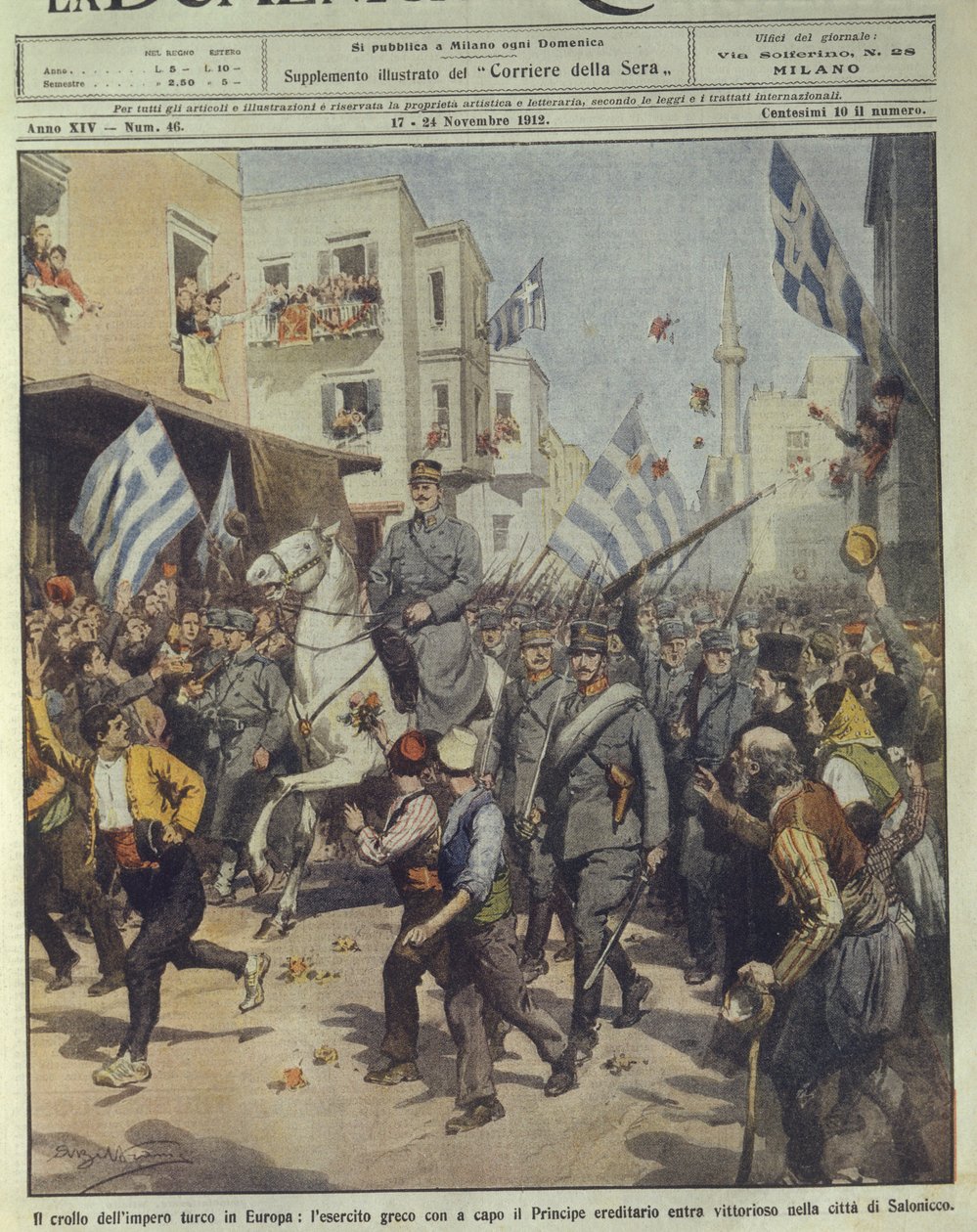
The Army of Thessaly, with Crown Prince Constantine as commander-in-chief, is victorious at Sarantaporo and Giannitsa. The government gives priority to Thessaloniki, as Bulgarian forces are also approaching the city. On 26 October according to the old, or 8 November according to the new calendar, the Ottoman commander Hasan Tahsin Pasha signs the surrender of Thessaloniki to the Greek army.
Sources have often presented the direction toward Thessaloniki as a personal conflict between Venizelos and Constantine. Their disagreement over operational priorities is documented, but the dramatized phrases attributed to them are not all equally certain. For this reason, we hold to the certain result: the government pressed for a rapid march toward the city, and the headquarters eventually moved toward it.
The entry of the Greek army does not turn Thessaloniki into a homogeneous city. It is a large Ottoman port, with a majority Jewish community and significant Muslim, Greek Orthodox, Bulgarian, and other communities. The change of power breeds hope for some, uncertainty or fear for others, and immediate problems of administration, supply, and security.
At sea, the fleet under Pavlos Kountouriotis occupies positions and islands in the northeastern Aegean and uses Moudros as a base. The victories at Elli, on 3 December according to the old calendar, and at Lemnos, on 5 January 1913, restrict the exit of the Ottoman fleet from the Straits. The occupation of the islands is a military event; the final international decision regarding their sovereignty has not yet been taken at the end of 1913.
In Epirus, the advance is slower. After a siege and the final assault at Bizani, Ioannina is surrendered on 21 February according to the old, or 6 March according to the new calendar of 1913. Greek forces advance further north, but the drawing of the borders of Albania by the Great Powers will limit final Greek sovereignty.
The stance of the Great Powers is not unified. Austria-Hungary and Italy particularly support the creation of an independent Albania, while Russia, France, and Britain have different allies and priorities. All, however, seek to prevent a wider European war and reserve for themselves decisions that the Balkan armies cannot close solely through the occupation of territory.
On 5 March according to the old calendar, or 18 March according to the new, George I is assassinated in Thessaloniki by Alexandros Schinas. The available evidence does not reliably substantiate a wider conspiracy. The throne is immediately succeeded by Constantine I, the former commander-in-chief.
In the meantime, the allies have already begun to clash over Macedonia. The Treaty of London, on 17 May according to the old, or 30 May according to the new calendar, ends the first war. The Ottoman Empire cedes to the allies the European territories west of the Enos–Midia line and waives its rights in Crete. The treaty does not divide the territories between the allies and entrusts the Great Powers with the decisions regarding Albania and the Aegean islands.
On 1 June according to the new calendar, Greece and Serbia conclude a defensive alliance. They fear a Bulgarian attack and seek to maintain the regions they control. The conflict over distribution is not a simple continuation of the war against the Ottomans: now former allies turn against one another.
On the night of 16 to 17 June according to the old calendar, 29 to 30 June according to the new, Bulgarian units attack Serbian and Greek positions. The Second Balkan War begins. Greece and Serbia counterattack, while later Romania and the Ottoman Empire intervene, each for its own goals.
The battles at Kilkis and Lachanas, at Doiran and toward the Kresna gorge are extremely bloody. The Greek army advances, but in the final operations, it finds itself exhausted and with long supply lines. The outcome is not solely due to the Greek and Serbian victories; the Romanian invasion toward Sofia and the Ottoman return to Eastern Thrace make Bulgaria’s position impossible.
Regarding military casualties, there is no single figure that can be stated without explanation. Some tables count only those killed in the field, while others add those who died from wounds or diseases, the missing, and prisoners. We can say with certainty that the Greek forces had several thousand dead and many more wounded in the two wars, with a particularly heavy cost in the second.
The cost is also heavy for civilians. Destruction of settlements, looting, executions, forced displacements, and intimidation of populations are recorded on many fronts and are attributed to the armies and armed groups of different states. The precise total numbers remain uncertain: research is uneven, testimonies are often biased, and the allegations of victims are not uniform. The acknowledgment of this uncertainty does not negate the documented extent of the violence.
The international Carnegie commission that investigated the wars gathered significant testimonies but worked after the events, with uneven access to the areas, and its report was questioned even then by involved governments. We use it as a critical, though not infallible, source and cross-reference individual allegations where possible.
The Treaty of Bucharest is signed on 28 July according to the old, or 10 August according to the new calendar. The Greco-Bulgarian border reaches from Belasitsa to the mouth of the Nestos. Greece secures Thessaloniki, a large part of southern Macedonia, and Kavala. The treaty regulates the border with Bulgaria but does not by itself settle every Greco-Ottoman or island issue.
The Treaty of Athens, on 1 November according to the old, or 14 November according to the new calendar, restores peace between Greece and the Ottoman Empire and regulates issues of nationality, property, religious communities, and prisoners. It refers to previous international acts and does not solve the pending issue of sovereignty over the islands, which will be decided by the Powers in 1914.
On 1 December according to the calendar used by Greece at the time, or 14 December according to the new, the Greek flag is officially raised at the Firkas fortress in Chania, in the presence of King Constantine and Venizelos. The ceremony seals the union of Crete with Greece after successive revolutions, a status of autonomy, unilateral acts, and international treaties.
By the end of 1913, the territory and population of the Greek state have almost doubled. The precise comparisons differ depending on the census, the date, and whether regions with pending sovereignty are included. The state now includes Epirus up to the new Albanian border, southern Macedonia with Thessaloniki, Crete, and islands that are governed by Greece but have not all yet been definitively recognized internationally.
The expansion creates a much more complex state. In the new provinces live Greek-speaking and Slavic-speaking Christians, Muslims, Jews, Vlachs, and other communities, with different languages, institutions, and experiences. Integration requires administration, justice, taxation, schools, infrastructure, and policies for property and citizenship. It is not an automatic process or one without conflict.
The term “liberation” reflects the official Greek perspective and the experience of many Orthodox populations, but not of all residents. In a comprehensive narrative, it needs to coexist with more accurate terms, such as occupation, handover, change of administration, and international recognition, depending on the specific stage and the community we are examining.
From Goudi to Bucharest, Greece has changed its political tempo, military capability, and geographical scale. The movement of 1909 did not bring about this outcome on its own, nor do the victories belong to one man. The Venizelos government, the army and navy, the monarchy, the diplomacy, the allies, and the opponents all acted within a conjuncture where the Ottoman Empire was retreating from the majority of its European territory.
On 31 December 1913, Constantine I is king and Eleftherios Venizelos is prime minister. Their cooperation has been linked to victory, but their different perceptions of strategy, diplomacy, and the limits of royal authority have not disappeared. Europe, meanwhile, is approaching a generalized war.
In the next episode, we move into the years 1914–1918, when the First World War will transform the disagreements between Venizelos and Constantine into a National Schism and will create two rival centers of power.
Find all episodes at ProjectGreece.gr, along with references, additional material, explanations, sources, and bibliography.
All episodes of the series are available for free on Spotify, Apple Podcasts, and YouTube Music.
ProjectGreece.
So the story can continue.
Sources & bibliography
This episode is linked to 44 documentation and rights records.
- Γενική Γραμματεία Νομικών και Κοινοβουλευτικών Θεμάτων, «Οι Κυβερνήσεις από το 1909 έως σήμερα», χρονολογικός πίνακας, εγγραφές Μαυρομιχάλη–Δραγούμη–Βενιζέλου: https://gslegal.gov.gr/kyvernisi/istorika-stoixeia/?sort=timeCITATION_ONLYOpen source
- Βουλή των Ελλήνων, «Συνταγματική Ιστορία», ενότητα αναθεώρησης 1911: https://www.hellenicparliament.gr/Vouli-ton-Ellinon/To-Politevma/Syntagmatiki-IstoriaOFFICIAL_LINK_ONLYOpen source
- Βουλή των Ελλήνων, *Σύνταγμα του 1911*, πρωτότυπο ψηφιοποιημένο κείμενο, ιδίως άρθρα 2, 10, 17, 82, 102–103: https://www.hellenicparliament.gr/UserFiles/f3c70a23-7696-49db-9148-f24dce6a27c8/syn14.pdfPD_TEXT / SCAN_LINK_ONLYOpen source
- Βουλή των Ελλήνων, πίνακας εκλογών 1822–1935, εγγραφές 1910 και 1912: https://www.hellenicparliament.gr/UserFiles/f3c70a23-7696-49db-9148-f24dce6a27c8/1822-1935.pdfOFFICIAL_LINK_ONLYOpen source
- Ζορμπάς, Νικόλαος. *Απομνημονεύματα*. Αθήνα, 1925, ιδίως σ.17–58. Ιστορικό κείμενο· χρήση επαληθευμένου αντιτύπου.CITATION_ONLY
- Ίδρυμα Μείζονος Ελληνισμού, *Ιστορία του Ελληνικού Έθνους 1897–1922*, Domestic Policy, facts/03: https://www.ime.gr/chronos/13/gr/domestic_policy/CITATION_ONLYOpen source
- Εθνικό Ίδρυμα Ερευνών και Μελετών «Ελευθέριος Κ. Βενιζέλος», «1910–1920: Ο Βενιζέλος στην ελληνική και διεθνή πολιτική σκηνή»: https://www.venizelos-foundation.gr/el/1910-1920-o-venizelos-stin-elliniki-kai-diethni-skini/CITATION_ONLYOpen source
- Llewellyn-Smith, Michael. *Venizelos: The Making of a Greek Statesman, 1864–1914*. Oxford University Press, 2021, chs.20–34, pp.185–338. DOI: https://doi.org/10.1093/oso/9780197586495.001.0001CITATION_ONLYOpen source
- Clogg, Richard. *A Concise History of Greece*. 3rd ed., Cambridge University Press, 2013, pp.82–89.CITATION_ONLY
- Koliopoulos, John S., and Thanos M. Veremis. *Modern Greece: A History since 1821*. Wiley-Blackwell, 2010, ch.5.CITATION_ONLY
- Hall, Richard C. *The Balkan Wars 1912–1913: Prelude to the First World War*. Routledge, 2000, chs.1–6, pp.1–153. DOI: https://doi.org/10.4324/9780203138055CITATION_ONLYOpen source
- Γενικό Επιτελείο Στρατού / Διεύθυνση Ιστορίας Στρατού. *Επίτομη Ιστορία των Βαλκανικών Πολέμων 1912–1913*. Αθήνα, 1987, ενότητες Α΄ και Β΄ Πολέμου και πίνακας απωλειών.CITATION_ONLY
- ΓΕΣ, «Η Μάχη του Σαρανταπόρου (9–10 Οκτωβρίου 1912)»: https://stelexi.army.gr/istoriko-gegonos/i-machi-tou-sarantaporou-09-10-okt-1912/CITATION_ONLYOpen source
- ΓΕΣ, «Η απελευθέρωση της Θεσσαλονίκης (26 Οκτωβρίου 1912)»: https://stelexi.army.gr/istoriko-gegonos/i-apeleftherosi-tis-thessalonikis-26-oktovriou-1912/CITATION_ONLYOpen source
- ΓΕΣ, «Η μάχη στο Μπιζάνι και η απελευθέρωση των Ιωαννίνων»: https://stelexi.army.gr/istoriko-gegonos/i-machi-sto-bizani-kai-i-apeleftherosi-ton-ioanninon-19-20-fevrouariou-1913-2/CITATION_ONLYOpen source
- ΓΕΣ, «Β΄ Βαλκανικός Πόλεμος (16 Ιουνίου–18 Ιουλίου 1913)»: https://stelexi.army.gr/istoriko-gegonos/b%CE%84-valkanikos-polemos-16-iouniou-1913-18-iouliou-1913/CITATION_ONLYOpen source
- Πολεμικό Ναυτικό / Πλωτό Ναυτικό Μουσείο Θωρηκτό «Γ. Αβέρωφ», ιστορικό πλοίου και Βαλκανικών Πολέμων: https://averof.hellenicnavy.gr/CITATION_ONLYOpen source
- Prevelakis, Eleutherios. “Eleutherios Venizelos and the Balkan Wars.” *Balkan Studies* 7.2 (1966), 365–378, ιδίως 369–377: https://ojs.lib.uom.gr/index.php/BalkanStudies/article/download/729/736CITATION_ONLYOpen source
- Dakin, Douglas. *The Unification of Greece, 1770–1923*. London: Ernest Benn, 1972, pp.197–224.CITATION_ONLY
- Erickson, Edward J. *Defeat in Detail: The Ottoman Army in the Balkans, 1912–1913*. Praeger, 2003, chs.4–10.CITATION_ONLY
- ΙΜΕ, Foreign Policy, facts/04, βαλκανικές συμμαχίες και Κρητικό: https://www.ime.gr/chronos/13/gr/foreign_policy/facts/04.htmlCITATION_ONLYOpen source
- Treaty of Ouchy/Lausanne, 18 October 1912, arts.II and XVI. Ιστορικό διπλωματικό κείμενο· επαληθευμένη έκδοση σε *American Journal of International Law*, Supplement 7.1 (1913), pp.58–62.PD_TEXT / SCAN_LINK_ONLY
- Treaty of Alliance between Greece and Bulgaria, 16/29 May 1912, και Military Convention, 22 September/5 October 1912. Κείμενα σε Carnegie Commission, appendices, και Hall, pp.25–31.PD_TEXT / SCAN_LINK_ONLY
- *Foreign Relations of the United States, 1912*, “War in the Balkans,” pp.1341–1354: https://history.state.gov/historicaldocuments/frus1912PUBLIC_DOMAIN_USGOVOpen source
- Treaty of London, 17/30 May 1913, arts.2–5, επαληθευμένο γαλλικό κείμενο: https://documentsdedroitinternational.fr/1913-30-mai-traite-de-londres/PD_TEXT / SCAN_LINK_ONLYOpen source
- *Foreign Relations of the United States, 1913*, ch.109, London and Athens peace settlements, docs.1655–1658: https://history.state.gov/historicaldocuments/frus1913/ch109PUBLIC_DOMAIN_USGOVOpen source
- Treaty of Friendship and Defensive Alliance between Greece and Serbia, 19 May/1 June 1913, μαζί με στρατιωτική σύμβαση. Locator: Prevelakis, pp.374–376· κείμενο σε Anderson and Hershey, no.14.PD_TEXT / SCAN_LINK_ONLY
- Treaty of Bucharest, 28 July/10 August 1913, ιδίως art.V και annexed frontier protocol. Αγγλικό κείμενο σε Frank Maloy Anderson and Amos Shartle Hershey, *Handbook for the Diplomatic History of Europe, Asia, and Africa, 1870–1914*, Washington, 1918, pp.439–443. Ψηφιακό αντίτυπο: https://archive.org/details/handbookfordipl00hersgoogPD_TEXT / SCAN_LINK_ONLYOpen source
- Treaty of Athens between Greece and the Ottoman Empire, 1/14 November 1913, arts.1–16, ιδίως art.15. Αρχειακή εγγραφή/τεκμήριο: https://www.searchculture.gr/aggregator/edm/venizelosdig/000132-38385?language=enPD_TEXT / SCAN_LINK_ONLYOpen source
- *Foreign Relations of the United States, 1913*, ch.59, “Assassination of King George I; accession … Constantine,” docs.601–610: https://history.state.gov/historicaldocuments/frus1913/ch59PUBLIC_DOMAIN_USGOVOpen source
- Treaty of Lausanne, 24 July 1923, art.12, ως μεταγενέστερη επιβεβαίωση της απόφασης των Δυνάμεων του Φεβρουαρίου 1914: https://www.mfa.gov.tr/lausanne-peace-treaty-part-i_-political-clauses.en.mfaPD_TEXT / SCAN_LINK_ONLYOpen source
- Εθνικό Ίδρυμα Ερευνών και Μελετών «Ελευθέριος Κ. Βενιζέλος», χρονολόγιο 1912–1913: https://timeline.venizelos-foundation.gr/timeline/CITATION_ONLYOpen source
- Carnegie Endowment for International Peace. *Report of the International Commission to Inquire into the Causes and Conduct of the Balkan Wars*. Washington, 1914, chs.II–IV, pp.71–274, appendices: https://archive.org/details/reportofinternat00inteuoftCITATION_ONLYOpen source
- Mazower, Mark. *Salonica, City of Ghosts: Christians, Muslims and Jews, 1430–1950*. Knopf, 2005, chs.11–12, pp.279–312.CITATION_ONLY
- Naar, Devin E. *Jewish Salonica: Between the Ottoman Empire and Modern Greece*. Stanford University Press, 2016, introduction and ch.1, pp.1–43.CITATION_ONLY
- Hellenic Statistical Authority / historical census series, απογραφές 1907 και 1913. Για τελικό infographic απαιτείται επιβεβαίωση συγκεκριμένου πίνακα και εδαφικής βάσης: https://www.statistics.gr/el/statistical-publicationsOFFICIAL_LINK_ONLYOpen source
- Προεδρία της Ελληνικής Δημοκρατίας, ιστορία Προεδρικού Μεγάρου, διαδοχή Γεωργίου–Κωνσταντίνου το 1913: https://www.presidency.gr/en/mansion/history/CITATION_ONLYOpen source
- ΙΤΥΕ «Διόφαντος» / Ψηφιακό Σχολείο, «Το κίνημα στο Γουδί (1909)», ενότητα 6.27, με απόσπασμα από τα απομνημονεύματα Ζορμπά: https://ebooks.edu.gr/ebooks/v/html/8547/2214/Istoria_G-Gymnasiou_html-empl/index6_27.htmlCITATION_ONLYOpen source
- Περιφέρεια Κρήτης, «Χρονολόγιο Περιόδου», ενότητες 1909–1913 και επίσημη τελετή της 1ης Δεκεμβρίου 1913: https://www.crete.gov.gr/chronologio-periodoy/CITATION_ONLYOpen source
- Οι δύο κυβερνήσεις πριν από την online επίσημη χρονολογία αποδίδονται σε επίπεδο μήνα, όχι με μη επαληθευμένη ημέρα διορισμού ή παύσης.CITATION_ONLY
- Η ακριβής ώρα υπογραφής της παράδοσης της Θεσσαλονίκης δεν εκφωνείται και δεν αποτελεί claim του επεισοδίου.CITATION_ONLY
- Δεν χρησιμοποιείται αριθμητικό infographic έκτασης ή πληθυσμού· το script κρατά τη συγκριτική τάξη μεγέθους και δηλώνει τις απογραφικές αποκλίσεις.CITATION_ONLY
- Δεν δίνεται ενιαίος αριθμός απωλειών· διατηρείται μόνο κατηγορικά προσεκτική, ποιοτική διατύπωση.CITATION_ONLY
- Κάθε μελλοντικός χάρτης, φωτογραφία, πορτρέτο ή scan παραμένει `ITEM_LEVEL_REVIEW — PUBLICATION PENDING` και δεν εμποδίζει την ηχογράφηση.CITATION_ONLY