George II, Metaxas and entry into war
The restoration of the monarchy, the 4 August regime and the Italian invasion of 1940.
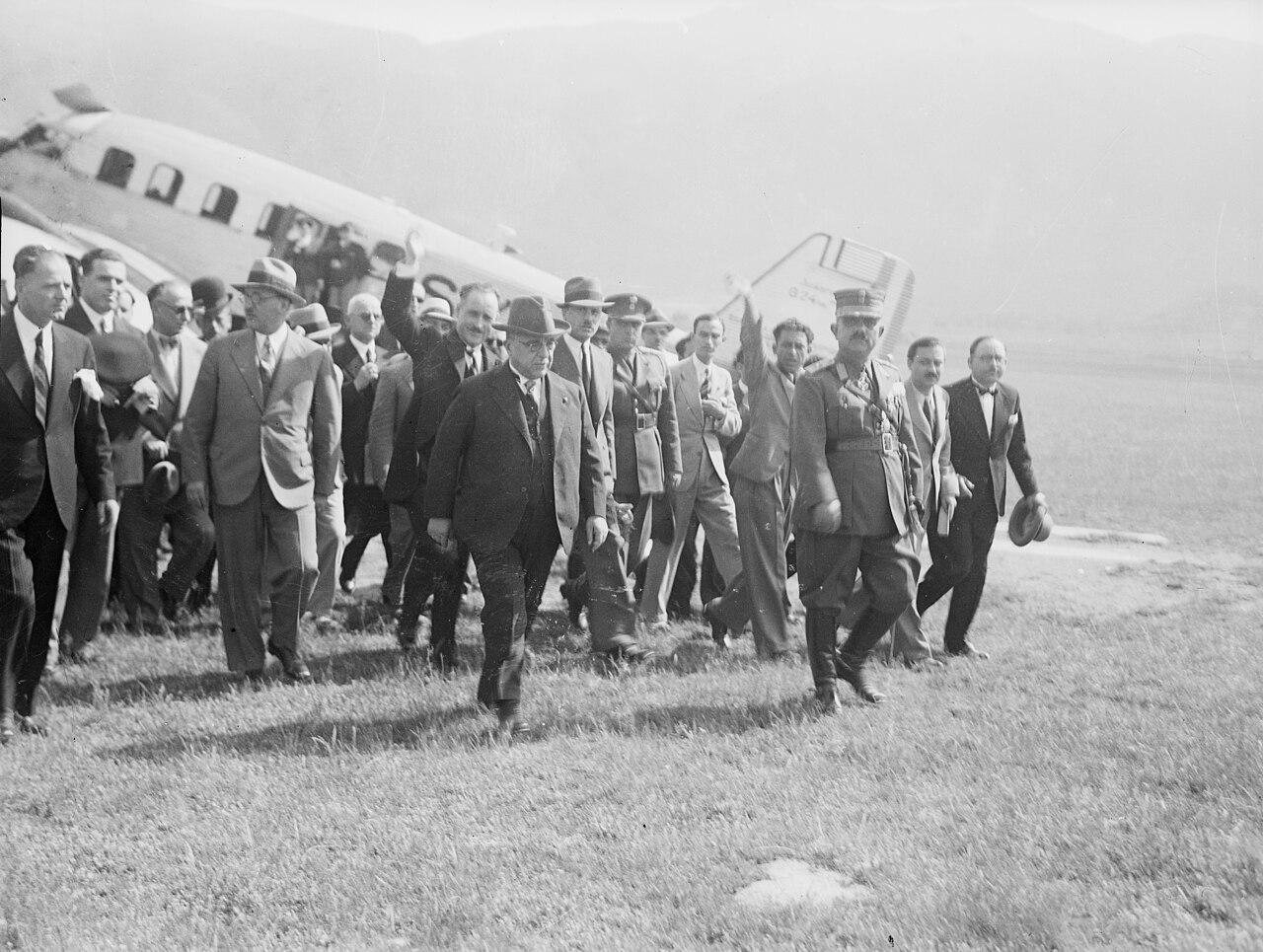
Audio will be added after final production.
In this episode
The restoration of the monarchy, the 4 August regime and the Italian invasion of 1940.
Full transcript
The complete English transcript of this episode is available to read.
ProjectGreece.
The History of Modern Greece, from 1800 to today.
A twenty-part series narrating the course of modern Greece with sobriety, calm, and documentation.
Twelfth episode.
1935–1940: George II, Metaxas and the entry into the war.
Welcome to another episode of the series "The History of Modern Greece, from 1800 to today."
In the previous episode, we reached the end of 1934. The economic crisis had sharpened social tensions, while the National Schism continued to divide Venizelists and anti-Venizelists. The republic without a king was functioning, but military interventions, attempted coups, and the conflict over the form of government had eroded its legitimacy.
We are now in 1935. The President of the Republic is Alexandros Zaimis and the Prime Minister is Panagis Tsaldaris. However, constitutional continuity will be interrupted within a few months, first by a failed Venizelist movement and then by the monarchist upheaval of Georgios Kondylis.
On 1 March 1935, Venizelist officers revolt in units and on ships, claiming they are defending the Republic from a monarchist restoration. The government declares martial law and assigns a decisive role in the suppression to the Minister of Military Affairs, Georgios Kondylis. The movement collapses by 11 March. Eleftherios Venizelos flees abroad once again.
Military courts, executions, imprisonments, and purges of Venizelist officers follow. The suppression does not restore a neutral army; it shifts the balance in favour of anti-Venizelists and royalists. In the elections of 9 June, which the most significant Venizelist forces boycott, the ruling parties obtain an overwhelming parliamentary majority. The result cannot be read as a free and full measurement of social preference for the form of government.
Tsaldaris accepts a referendum on the monarchy, but seeks a controlled process. On 10 October, the heads of the armed forces force his resignation. Kondylis becomes Prime Minister and Regent, abolishes the republic without a king, and temporarily restores the 1911 Constitution. President Zaimis is removed. This is a militarily imposed change of government, not a normal constitutional succession.
The referendum takes place on 3 November. The official result shows approximately 97.8% in favour of the monarchy. The percentage is not a reliable record of the voters' will: the voting takes place in a climate of coercion and censorship, with persecution of opponents, insufficient secrecy, and extensive fraud. The abstention of pro-Venizelist forces is not enough to explain the unrealistic result.
George II returns to Greece on 25 November, eleven years after his departure. He does not remain merely a symbol. He grants an amnesty, clashes with Kondylis, and on 30 November entrusts the government to Professor Konstantinos Demertzis. The monarchy has been restored, but the reconciliation promised by the King is not accompanied by a stable parliamentary majority.
The amnesty allows for the return of some exiles and temporarily reduces tension, but it does not reverse the purges of the army nor restore confidence in the restoration process. Democratic politicians are divided between accepting the new regime as a fait accompli and insisting on a republic without a king. The army, the Palace, and party leaders continue to be competing centres of power.
The elections of 26 January 1936 are held under proportional representation. The two major camps elect an almost equal number of deputies, and the 15 seats of the Popular Front, in which the Communist Party participates, gain a regulatory weight. The secret Sofoulis–Sklavainas agreement attempts to secure parliamentary cooperation in exchange for measures of political normalisation and social protection, but meets fierce opposition from the Palace, the army, and opponents of the Left.
The political generation of the Schism is decimated. Kondylis dies in January, Venizelos in March, and Demertzis suddenly on 13 April. On the same day, George appoints Ioannis Metaxas as Prime Minister, the leader of a small party of 7 deputies. On 27 April, Parliament grants him a vote of confidence with a large majority. The dictatorship has not yet been imposed, but a large part of the political world has already accepted strong extra-parliamentary governance.
In late April, tobacco workers' strikes begin. In Thessaloniki, the mobilisation takes on a more general labour and popular character. On 9 May, the gendarmerie fires on demonstrators. 12 deaths are recorded in modern academic research, but reports and the attribution of individual injuries differ. The photograph of a mother over the body of her son is later connected with the "Epitaphios" by Yannis Ritsos.
The events in Thessaloniki reveal real social tensions: low wages, unemployment, weak protection, and harsh policing. However, they are not evidence that a communist seizure of power was imminent. The scheduled general strike of 5 August will be used by Metaxas as an immediate pretext, not as the complete cause of the upheaval.
On 4 August 1936, with the consent and decrees of George, the government declares martial law, dissolves Parliament, and suspends basic articles of the Constitution regarding freedoms and political rights. Parties and independent trade unions are banned. The regime of the Fourth of August is a dictatorship of Metaxas with the King as a necessary institutional pillar, not a seizure of power by an electorally dominant fascist party.
The new regime borrows symbols, rituals, and corporatist vocabulary from fascist Italy and other European dictatorships. It does not, however, create a single party that absorbs the state, nor does it abolish the monarchy in favour of a party leader. Power rests on the cooperation of Metaxas and George, the Security Police, the army, and the administration. This is why historians discuss the exact typological affinities, without doubt as to the dictatorial character.
The Security Police under Konstantinos Maniadakis arrests, exiles, and tortures communists, trade unionists, and other opponents. Censorship is imposed on the press, theatre, music, and books. Declarations of repentance are used for the political and moral crushing of prisoners. Infiltration of the illegal communist apparatus later extends to the publication of a fake "Rizospastis" and the creation of competing party leaderships.
The regime promotes the "Third Greek Civilisation," combining selective images of ancient Sparta, Byzantium, Orthodoxy, and folk tradition. The National Organisation of Youth (EON) organises boys and girls in uniforms, parades, sports, camps, and ideological training. However, it does not acquire the autonomous party power of Nazi or fascist organisations; it remains an instrument of the state, of Metaxas, and of the throne.
For women, the regime combines public mobilisation with a strictly patriarchal model. Girls participate in the EON and gain visibility in collective activities, but official ideology destines them primarily for motherhood, family, and service to the nation. Participation does not equate to political equality; women still do not have a national right to vote.
In the economy, the dictatorship continues many state intervention policies that had begun before it: currency controls, protective tariffs, public works, and production regulation. In 1937, the Social Insurance Foundation (IKA) begins to operate, an institution that had already been legislated in 1934 after long labour demands. The regime expands social measures and collective regulations, while simultaneously abolishing free trade union action and controlling labour organisations.
The economy recovers gradually from the Great Depression, but rural poverty and regional inequalities remain. Armament programmes after 1936 create deficits. Trade with Nazi Germany increases through clearing agreements, without this meaning that Greece's geostrategic direction becomes German. Shipping, the public debt, and the security of the eastern Mediterranean keep the country closely linked to Britain.
Organised refugee rehabilitation has already passed the urgent phase of previous years, while land reclamation projects, such as those in the Strymon valley, change the possibilities for settlement and cultivation. Social integration, however, is not finished. Refugee settlements maintain their own memories and political identities, while access to land, housing, health, and stable work remains unequal.
Athens, Piraeus, and Thessaloniki have already been transformed by refugee settlement and internal migration. Industrial districts, small workshops, and new popular forms of entertainment develop alongside serious shortages of housing and hygiene. The regime attempts to control this mass culture: it censors lyrics and performances, but cannot erase rebetiko, modern literature, or the different memories of the city.
The national homogeneity projected by the regime conceals different experiences. In Western Macedonia, Slav-speaking citizens suffer systematic assimilation pressures, language bans, fines, and persecutions. The Muslim communities of Thrace and the Cham Albanians of Epirus are treated with security suspicion. Jewish communities, with the largest being that of Thessaloniki, do not suffer German-style state racial legislation, but they live within an authoritarian, nationalist environment and in a society where anti-Semitism has not disappeared.
In foreign policy, Metaxas does not mechanically follow his ideological sympathies for authoritarian regimes. He maintains the Balkan Pact, seeks better relations with neighbours, and tries to avoid commitments that would provoke Italy. At the same time, George and the government believe that, in a great Mediterranean war, British naval power will be decisive.
The fortification of the northern borders is strengthened with the so-called Metaxas Line, mainly against Bulgaria. This strong project absorbs significant resources but does not protect the Epirus front from an attack through Italian-occupied Albania. War preparation proceeds amid limitations in equipment, transport, and industrial base.
Reorganisation does not start from scratch nor is it completed. Mobilisation plans are reviewed, materials are stored, and certain units are improved, while the purges of 1935 have deprived the army of experienced personnel. The leadership must plan simultaneously for different threats: a Bulgarian attack in the north, Italian pressure from the sea or Albania, and the danger of a generalised European war.
On 7 April 1939, Italy invades Albania. Greece now acquires a common border with Italian forces. On 13 April, Britain and France provide guarantees for Greek independence. When the European war begins on 1 September, Athens declares neutrality, while discreetly preparing for a potential Italian attack.
On 10 June 1940, Italy enters the war on the side of Germany. Propaganda accusations, violations, and attacks against Greek ships follow. On 15 August, during the celebration on Tinos, the Italian submarine "Delfino" torpedoes and sinks the cruiser "Elli". Nine sailors are killed according to the official naval record. The government knows the Italian origin from the evidence but does not publicise it immediately, seeking to maintain neutrality and gain time.
At three in the morning on 28 October, the Italian ambassador, Emanuele Grazzi, delivers an ultimatum to Metaxas demanding free passage and occupation of unspecified strategic points. According to Grazzi's later testimony, Metaxas rejects it in French with the phrase "Alors, c'est la guerre" — "Well, it is war." The later one-word "Ochi" (No) conveys the meaning of the decision and the popular mobilisation, not the exact wording of the conversation.
At five-thirty, before the ultimatum has even expired, Italian forces attack from Albania. The attack turns towards Epirus, Pindus, and Western Macedonia. The regime calls for general mobilisation. The decision to resist is taken by a dictator and a king, but the war mobilisation goes beyond the regime: people of different political beliefs, social classes, regions, and linguistic communities serve in the army or support the front.
In Epirus, the 8th Division under Charalambos Katsimitros consolidates in the organised Elaia–Kalamas position and repels the main Italian effort. In Pindus, the "Julia" alpine division penetrates towards Metsovo, but Greek units, reservists, and the local population contribute to its containment. The women of Pindus carry supplies and wounded, without this meaning that logistics relied only on a spontaneous legend or that all of them had the same experience.
By 13 November, the initial Italian invasion has failed. Rapid Greek mobilisation, knowledge of the terrain, defensive preparations, and errors in Italian planning are combined. The explanation does not lie in a single virtue or a single incompetence. Both armies face rain, mud, inadequate roads, and supply difficulties.
Behind the front, families face mobilisation, requisitions, shortages, and fear of air raids. Nurses, volunteers, workers, and peasant women take on additional work, while official images highlight self-sacrifice and often silence exhaustion. Censorship continues in wartime: the unity that is manifested is real, but public information remains controlled by the dictatorship.
On 14 November, the general Greek counter-offensive begins. The army crosses the border and operates on Albanian soil, which has been under Italian occupation since 1939 and is inhabited by Albanian, Greek, and other populations. Korçë is captured on 22 November and Pogradec on the thirtieth. In December, Gjirokastër, Delvinë, Sarandë and, on the twenty-second, Himarë follow.
The advance causes enthusiasm in Greece and fear or different expectations in local communities. For many Greek-speaking inhabitants of southern Albania with a Greek identity, it is experienced as liberation. For many Albanians, it is the entry of a foreign army into Albanian territory. The narrative must record both perspectives without equating the Greek counter-offensive with the Italian attack that began the war.
Britain provides air and material assistance, but the main bulk of ground operations until the end of 1940 is conducted by the Greek army. British air units operate from Greek airports, while Athens still avoids the installation of a large British land force that could hasten a German reaction. On 13 December, Hitler issues the directive for Operation "Marita," preparing a German intervention through Bulgaria. This development does not yet change the front, but shifts the war towards the next, much more dangerous phase.
On 31 December, Greek forces are deep inside Albania, without having destroyed the Italian army or decided the war. The winter, frostbite, diseases, and exhaustion increase the cost. The counts of dead, wounded, missing, and sick differ by period and category; there is no single safe number for the first two months that should be presented as definitive.
Greece closes 1940 with a significant military success against the first Italian attack, but remains a dictatorship and is now in a world war. Collective resistance does not retroactively turn the Fourth of August into a democratic regime, nor does the regime's suppression negate the importance of the decision to reject the ultimatum.
In the next episode, we move to the years 1941–1944: to the German invasion, the Occupation, the famine, the extermination of Greek Jews, the Resistance, and the Liberation.
Find all episodes at ProjectGreece.gr, along with references, supplementary material, explanations, sources, and bibliography.
All episodes of the series are available for free on Spotify, Apple Podcasts, and YouTube Music.
ProjectGreece.
So the story can continue.
Sources & bibliography
This episode is linked to 32 documentation and rights records.
- Βουλή των Ελλήνων, «Συνταγματική Ιστορία»: https://www.hellenicparliament.gr/Vouli-ton-Ellinon/To-Politevma/Syntagmatiki-IstoriaOFFICIAL_LINK_ONLYOpen source
- Βουλή των Ελλήνων, Πρακτικά 1936 και εκλογικοί πίνακες: https://library.parliament.gr/Συλλογές/Κοινοβουλευτική-ΣυλλογήPD_TEXT / SCAN_LINK_ONLYOpen source
- Γενική Γραμματεία Νομικών και Κοινοβουλευτικών Θεμάτων, «Ελληνικές Κυβερνήσεις από το 1909»: https://gslegal.gov.gr/kyvernisi/istorika-stoixeia/CITATION_ONLYOpen source
- ΙΜΕ, «Η παλινόρθωση του 1935 και ο δρόμος προς τη δικτατορία»: https://www.ime.gr/chronos/14/gr/1923_1940/domestic_policy/facts/10.htmlCITATION_ONLYOpen source
- ΙΜΕ/Παλαιά Βουλή, «The Crisis of the Parliamentary Regime»: https://www.ime.gr/projects/vouli/index.php?lg=en&view=1935OFFICIAL_LINK_ONLYOpen source
- Nohlen, Dieter, and Philip Stöver. *Elections in Europe: A Data Handbook*. Nomos, 2010, pp.830, 838.CITATION_ONLY
- Mavrogordatos, George Th. *Stillborn Republic: Social Coalitions and Party Strategies in Greece, 1922–1936*. University of California Press, 1983, chapters 8–9.CITATION_ONLY
- ΙΜΕ, διάγγελμα Μεταξά της 4ης Αυγούστου: https://www.ime.gr/chronos/14/gr/1923_1940/domestic_policy/sources/metaxas.htmlCITATION_ONLYOpen source
- ΙΜΕ, «The imposition of the 4th of August dictatorship»: https://www.ime.gr/projects/cooperations/f_policy36_45/en/text/132.htmlCITATION_ONLYOpen source
- ΙΜΕ, λογοκρισία και πολιτισμός: https://www.ime.gr/chronos/14/gr/1923_1940/civilization/facts/05.htmlCITATION_ONLYOpen source
- ΙΜΕ, κοινωνική κρίση 1936: https://www.ime.gr/chronos/14/en/1923_1940/society/facts/13.htmlCITATION_ONLYOpen source
- Srougo, Shai. “Multivocal Narratives of a Nonviolent Campaign in the May 1936 Thessaloniki Events.” *Journal of Contemporary History* (2025). DOI: https://doi.org/10.1177/00220094251329823CITATION_ONLYOpen source
- Petraki, Marina. “Women and Femininity under the Metaxas Regime in Greece.” *Fascism* 11 (2022), 237–259: https://brill.com/view/journals/fasc/11/2/article-p237_5.pdfCITATION_ONLYOpen source
- ΕΑΔΔ, «Η πολιτική και κοινωνική ιδεολογία της 4ης Αυγούστου… ΕΟΝ»: https://phdtheses.ekt.gr/eadd/handle/10442/38790CITATION_ONLYOpen source
- Τράπεζα της Ελλάδος, *The History of the Bank of Greece, 1928–2008*, pp.78–84: https://www.bankofgreece.gr/Publications/The_History_of_the_Bank_of_Greece_1928_to_2008.pdfOFFICIAL_LINK_ONLYOpen source
- Τράπεζα της Ελλάδος, Working Paper 290, economic recovery/rearmament, pp.20–31: https://www.bankofgreece.gr/Publications/Paper2021290.pdfOFFICIAL_LINK_ONLYOpen source
- Carabott, Philip. “The Politics of Constructing the Ethnic ‘Other’: The Greek State and Its Slav-Speaking Citizens, ca. 1912–ca. 1949.” *Jahrbücher für Geschichte und Kultur Südosteuropas* 5 (2003), pp. 141–159: https://kclpure.kcl.ac.uk/portal/en/publications/the-politics-of-constructing-the-ethnic-other-the-greek-state-and/CITATION_ONLYOpen source
- LSE thesis, *Authoritarianism in 20th Century Greece*, U062733, minority chapter: https://etheses.lse.ac.uk/1304/1/U062733.pdfCITATION_ONLYOpen source
- Molho, Rena. *The Fourth of August Regime and Greek Jewry, 1936–1941*. Palgrave Macmillan, 2023. DOI landing page: https://link.springer.com/book/10.1007/978-3-031-20533-0CITATION_ONLYOpen source
- Neapolis University, «Η εκπαιδευτική πολιτική εξελληνισμού των Σλαβόφωνων… Φλώρινα»: https://hephaestus.nup.ac.cy/items/4af4865f-5a71-4ec4-b7af-d96a8b74f462CITATION_ONLYOpen source
- ΙΜΕ, *Hellenic Foreign Policy 1936–1944*, overview: https://www.ime.gr/projects/cooperations/f_policy36_45/en/text/130.htmlCITATION_ONLYOpen source
- ΙΜΕ, Greece and Britain / strategic orientation: https://www.ime.gr/chronos/14/en/1923_1940/foreign_policy/facts/12.htmlCITATION_ONLYOpen source
- Pelt, Mogens. *Tobacco, Arms and Politics: Greece and Germany from World Crisis to World War, 1929–1941*. Museum Tusculanum Press, 1998, chapters 6–8.CITATION_ONLY
- ΓΕΣ, «28 Οκτωβρίου 1940 — Έναρξη του Ελληνοϊταλικού Πολέμου»: https://stelexi.army.gr/ekdiloseis/28-oktovriou-1940-enarxi-tou-ellinoitalikou-polemou/CITATION_ONLYOpen source
- ΓΕΣ/ΔΙΣ, *Ο Ελληνοϊταλικός Πόλεμος 1940–1941*: https://stelexi.army.gr/wp-content/uploads/2022/10/0.pdfCITATION_ONLYOpen source
- ΓΕΣ/ΔΙΣ, «Μάχη Πίνδου–Ελαίας–Καλαμά, 28 Οκτ.–13 Νοε. 1940»: https://stelexi.army.gr/istoriko-gegonos/machi-pindou-elaias-kalama-28-oktovriou-13-noemvriou-1940/CITATION_ONLYOpen source
- ΓΕΣ/ΔΙΣ, «Μόροβα–Ιβάν και Κορυτσά, 14–23 Νοε. 1940»: https://stelexi.army.gr/istoriko-gegonos/i-machi-morovas-ivan-kai-i-apeleftherosi-tis-korytsas-14-23-noemvriou-1940/CITATION_ONLYOpen source
- ΓΕΣ/ΔΙΣ, «Μάχη Χειμάρρας, 20–22 Δεκ. 1940»: https://stelexi.army.gr/istoriko-gegonos/i-machi-tis-cheimarras-20-22-dekemvriou-1940/CITATION_ONLYOpen source
- ΓΕΣ, *Contribution of Greece to the Victory of the Allies during WWII*: https://army.gr/wp-content/uploads/2022/10/contribution_of_greece_to_the_victory_of_the_allies_during_wwii-1.pdfCITATION_ONLYOpen source
- ΓΕΣ/ΔΙΣ, ονομαστικός κατάλογος πεσόντων 1940–41: https://stelexi.army.gr/wp-content/uploads/2022/10/19_OKT_PESONTES_40_41.htmlCITATION_ONLYOpen source
- German Führer Directive No. 20, 13 December 1940, “Operation Marita,” Nuremberg document 1541-PS, §§1–4: https://avalon.law.yale.edu/imt/1541-ps.aspCITATION_ONLYOpen source
- Koliopoulos, John S. *Greece and the British Connection, 1935–1941*. Clarendon Press, 1977.CITATION_ONLY