Occupation, Resistance and Liberation
Occupation, famine, persecution, resistance, collaboration and the difficult liberation of 1944.
Audio will be added after final production.
In this episode
Occupation, famine, persecution, resistance, collaboration and the difficult liberation of 1944.
Full transcript
The complete English transcript of this episode is available to read.
ProjectGreece.
The History of Greece, from 1800 to today.
A twenty-part series recounting the journey of modern Greece with sobriety, composure, and documentation.
Thirteenth episode.
1941–1944: Occupation, Resistance, and Liberation.
Welcome to another episode of the series "The History of Greece, from 1800 to today."
In the previous episode, we reached the end of 1940. The 4th of August dictatorship remained in power, King George II was head of state, and the Greek army, having repelled the Italian invasion, was already fighting inside Albania.
The year 1941, therefore, begins while the Greco-Italian war continues. Within a few months, however, Greece will be defeated by the German intervention, divided into occupation zones, and will acquire parallel power structures: the internationally recognised government that will depart for abroad, collaborationist governments in the occupied country, and, later, the political and military institutions of the Resistance.
On 29 January, Ioannis Metaxas dies. The King appoints the banker Alexandros Koryzis as prime minister. The authoritarian regime is not abolished, while Britain sends an expeditionary force as the German presence in the Balkans increases.
On 6 April, Germany attacks Greece and Yugoslavia simultaneously. The fortifications of the Metaxas Line resist in several places, but the German advance through Yugoslavia bypasses the main Greek defences. The army in Albania is now at risk of being cut off.
Koryzis dies on 18 April; the circumstances are officially recorded as suicide. After a brief government crisis, Emmanouil Tsouderos assumes the premiership on the 21st. On 23 April, an armistice with the Axis powers is signed by the military leadership of the front, without the authorisation of the government.
On 27 April, German forces enter Athens. The King and the government have moved to Crete. The Battle of Crete, from 20 May to 1 June, involves a massive German airborne landing, Allied defence, and spontaneous participation by the inhabitants. The German victory is immediately accompanied by reprisals against civilians.
George and the Tsouderos government eventually take refuge in the Middle East and subsequently operate between Cairo and London. They maintain international recognition and control the Greek armed forces continuing the war alongside the Allies. Their political legitimacy internally, however, is challenged due to their connection to the Metaxas regime and their long absence.
In occupied Athens, the Axis authorities install a government under General Georgios Tsolakoglou on 30 April. It is not a continuation of the free government nor a government with a democratic mandate. It rules under the authority of the occupiers, and for this reason, it is characterised here as an occupation collaborationist government.
The country is divided into German, Italian, and Bulgarian zones. Germany keeps strategic regions, including Thessaloniki, Piraeus, parts of Crete, and islands. Italy controls most of the mainland and many islands. Bulgaria occupies eastern Macedonia and western Thrace, where it implements a policy of integration and Bulgarisation. The zones are not static and will change after the Italian surrender.
In September 1941, an uprising breaks out around Drama. The Bulgarian repression extends to towns and villages and kills thousands of people, but the exact figures differ significantly in the sources. The violence and administrative pressures trigger a large flight of the population towards the other occupation zones.
Requisitions of food and raw materials, occupation costs, the collapse of transport, inflation, the black market, and the Allied blockade constitute the nutritional catastrophe. In the winter of 1941 to 1942, famine strikes Athens, Piraeus, and islands dependent on imports particularly hard.
The dead number in the tens of thousands, but there is no single, reliable nationwide figure. Civil registry records are uneven; later estimates use different periods, and some count only direct malnutrition while others include related diseases. The famine is not due to a single cause: the plunder policies of the Axis are decisive, along with the blockade and the dissolution of the economy.
From the autumn of 1941, aid shipments begin via the Turkish Red Crescent and the International Red Cross. In 1942, the relaxation of the blockade allows for more systematic food transport under neutral supervision. The aid limits mortality but does not eliminate the shortages and the great local inequalities.
Survival also depends on family and local networks, soup kitchens, the exchange of items for food, and movement towards the countryside. Not everyone is affected equally: those with access to production, money, or protection networks have better chances. Children, the elderly, the urban poor, and residents of isolated islands are often in the most precarious position.
Resistance takes many forms: hiding soldiers, underground press, information for the Allies, strikes, sabotage, and armed action. The removal of the Nazi flag from the Acropolis by Manolis Glezos and Apostolos Santas, on the night of the 30th to 31 May 1941, becomes an early symbol.
In September, the National Liberation Front (EAM) is founded, with the Communist Party as its central power and the participation of smaller left-wing parties. In February 1942, the Greek People's Liberation Army (ELAS) is formed. Simultaneously, Napoleon Zervas's EDES, Dimitrios Psarros's EKKA, and many smaller organisations develop. They do not have a common ideology, equal strength, or a unified command.
EAM evolves into the most massive organisation, linking national liberation with social and political change. EDES begins with a democratic and anti-monarchist programme but develops a different relationship with British policy and operates mainly in Epirus. EKKA also projects a democratic orientation and forms the 5/42 Regiment. Their identities and alliances shift during the Occupation.
On 25 November 1942, groups from ELAS and EDES, with British saboteurs, blow up the Gorgopotamos bridge. The operation temporarily disrupts an important railway line and becomes the best-known example of joint action. It does not cancel the political rivalry that already exists between the organisations.
Outside the occupied country, Greek warships, merchant crews, and military units continue to fight with the Allies. A Greek brigade participates in 1942 in the Second Battle of El Alamein. The war effort abroad is distinct from the Resistance inside, but both belong to the Greek participation in the Allied war.
In December 1942, Konstantinos Logothetopoulos succeeds Tsolakoglou in the occupation government. Real power remains with the occupiers. State mechanisms, police services, and individual officials participate to varying degrees in the collaboration, while others help those persecuted or are connected to the Resistance. Social reality does not fit into a single characterisation for all civil servants.
In March 1943, a massive strike and demonstrations in Athens contribute to the thwarting of plans for the political mobilisation of workers for Germany. In April, Ioannis Rallis assumes the third occupation government and organises the Security Battalions. These units mainly fight EAM-ELAS and collaborate operationally with German authorities.
The three occupation prime ministers do not have the same background or exactly the same policy, but they serve within a common framework of dependence on the Axis. Their participation is not equated with the constitutional and international position of the government-in-exile. At the same time, legal continuity does not imply that the exiled government represents all political forces within the country without question.
That same year marks the climax of the extermination of the country's largest Jewish community. In Thessaloniki, public humiliation and the forced labour of men in Eleftherias Square, the looting of property, the destruction of the cemetery, the yellow star, and confinement to specific neighbourhoods have preceded it. From 15 March to August 1943, more than 40,000 Jews are deported mainly to Auschwitz-Birkenau. Most are murdered.
In the Bulgarian zone, about 4,200 Jews from eastern Macedonia and Thrace are arrested by Bulgarian authorities in March 1943, handed over to the Germans, and transported to Treblinka. Almost no one survives. The rescue of Jews with Bulgarian citizenship in pre-war Bulgaria does not extend to the Jews of the occupied Greek territories.
The fate of the communities varies. In the Italian zone, persecutions are delayed, and in Athens, more people find opportunities for escape or concealment, with the help of networks, forged documents, clergy, resistance fighters, and ordinary citizens. This does not mean universal protection, nor does it eliminate instances of collaboration, informants, and the appropriation of Jewish property.
In September, Italy surrenders. The Germans occupy the former Italian zones and disarm Italian units; in Cephalonia, they mass-execute men of the Acqui Division after the conflict. For the civilian population, the German expansion means more intense reprisals and, for the Jewish communities, an immediate threat of deportation.
Operations against guerrillas are accompanied by collective punishments, the burning of villages, hostage-taking, and executions. Kommeno in August and Kalavryta in December 1943 are two of the best-known examples. The casualty numbers differ in some sources; the uncertainty in the exact count does not change the character of the acts as crimes against civilians.
From the autumn of 1943, ELAS and EDES clash with each other while the Occupation continues. In April 1944, ELAS forces dissolve the 5/42 Evzone Regiment of EKKA, and Dimitrios Psarros is killed after having been captured, according to the most prevalent documentation. The exact circumstances and the chain of command remain a subject of disagreement. The Resistance is simultaneously a struggle against the Axis and a field of conflict for post-war power.
The civil conflict does not end the ongoing resistance activity nor allow all organisations to be presented as the same. It does, however, force villages and families to confront occupiers, resistance mobilisations, collaboration networks, and local vendettas simultaneously. Personal differences and struggles for resources are often linked to ideological conflict.
In March 1944, EAM forms the Political Committee of National Liberation (PEEA), known as the "Mountain Government." Its first president is Evripidis Bakirtzis, and from April, it is Alexandros Svolos. PEEA governs areas controlled by the Resistance but does not replace the government-in-exile internationally.
In the elections organised by PEEA for the National Council, women participate massively for the first time as voters and candidates. The process has significant social and political value, but it is not a nationwide election under uniform and free conditions: the country remains occupied, and the ability to participate varies by region.
Abroad, units of the Greek army and navy mutiny in April, demanding a government of national unity. The crisis is suppressed with British support. Tsouderos resigns, Sophoklis Venizelos follows for twelve days, and on 26 April, Georgios Papandreou takes over.
At the Lebanon Conference in May, representatives of the government, the parties, and the resistance organisations agree on a programme of national unity. In September, EAM ministers also participate in the Papandreou government. With the Caserta Agreement on 26 September, the armed resistance forces are placed under the command of the British General Ronald Scobie. The agreement does not resolve the critical issue of post-war disarmament.
Lebanon and Caserta are real compromises, not a complete reconciliation. The return of the king, the staffing of the army and the police, the fate of the collaborators, and the balance between the armed power of ELAS, the government, and the British presence remain open. These issues will intensify in Athens after the liberation.
In the meantime, the genocide continues. In 1944, German authorities deport Jews from Athens, Ioannina, Corfu, Rhodes, Kos, and other communities. About 72,000 Jews lived in the areas that make up today's Greece before the war. The exact accounts differ depending on borders, censuses, and the definition of a survivor, but more than 80%, approximately 58,000 to 60,000 people, are murdered in the Holocaust.
Survival rates diverge dramatically from community to community. Geography, the timing of the German occupation, the possibility of escape to the mountains or the Middle East, the stance of local authorities, and the actions of neighbours influence the outcome. The Jewish experience is not limited to Thessaloniki and was not uniform for Sephardim, Romaniotes, and the island communities.
In 1944, German executions and roundups also continue, often with the participation of Greek collaborationist bodies: the two hundred of Kaisariani on 1 May, Distomo in June, Kokkinia in August, and Hortiatis in September. We do not merge the numbers of these different crimes into an easy total.
As the Germans withdraw, conflicts break out between ELAS and the Security Battalions. In Meligalas, from 13 to 15 September, after the battle, executions of prisoners and other detainees by the victors follow. The numbers and the composition of the victims remain highly disputed. The occupation collaboration of the Battalions does not justify executions without trial.
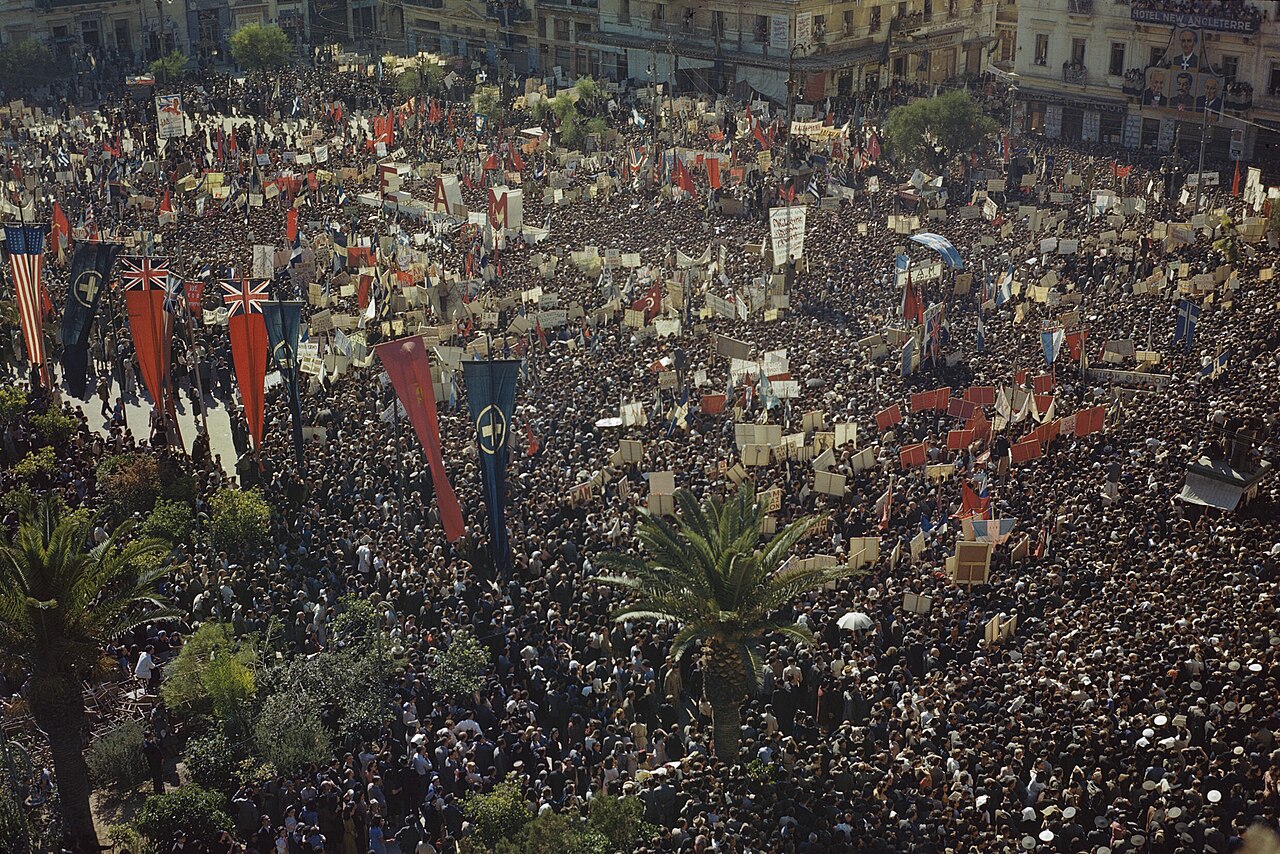
On 12 October 1944, the last main German forces leave Athens. The day is the liberation of the capital, not the simultaneous liberation of every Greek region: the withdrawal unfolds gradually, and German garrisons still remain on the islands.
On 18 October, the national unity government of Papandreou arrives in Athens together with British forces. The King remains outside Greece, as the constitutional issue has been postponed for a referendum. The government is called upon to restore administration and the economy, to punish collaboration, and, most importantly, to create a unified national army.
The liberated capital celebrates, but the country does not start from a neutral point. In much of the countryside, EAM possesses administrative institutions, and ELAS has military superiority. The government relies on international recognition and British power. The police and the state mechanism carry, in parallel, the burden of the dictatorship and the Occupation.
The agreement on disarmament collapses. EAM considers the exceptions provided for government units such as the 3rd Mountain Brigade and the Sacred Band to be unequal, while the government and the British fear that ELAS will maintain decisive military superiority. At the beginning of December, the EAM ministers resign from the government.
On 3 December, a large EAM demonstration at Syntagma Square receives fire from the police. About 20 to 30 demonstrators are killed and many more wounded, but the exact numbers and the full sequence of the first shots remain a subject of investigation and political controversy.
A general strike and open battle follow in Athens and Piraeus. ELAS clashes with the police, government units, anti-communist organisations, and increasingly powerful British forces. Former collaborators with the occupiers appear in some government formations and detention centres, which deepens mistrust; this does not mean that every government soldier or opponent of EAM was a collaborator.
Both sides engage in arrests and abuse, while ELAS moves thousands of hostages out of Athens and executes opponents or perceived opponents. British forces use artillery and aviation within the city. For the dead combatants, civilians, and hostages, there is no undisputed common account, nor should the categories be confused.
Winston Churchill arrives in Athens on Christmas and convenes a political conference, without an immediate agreement. On 31 December, Archbishop Damaskinos is sworn in as Regent. George II remains formally king abroad, but Damaskinos assumes the functions of head of state in Greece.
The year 1944 closes with battles still underway. The Liberation has not led to a commonly accepted state, army, or constitutional solution. The experience of famine, the Holocaust, occupation collaboration, reprisals, and civil violence has left a society exhausted and deeply divided.
In the next episode, we move to the years 1945–1949: to the end of the Battle of Athens, the Varkiza Agreement, post-war violence, and finally the Greek Civil War.
Find all episodes at ProjectGreece.gr, along with references, additional material, explanations, sources, and bibliography.
All episodes of the series are available for free on Spotify, Apple Podcasts, and YouTube Music.
ProjectGreece.
So the story can continue.
Sources & bibliography
This episode is linked to 56 documentation and rights records.
- Γενική Γραμματεία Νομικών και Κοινοβουλευτικών Θεμάτων, «Οι Κυβερνήσεις από το 1909 έως σήμερα», χρονολογικός πίνακας: https://gslegal.gov.gr/kyvernisi/istorika-stoixeia/?sort=timeCITATION_ONLYOpen source
- ΓΓ Νομικών Θεμάτων, «Κυβερνήσεις κατά τη διάρκεια της Εχθρικής Κατοχής», πλήρεις εγγραφές Τσολάκογλου, Λογοθετόπουλου και Ράλλη: https://gslegal.gov.gr/government/ralli-ioannou-2/CITATION_ONLYOpen source
- ΓΓ Νομικών Θεμάτων, κυβέρνηση Αλεξάνδρου Κορυζή, 29.1–20.4.1941: https://gslegal.gov.gr/government/korizi-alexandrou-2/CITATION_ONLYOpen source
- ΓΓ Νομικών Θεμάτων, κυβέρνηση Εμμανουήλ Τσουδερού στην Ελλάδα, 20.4–2.6.1941: https://gslegal.gov.gr/government/tsouderou-emmanouil-3/CITATION_ONLYOpen source
- ΓΓ Νομικών Θεμάτων, ελεύθερη κυβέρνηση εξωτερικού Τσουδερού, 2.6.1941–14.4.1944, και θεσμική σημείωση για ΠΕΕΑ: https://gslegal.gov.gr/government/tsouderou-emmanouil-2-2/CITATION_ONLYOpen source
- ΓΓ Νομικών Θεμάτων, κυβέρνηση Σοφοκλή Βενιζέλου, 14–26.4.1944: https://gslegal.gov.gr/government/venizelou-sofokleous-6/CITATION_ONLYOpen source
- ΓΓ Νομικών Θεμάτων, κυβερνήσεις Γεωργίου Παπανδρέου 1944–1945: https://gslegal.gov.gr/government/papandreou-georgiou-3-2/CITATION_ONLYOpen source
- *Foreign Relations of the United States, 1941*, Europe, vol.II, “The Axis War against Greece,” docs.595–747: https://history.state.gov/historicaldocuments/frus1941v02/ch19PUBLIC_DOMAIN_USGOVOpen source
- OSS Research and Analysis Branch. “Greece: Zones of Occupation,” 1944, pp.2–8, archived scan: https://www.elia.org.gr/userfiles/pdf_archieve/1944%2010-144%20Greek%20Government%2C%20Public%20Health%2C%20Press%2C%20Geography%2C%20Demography%2C%20Collaborators%2C%20Italian%20Troops%2C%20German%20Troops%2C%20Civil%20Administration%2C%20%5B52%20pgs%5D%20226-CID-41174%20%28OSS%29.pdfCITATION_ONLYOpen source
- Playfair, I. S. O. et al. *The Mediterranean and Middle East*, vols.I–II and IV. UK Official History, HMSO, 1954–1966, Greek campaign and El Alamein chapters.CITATION_ONLY
- Beevor, Antony. *Crete 1941: The Battle and the Resistance*. Revised ed., John Murray, 2005, chs.13–20.CITATION_ONLY
- Mazower, Mark. *Inside Hitler’s Greece: The Experience of Occupation, 1941–44*. Yale University Press, 1993, pp.1–326 and epilogue.CITATION_ONLY
- Hondros, John Louis. *Occupation and Resistance: The Greek Agony, 1941–44*. Pella, 1983, chs.1–8.CITATION_ONLY
- Fleischer, Hagen. *Στέμμα και Σβάστικα: Η Ελλάδα της Κατοχής και της Αντίστασης, 1941–1944*. 2 vols., Παπαζήσης, 1988–1995.CITATION_ONLY
- Hionidou, Violetta. *Famine and Death in Occupied Greece, 1941–1944*. Cambridge University Press, 2006, chs.2–10, esp. pp.103–225. DOI/title record: https://www.cambridge.org/9780521829328CITATION_ONLYOpen source
- Hionidou, Violetta. “Relief and Politics in Occupied Greece, 1941–4.” *Journal of Contemporary History* 48.4 (2013), 752–768. DOI: https://doi.org/10.1177/0022009413493947CITATION_ONLYOpen source
- International Committee of the Red Cross, archives B SEC CGSG, “Commission de gestion des secours en Grèce, 1940–1946”: https://www.icrc.org/sites/default/files/external/doc/en/assets/files/other/b_sec_cgsg.pdfCITATION_ONLYOpen source
- ICRC. *Ravitaillement de la Grèce pendant l’occupation 1941–1944 et pendant les premiers cinq mois après la libération: rapport final*. Geneva, 1949. Archival description: https://blogs.icrc.org/cross-files/the-icrc-during-world-war-ii/CITATION_ONLYOpen source
- Woodhouse, C. M. *The Apple of Discord: A Survey of Recent Greek Politics in Their International Setting*. London, 1948, chs.3–8. Participant account; use critically.CITATION_ONLY
- Close, David H. *The Origins of the Greek Civil War*. Longman, 1995, pp.70–206.CITATION_ONLY
- Hart, Janet. “The Security Battalions and the Civil War.” *Journal of the Hellenic Diaspora* 10.1–2 (1983), 15–27.CITATION_ONLY
- ΕΡΤ Αρχείο, «Επιχείρηση Γοργοπόταμος — 25 Νοεμβρίου 1942», institutional locator only: https://www.ert.gr/ert-arxeio/epicheirisi-quot-gorgopotamos-quot-25-noemvrioy-1942/CITATION_ONLYOpen source
- Skalidakis, Yannis. “From Resistance to Counterstate: The Making of Revolutionary Power in the Liberated Zones of Occupied Greece, 1943–1944.” *Journal of Modern Greek Studies* 33.1 (2015), 155–184. DOI: https://doi.org/10.1353/mgs.2015.0000CITATION_ONLYOpen source
- Ίδρυμα της Βουλής, «Προοίμιο», γυναίκες και εκλογές ΠΕΕΑ 1944: https://foundation.parliament.gr/el/prooimioOFFICIAL_LINK_ONLYOpen source
- United States Holocaust Memorial Museum, Holocaust Encyclopedia, “Greece”: https://encyclopedia.ushmm.org/content/en/article/greeceCITATION_ONLYOpen source
- USHMM, “Salonika”: https://encyclopedia.ushmm.org/content/en/article/salonikaCITATION_ONLYOpen source
- USHMM, “Deportations to Killing Centers,” Southern Europe section: https://encyclopedia.ushmm.org/content/el/article/deportations-to-killing-centersCITATION_ONLYOpen source
- Jewish Museum of Greece, “The Good Shepherds—Metropolitans and Chief Rabbis in the Face of the Holocaust”: https://jewishmuseum.gr/en/psifiaki-ekthesi/the-good-shepherds-metropolitans-and-chief-rabbis-in-the-face-of-the-holocaust/CITATION_ONLYOpen source
- Jewish Museum of Greece, “Hidden Children in Occupied Greece”: https://jewishmuseum.gr/en/psifiaki-ekthesi/hidden-children-in-occupied-greece/CITATION_ONLYOpen source
- Jewish Museum of Greece, *Memory, Acceptance, Solidarity — Greece*, educational logbook, pp.10–12: https://education.jewishmuseum.gr/wp-content/uploads/2022/10/Logbook-final.pdfCITATION_ONLYOpen source
- Bowman, Steven B. *The Agony of Greek Jews, 1940–1945*. Stanford University Press, 2009, chs.3–8.CITATION_ONLY
- Antoniou, Giorgos, and A. Dirk Moses, eds. *The Holocaust in Greece*. Cambridge University Press, 2018, selected community studies.CITATION_ONLY
- Saltiel, Leon. *The Holocaust in Thessaloniki: Reactions to the Anti-Jewish Persecution, 1942–1943*. Routledge, 2020. Earlier dissertation with occupation-zone map: https://dspace.lib.uom.gr/bitstream/2159/20301/1/SaltielLeonPhD2017.pdfCITATION_ONLYOpen source
- Ίδρυμα της Βουλής, εκπαιδευτικό dossier «Ναζισμός», παράρτημα Β, πίνακας τόπων/ημερομηνιών: https://foundation.parliament.gr/VoulhFoundation/VoulhFoundationPortal/images/site_content/voulhFoundation/file/Ekpaideytika%20New/nazismos/4_2nazismos.pdfOFFICIAL_LINK_ONLYOpen source
- “Memories of the Occupation in Greece,” Freie Universität Berlin / National and Kapodistrian University of Athens, “Important Terms,” Kalavryta/Distomo: https://www.occupation-memories.org/en/deutsche-okkupation/Wichtige-Begriffe/index.htmlCITATION_ONLYOpen source
- Meyer, Hermann Frank. *Blutiges Edelweiss: Die 1. Gebirgs-Division im Zweiten Weltkrieg*. Ch. Links, 2008, Greek operations chapters.CITATION_ONLY
- Κωστόπουλος, Τάσος. *Η αυτολογοκριμένη μνήμη: Τα Τάγματα Ασφαλείας και η μεταπολεμική εθνικοφροσύνη*. Αθήνα: Φιλίστωρ, 2005, ιδίως pp.16–19 και οι ενότητες για τη δημόσια μνήμη του Μελιγαλά.CITATION_ONLY
- Kalyvas, Stathis N. «Η γεωγραφία της εμφύλιας βίας στην κατοχική Μεσσηνία: Μια ποσοτική προσέγγιση», pp.1–24, ιδίως pp.4–6. Author-hosted manuscript: https://stathiskalyvas.com/wp-content/uploads/2016/01/messinia-kalyvas-revised.pdfCITATION_ONLYOpen source
- *Foreign Relations of the United States, 1944*, vol.V, doc.110 και μεταγενέστερα Greece documents: https://history.state.gov/historicaldocuments/frus1944v05/d110PUBLIC_DOMAIN_USGOVOpen source
- “National Charter / Lebanon Agreement,” approved 20 May 1944, English translation in US diplomatic file, archived scan: https://www.elia.org.gr/userfiles/pdf_archieve/1944%207-1044%20Lebanon%20Conference%2C%20Papandreou%2C%20%5B6%20pgs%5D%20226-CID-83257%20%28State%29.pdfCITATION_ONLYOpen source
- Caserta Agreement, 26 September 1944. Text reproduced in John T. Malakasses, “British Diplomacy on Greece 1943–44,” appendix A: https://olympias.lib.uoi.gr/jspui/bitstream/123456789/30461/1/The%20British%20Diplomacy%20on%20Greece%201943-1944.pdfCITATION_ONLYOpen source
- Iatrides, John O. *Revolt in Athens: The Greek Communist “Second Round,” 1944–1945*. Princeton University Press, 1972, chs.2–8, esp. pp.119–260.CITATION_ONLY
- Haralambidis, Menelaos. *Δεκεμβριανά 1944: Η μάχη της Αθήνας*. Αλεξάνδρεια, 2014, relevant operational and casualty chapters.CITATION_ONLY
- Papastratis, Procopis. *British Policy towards Greece during the Second World War, 1941–1944*. Cambridge University Press, 1984, chs.8–10.CITATION_ONLY
- Παπανδρέου, Γεώργιος. *Η Απελευθέρωσις της Ελλάδος*. Αθήνα, 1945. Συλλογή λόγων/εγγράφων· χρήση ως πρωτογενής πολιτική πηγή, όχι ουδέτερη αφήγηση.CITATION_ONLY
- Clogg, Richard. *A Concise History of Greece*. 3rd ed., Cambridge University Press, 2013, pp.119–140.CITATION_ONLY
- Jewish Museum of Greece, “The Jewish Community of Ioannina — A Journey Through Time,” ενότητα Holocaust/25 March 1944: https://jewishmuseum.gr/en/psifiaki-ekthesi/the-jewish-community-of-ioannina-a-journey-through-time/CITATION_ONLYOpen source
- Jewish Museum of Greece, “At the Crossroads: The Jewish Community of Corfu,” ενότητα German occupation and deportation, June 1944: https://jewishmuseum.gr/en/psifiaki-ekthesi/at-the-crossroads-the-jewish-community-of-corfu/CITATION_ONLYOpen source
- *Foreign Relations of the United States, 1944*, vol.V, doc.157, “The Situation in Greece,” including the resignations, 3 December police fire and contemporary casualty report: https://history.state.gov/historicaldocuments/frus1944v05/d157PUBLIC_DOMAIN_USGOVOpen source
- UK Parliament, Hansard, “Greece (Disturbances, Athens),” HC Deb 5 December 1944, vol.406, cc.356–365: https://api.parliament.uk/historic-hansard/commons/1944/dec/05/greece-disturbances-athensOPEN_PARLIAMENT_LICENCE_3.0Open source
- Hellenic Parliament, historical chronology, entry 31 December 1944, appointment of Archbishop Damaskinos as Regent: https://www.hellenicparliament.gr/UserFiles/8c3e9046-78fb-48f4-bd82-bbba28ca1ef5/2009_CATALOG_KTHRIO.pdfCITATION_ONLYOpen source
- Η συμμετοχή στο Ελ Αλαμέιν αποδίδεται χωρίς αναπαραγωγή προστατευμένου κειμένου ή μη αναγκαίο αριθμητικό claim.CITATION_ONLY
- Η Συμφωνία της Καζέρτας περιγράφεται πραγματολογικά· δεν γίνεται αυτούσια παράθεση ούτε αποδίδεται μη επαληθευμένη λεπτομέρεια υπογραφών.CITATION_ONLY
- Δεν δημοσιεύεται ακριβής κάρτα θυμάτων για τον Μελιγαλά· το audio διαχωρίζει μάχη και μεταγενέστερες εκτελέσεις χωρίς ενιαίο σύνολο.CITATION_ONLY
- Δεν δημοσιεύεται community infographic· το audio χρησιμοποιεί ελεγμένες επιμέρους ιστορίες κοινοτήτων και δηλώνει τη γεωγραφική βάση των αριθμών.CITATION_ONLY
- Κάθε φωτογραφία, χάρτης, προκήρυξη ή ηχητικό αρχείο παραμένει `ITEM_LEVEL_REVIEW — PUBLICATION PENDING`.CITATION_ONLY