Karamanlis, Papandreou and European integration
Democratic consolidation, EEC accession, political change and the realignments of the 1980s.
Audio will be added after final production.
In this episode
Democratic consolidation, EEC accession, political change and the realignments of the 1980s.
Full transcript
The complete English transcript of this episode is available to read.
ProjectGreece.
The History of Greece, from 1800 to today.
A twenty-episode series that recounts the journey of modern Greece with sobriety, composure, and documentation.
Seventeenth episode.
1976–1989: Karamanlis, Papandreou, and European integration.
Welcome to another episode of the series "The History of Greece, from 1800 to today."
In the previous episode, we reached the end of 1975. The dictatorship had collapsed amidst the Cyprus crisis, democracy had been restored, the monarchy had been abolished, and the new Constitution had come into effect. However, we left Greece with Cyprus divided, Greek-Turkish relations tense, and society demanding not only political normalcy but also rights and social change.
We are now in 1976. The President of the Republic is Konstantinos Tsatsos and the Prime Minister is Konstantinos Karamanlis. The 1975 Constitution begins to be tested in practice: legal political parties, free elections, parliamentary oversight, and political freedoms solidify the Metapolitefsi, without eliminating conflicts over the state, the economy, and foreign policy.
In 1976, the Dimotiki (modern Greek) language is established in education. The change is not merely linguistic: it institutionally closes a dispute that had caused crises as early as the Evangelika and the Oresteiaka. At the same time, the government organizes the functioning of the new constitutional institutions and continues the removal of the military from political power.
Democratic consolidation is also visible in daily life. Trade unions, student associations, women’s organizations, and local movements acquire a public voice. The press operates without prior censorship, while television remains state-controlled and thus a field of government influence. Politicization is intense, but political conflict now shifts primarily to institutions, elections, and protests.
In August 1976, the Turkish research vessel "Hora," known in Greece as "Sismik," conducts surveys in the Aegean. Greece appeals to the Security Council and the International Court of Justice. The crisis de-escalates, and in November the Bern Protocol is signed, with a commitment to refrain from actions that would hinder negotiations on the continental shelf.
The International Court of Justice rules in 1978 that it does not have jurisdiction to examine the Greek appeal unilaterally. It does not judge which country is in the right regarding the delimitation. The distinction is essential: a decision on jurisdiction is not a decision on the merits, and the Greek-Turkish dispute remains open.
In the elections of 20 November 1977, New Democracy maintains the government with a smaller majority. PASOK, led by Andreas Papandreou, emerges as the official opposition, while the Union of the Democratic Centre declines. The party system is transformed rapidly: the main confrontation gradually shifts from New Democracy and the forces of the old Centre to New Democracy and PASOK.
The legal parliamentary presence of the KKE (Communist Party of Greece) and the other forces of the Left also means that a historical political space is no longer outside the constitutional system. The break with the post-Civil War state is not completed in a single day, but the alternation of power gradually ceases to be viewed as a threat to the political system itself.
A central goal of Karamanlis is full membership in the European Communities. The negotiations, which began in 1976, concern agriculture, tariffs, transition periods, and the adaptation of Greek law. Supporters foresee economic development and democratic protection. PASOK and the Left at the time raise fears of dependency, unequal competition, and the restriction of national economic policy.
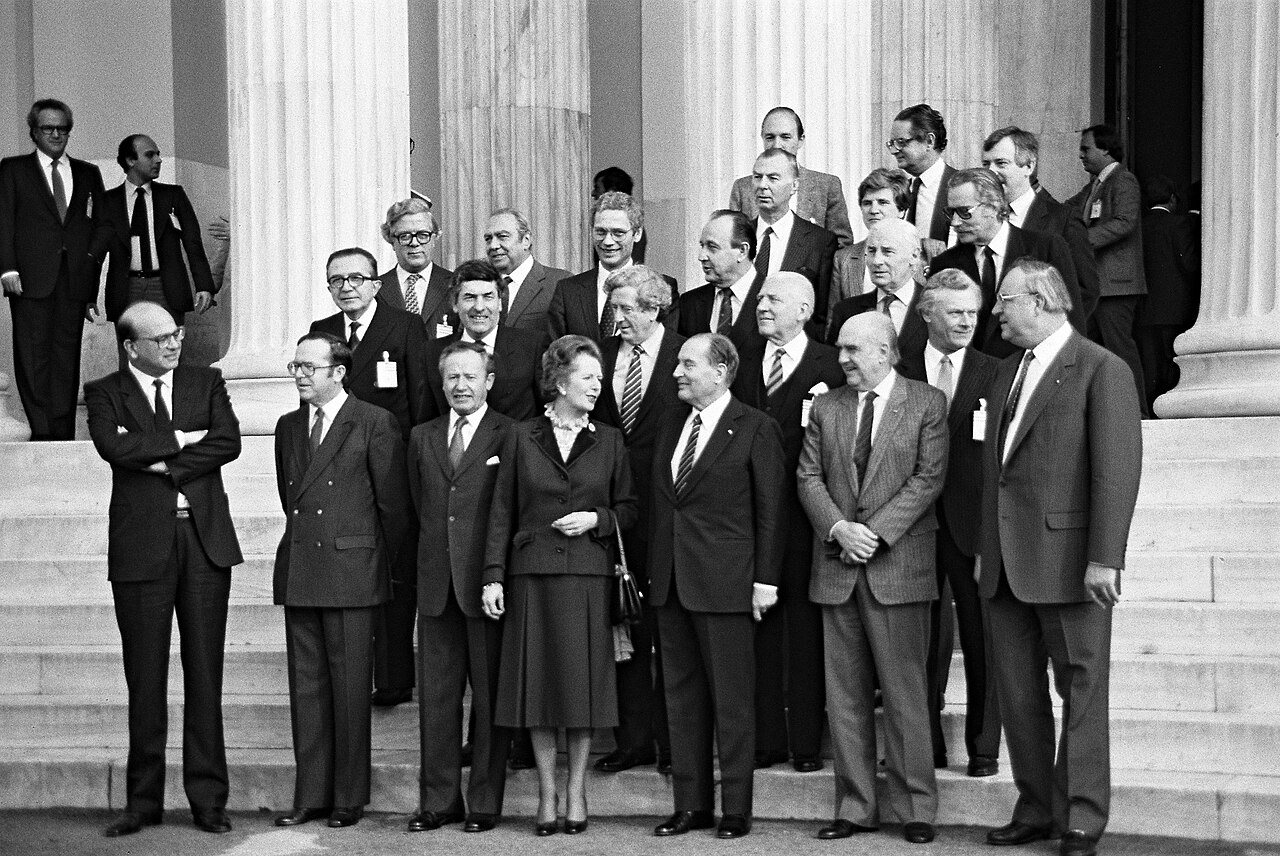
On 28 May 1979, the Treaty of Accession is signed at the Zappeion. This date marks the signing, not the beginning of membership. Ratifications by parliaments and transitional preparations follow. Greece will become the tenth member of the European Communities on 1 January 1981.
The economy, meanwhile, faces the second oil crisis, high inflation, and a slowdown. The post-dictatorship expansion of wages, social demands, and state intervention meets low productivity and energy dependency. There is no single cause for the deterioration: international shocks, domestic weaknesses, and policy choices interact.
Society has already changed deeply. Athens and Thessaloniki concentrate population, services, and industry, while agricultural employment declines. More young people are studying and more women are seeking paid employment. Expectations for housing, consumption, health, and education grow faster than the state's ability to cover them equitably.
In May 1980, Karamanlis is elected President of the Republic, succeeding Tsatsos. Georgios Rallis becomes Prime Minister. The change takes place within the rules of the Constitution, but New Democracy enters a period of attrition and internal soul-searching after the departure of its founder from government leadership.
In October 1980, Greece returns to the integrated military structure of NATO, from which it had withdrawn its forces in 1974. It had not withdrawn from the Alliance itself. The return seeks to strengthen the country's position in the Aegean, but it causes intense internal confrontation.
On 1 January 1981, Greece officially becomes a member of the EEC and the other European Communities. Membership opens access to community funding and the common market, but imposes adaptation to common rules and more intense competition. The results vary by sector and region; it is neither an automatic economic miracle nor a single act of dependency.
Farmers join the Common Agricultural Policy, businesses face a gradual reduction in tariff protection, and the state participates in the making of community decisions. Funding supports incomes and projects, but can also encourage consumption without corresponding productive restructuring. European integration becomes a permanent framework for Greek policy, even for those who had opposed it.
In the elections of 18 October 1981, PASOK wins approximately 48% and 172 seats. Andreas Papandreou forms a government on 21 October. The "Allagi" (Change) signifies the first majority socialist government and the integration into state power of social groups that felt they had been excluded from the post-Civil War order.
The handover of power from Rallis to Papandreou takes place smoothly. The moment has institutional value beyond the electoral result: the Right accepts defeat, PASOK takes over without interference from the military or the President, and the first major alternation of the Metapolitefsi confirms that the rules can withstand a radical change of political rhetoric and personnel.
In 1982, the National Resistance is institutionally recognized, with the political and symbolic inclusion of organizations that had been excluded from the official post-war memory. The recognition contributes to overcoming old divisions, without resolving all disagreements regarding the Civil War, the organizations, and the memory of the Occupation.
Simultaneously, the repatriation of many political refugees from the Civil War is facilitated. The regulation, however, concerns those characterized as "Greeks by descent" and leaves out a portion of Slavic-speaking refugees. Even a policy of national reconciliation therefore has limits, which must be reported without cancelling the significance of the return of thousands of people.
In the same year, civil marriage is established as an equal option and the monotonic system is introduced. In 1983, the reform of family law establishes the equality of spouses, abolishes the dowry and parental authority as an exclusively male principle, and reshapes divorce and the relationships between parents and children.
The laws do not change daily life immediately. Women continue to face wage inequalities, limited representation, and unequal distribution of care work. They do, however, create new legal tools and change the institutional framework within which equality is claimed.
In 1983, the National Health System is founded. The goal is more universal access, public hospitals, and health centers, particularly in the provinces. The expansion of services constitutes a major social milestone, but implementation is accompanied by staff shortages, administrative difficulties, and long-standing tensions between the public and private sectors.
For rural residents, the creation of health centers reduces distances that previously made even basic care difficult. For doctors and hospitals, full-time and exclusive employment and the new organization change professional balances. The NHS is not born complete; it is built gradually and unevenly.
The government increases minimum wages, pensions, and social spending, strengthens trade union protection, and expands public employment. The policies improve incomes and access to services for many citizens. At the same time, without a corresponding increase in revenue and productivity, they fuel deficits, inflation, and borrowing.
The Automatic Indexation System attempts to protect wages from rising prices. In conditions of persistent inflation, however, it also fuels a difficult cycle of prices, wages, and devaluations. Social redistribution and macroeconomic imbalance are not two unrelated stories; they are simultaneous aspects of the same political period.
With the law on "problematic enterprises," the state takes over or restructures over-indebted industries to prevent closures and unemployment. In some cases, jobs are maintained; in others, losses are prolonged and liabilities are transferred to the public sector. Deindustrialization is not due to a single government: it is also linked to international competition, the EEC, the energy crisis, and older structural weaknesses.
In foreign policy, the Papandreou government uses harsh rhetoric regarding NATO, American bases, and the EEC, but does not withdraw from these institutions. In 1983, a defense and economic cooperation agreement is signed with the United States, which allows for the continued operation of American military installations and can be terminated after five years with written notice.
The distance between opposition promise and government practice is interpreted differently: as a realistic adaptation, as a retreat, or as an attempt to negotiate from within the alliances. The certain fact is that Greece's position in the EEC and NATO is maintained.
In November 1983, the Turkish-Cypriot administration unilaterally declares the "Turkish Republic of Northern Cyprus." The Security Council, with resolution 541, considers the declaration legally invalid and calls on states not to recognize it. Only Turkey recognizes it. The division of Cyprus is solidified without an internationally accepted solution.
In March 1985, Papandreou does not support a second presidential term for Karamanlis and proposes the judge Christos Sartzetakis. Karamanlis resigns. From 10 March until Sartzetakis assumes office on 30 March, the Speaker of Parliament, Ioannis Alevras, acts as his temporary replacement. The election of Sartzetakis on 29 March is concluded amidst great tension, with disagreements over the procedure and the colored ballots.
PASOK wins the elections of 2 June 1985 again, and Papandreou forms a second government. In July, the European Community establishes the Integrated Mediterranean Programs, with particular emphasis on Greece. Their implementation in the following years adds community funds for infrastructure and regional adjustment.
In the autumn of 1985, faced with high inflation and an external deficit, the government implements a stabilization program under Minister Kostas Simitis: devaluation of the drachma, limitation of wage increases, and stricter economic policy. The program improves certain indicators but reduces real incomes and causes strong social reactions. It relaxes before the end of the decade.
In March 1986, the revision of eleven articles of the Constitution is completed. The strong interventionist powers the President had since 1975 are significantly limited, and the system becomes more clearly prime-minister-centered and parliamentary.
Supporters of the revision consider that it removes a potential center of conflict with the elected government. Its critics argue that it reduces institutional counterweights and concentrates excessive power in the Prime Minister. Both readings concern a real change: after 1986, the President remains a regulator of the political system, but with a much more limited possibility of autonomous political intervention.
In July 1986, artificial termination of pregnancy is regulated by law, with terms of consent, health, and time limits. The change expands the ability of women to decide legally and with medical care regarding pregnancy.
In March 1987, a new sortie of "Sismik" causes a serious Greek-Turkish crisis. The two countries increase military readiness and for a few days the risk of conflict is real. The research vessel does not eventually conduct research in the disputed waters and the tension de-escalates through diplomatic interventions.
In January 1988, Papandreou and Turkish Prime Minister Turgut Özal meet in Davos. They agree to reduce tension and promote dialogue. The so-called "Davos process" temporarily improves the climate, without solving the continental shelf, Cyprus, or the sum of the differences.
As the decade approaches its end, inflation remains very high, often close to 20%, growth is low, and unemployment is higher than in the 1970s. Public debt as a percentage of national product has increased from a relatively low base to a multiple level. The exact ratios change with the statistical series and later revisions; what is certain is the magnitude and the speed of the deterioration, not a single "eternal" number.
The picture is not the same for everyone. Community subsidies, tourism, and construction support incomes, while public employment offers security to new social strata. Conversely, several manufacturing businesses close or shrink, and unemployment affects young people and women in particular. The prosperity of some households coexists with the weakening of the productive base.
From 1988, the case of the Bank of Crete and businessman George Koskotas develops into a major political crisis. Journalistic and judicial investigations link embezzlement and illegal funding to government and party factors. Criminal responsibilities must be assigned only on the basis of indictments and decisions, not by the collective incrimination of entire factions.
The case coincides with Papandreou’s illness and an acute conflict between the government, the opposition, and the press. Political language becomes personal and often toxic. Real questions of transparency coexist with party instrumentalization, which is why the narrative separates what had been documented until 1989 from what would be judged judicially later.
In the elections of 18 June 1989, New Democracy, led by Konstantinos Mitsotakis, receives 44.28% and 145 seats, without a majority. The electoral system that the previous majority had established makes the formation of a single-party government difficult. New Democracy and the Coalition of the Left and Progress form a coalition government under Tzannis Tzannetakis on 2 July.
The cooperation of opponents with deep historical differences is presented as a government of "catharsis" and undertakes to investigate the scandals. Parliament refers Andreas Papandreou and former ministers to the Special Court. The referral is not a conviction; the subsequent trial and the decisions belong to the next period.
For part of the Left, the participation in the government symbolizes a definitive end to the exclusions of the Civil War. For others, it constitutes a political partnership with the historical opponent and causes deep division. The same act can therefore be read as institutional maturity, as tactical compromise, or as a political mistake; the fact of the cooperation remains common.
The Tzannetakis government resigns in October. A caretaker government under the President of the Supreme Court, Ioannis Grivas, leads the country to the elections of 5 November. Again, no majority emerges. On 23 November, an ecumenical government is formed under the academic and former Governor of the Bank of Greece, Xenophon Zolotas, with the participation of New Democracy, PASOK, and the Coalition.
On 31 December 1989, Greece has experienced two peaceful alternations of government, a major social reform, and integration into the European community. It has also accumulated economic imbalances and deep party polarization. Coalition governments prove that the Constitution can function without a majority, but the political crisis has not yet ended.
In the next episode, we move to the years 1990–2003: the Mitsotakis government, the Macedonian issue, the return and succession of Papandreou, and the path towards the euro.
Find all episodes at ProjectGreece.gr, along with references, additional material, explanations, sources, and bibliography.
All episodes of the series are available for free on Spotify, Apple Podcasts, and YouTube Music.
ProjectGreece.
So the story can continue!
Sources & bibliography
This episode is linked to 41 documentation and rights records.
- Βουλή των Ελλήνων, «Συνταγματική Ιστορία», ενότητα αναθεώρηση 1986: https://www.hellenicparliament.gr/Vouli-ton-Ellinon/To-Politevma/Syntagmatiki-IstoriaOFFICIAL_LINK_ONLYOpen source
- Βουλή των Ελλήνων, «Εκλογικά Αποτελέσματα», αναμετρήσεις 1977, 1981, 1985, Ιουνίου/Νοεμβρίου 1989: https://www.hellenicparliament.gr/Vouli-ton-Ellinon/To-Politevma/Ekloges/Eklogika-apotelesmata-NewOFFICIAL_LINK_ONLYOpen source
- Γενική Γραμματεία Νομικών και Κοινοβουλευτικών Θεμάτων, «Οι Κυβερνήσεις από το 1909 έως σήμερα»: https://gslegal.gov.gr/kyvernisi/istorika-stoixeia/CITATION_ONLYOpen source
- ΓΓΝΚΘ, κυβέρνηση Καραμανλή 1977–80: https://gslegal.gov.gr/government/karamanli-g-konstantinou-7-2/CITATION_ONLYOpen source
- ΓΓΝΚΘ, κυβέρνηση Παπανδρέου 1981–85: https://gslegal.gov.gr/government/papandreou-andrea-4/CITATION_ONLYOpen source
- ΓΓΝΚΘ, κυβέρνηση Παπανδρέου 1985–89: https://gslegal.gov.gr/government/papandreou-andrea-2-2/CITATION_ONLYOpen source
- ΓΓΝΚΘ, κυβέρνηση Τζαννετάκη: https://gslegal.gov.gr/government/tzannetaki-tzanni-2/CITATION_ONLYOpen source
- ΓΓΝΚΘ, υπηρεσιακή κυβέρνηση Γρίβα: https://gslegal.gov.gr/government/griva-ioanni-2/CITATION_ONLYOpen source
- ΓΓΝΚΘ, κυβέρνηση Ζολώτα: https://gslegal.gov.gr/government/zolota-xenofonta-2/CITATION_ONLYOpen source
- Προεδρία της Δημοκρατίας, Κωνσταντίνος Τσάτσος: https://www.presidency.gr/konstantinos-tsatsos/CITATION_ONLYOpen source
- Προεδρία της Δημοκρατίας, Κωνσταντίνος Καραμανλής: https://www.presidency.gr/konstantinos-karamanlis/CITATION_ONLYOpen source
- Προεδρία της Δημοκρατίας, Χρήστος Σαρτζετάκης: https://www.presidency.gr/christos-sartzetakis-el/CITATION_ONLYOpen source
- Βουλή, *Πρωθυπουργοί και Πρόεδροι της Βουλής*, λήμμα Ιωάννη Αλευρά: https://www.hellenicparliament.gr/UserFiles/8c3e9046-78fb-48f4-bd82-bbba28ca1ef5/2007_%CE%A0%CE%A1%CE%A9%CE%98%CE%A5%CE%A0%CE%9F%CE%A5%CE%A1%CE%93%CE%9F%CE%99%20%CE%9A%CE%91%CE%99%20%CE%A0%CE%A1%CE%9F%CE%95%CE%94%CE%A1%CE%9F%CE%99_1.pdfOFFICIAL_LINK_ONLYOpen source
- EUR-Lex, Act concerning the conditions of accession of Greece, OJ L291, 19.11.1979, arts 1–3: https://eur-lex.europa.eu/eli/treaty/acc_1979/act_1/sign/engPD_TEXT / SCAN_LINK_ONLYOpen source
- CVCE, Treaty of Accession, Athens 28.5.1979: https://www.cvce.eu/obj/en-c0f4782f-969a-4b20-8992-c1ede3370164PD_TEXT / SCAN_LINK_ONLYOpen source
- Council of the EU, accession timeline, Greece 1.1.1981: https://www.consilium.europa.eu/el/policies/how-enlargement-works/timeline-accession-eu-member-states/CITATION_ONLYOpen source
- ICJ, *Aegean Sea Continental Shelf*, Judgment 19.12.1978, Case 62: https://www.icj-cij.org/node/103115CITATION_ONLYOpen source
- UN Security Council Resolution 395 (1976): https://docs.un.org/S/RES/395(1976)CITATION_ONLYOpen source
- UN Security Council Resolution 541 (1983): https://docs.un.org/S/RES/541(1983)CITATION_ONLYOpen source
- Ν.309/1976, ΦΕΚ Α΄100, «Οργάνωσις και διοίκησις της Γενικής Εκπαιδεύσεως».CITATION_ONLY
- Ν.1285/1982, ΦΕΚ Α΄115, «Αναγνώριση της Εθνικής Αντίστασης».CITATION_ONLY
- Ν.1250/1982, ΦΕΚ Α΄46, «Για την καθιέρωση του πολιτικού γάμου»: https://api.et.gr/apiLAW/1/1982/1250/pdfCITATION_ONLYOpen source
- Ν.1329/1983, ΦΕΚ Α΄25, οικογενειακό δίκαιο· ΓΓ Ισότητας: https://isotita.gr/nomothesia/ethniki-nomothesia/CITATION_ONLYOpen source
- Ν.1397/1983, ΦΕΚ Α΄143, «Εθνικό Σύστημα Υγείας».CITATION_ONLY
- Ν.1386/1983, ΦΕΚ Α΄107, «Οργανισμός Οικονομικής Ανασυγκρότησης Επιχειρήσεων».CITATION_ONLY
- Ν.1609/1986, ΦΕΚ Α΄86, τεχνητή διακοπή εγκυμοσύνης: https://nomothesia.0012.syzefxis.gov.gr/index.php/poiniko-dikaio/724-nomos-1609-1986-fek-a-86-texniti-diakopi-tis-egkymosynis-prostasia-tis-ygeias-tis-gynaikas-kai-alles-diatakseis.htmlCITATION_ONLYOpen source
- OECD, *Economic Surveys: Greece 1990*, pp.9–48: https://www.oecd.org/content/dam/oecd/en/publications/reports/1990/01/oecd-economic-surveys-greece-1990_g1g17161/eco_surveys-grc-1990-en.pdfCITATION_ONLYOpen source
- Garganas, Nicholas C., and George S. Tavlas, “Monetary Regimes and Inflation Performance: The Case of Greece,” in Bank of Greece/Brookings, *Greece’s Economic Performance and Prospects*, pp.43–95: https://www.bankofgreece.gr/RelatedDocuments/Brookings_En.pdfOFFICIAL_LINK_ONLYOpen source
- Alogoskoufis, George, “The Historical and Institutional Background of the Greek Economy,” LSE Hellenic Observatory GreeSE Paper 198, sections 4–5: https://www.lse.ac.uk/Hellenic-Observatory/Assets/Documents/Publications/GreeSE-Papers/GreeSE-No198.pdfCITATION_ONLYOpen source
- NATO Archives, IMSM-0455-80, “Reintegration of Greece to the Integrated Military Structure of NATO,” 20.10.1980: https://archives.nato.int/reintegration-of-greece-to-the-integrated-military-structure-of-natoCITATION_ONLYOpen source
- ΚΥΑ 106841/29.12.1982, «Ελεύθερος επαναπατρισμός και απόδοση της Ελληνικής Ιθαγένειας στους πολιτικούς πρόσφυγες»· ακριβές κείμενο παρατίθεται σε κοινοβουλευτικό έγγραφο: https://www.hellenicparliament.gr/UserFiles/c0d5184d-7550-4265-8e0b-078e1bc7375a/7207531.pdfCITATION_ONLYOpen source
- Ν.1228/1982, ΦΕΚ Α΄15, κύρωση πράξης για την εισαγωγή του μονοτονικού συστήματος στη δημόσια διοίκηση και εκπαίδευση.CITATION_ONLY
- CIA, *The Aegean Dispute*, declassified assessment, section “A crisis erupted in March 1987”: https://www.cia.gov/readingroom/docs/CIA-RDP93T00837R000400040002-4.pdfCITATION_ONLYOpen source
- Dimitrakis, Panagiotis. “Greek Military Intelligence and the Turkish ‘Threat’ during the 1987 Aegean Crisis.” *Journal of Modern Greek Studies* 25:1 (2007), pp.99–127. DOI: https://doi.org/10.1353/mgs.2007.0002CITATION_ONLYOpen source
- LSE Hellenic Observatory, paper on Greek-Turkish relations, section on the 1987 crisis and 1988 Davos process: https://www.lse.ac.uk/Hellenic-Observatory/Assets/Documents/HO-PhD-Symposia/The-2nd-HO-PhD-Symposium/Session-2/Panel-2-Foreign-Policy-II.pdfCITATION_ONLYOpen source
- United Nations Treaty Series, vol.1590, no.27833, *Agreement on Defense and Economic Cooperation between the Government of the United States of America and the Government of the Hellenic Republic*, signed 8.9.1983, in force 20.12.1983, pp.117–124, esp. arts II and XII: https://treaties.un.org/doc/publication/UNTS/Volume%201590/v1590.pdfPD_TEXT / SCAN_LINK_ONLYOpen source
- Council Regulation (EEC) No 2088/85 of 23 July 1985 concerning the integrated Mediterranean programmes, OJ L197, 27.7.1985, pp.1–9: https://eur-lex.europa.eu/eli/reg/1985/2088/oj/engCITATION_ONLYOpen source
- Βουλή των Ελλήνων, *Η πρώτη αναθεώρηση του Συντάγματος του 1975 (1986)*, ενότητα για την αναθεώρηση έντεκα άρθρων και τον περιορισμό των προεδρικών αρμοδιοτήτων: https://www.hellenicparliament.gr/UserFiles/8c3e9046-78fb-48f4-bd82-bbba28ca1ef5/vouli_site_version.pdfOFFICIAL_LINK_ONLYOpen source
- Agnantopoulos, Apostolos, “The Europeanisation of Greek Foreign Policy: A Conceptual Framework and an Empirical Application in Greek-Turkish Relations,” paper submitted to the 2nd LSE Symposium on Modern Greece, 2005, pp.22–23, στο συλλογικό PDF της εγγραφής 35.CITATION_ONLY
- Panagiotou, Nikos, “The Role of the Press in Foreign Policy: A Critical Discourse Analysis of the Greek Press Coverage of Greek-Turkish Relations,” 2nd LSE Symposium on Modern Greece, 2005, pp.96–97, στο συλλογικό PDF της εγγραφής 35.CITATION_ONLY
- Ν.1847/1989, ΦΕΚ Α΄105/27.4.1989, «Αναλογική εκπροσώπηση των πολιτικών κομμάτων, διεύρυνση του εκλογικού δικαιώματος και άλλες διατάξεις για την εκλογή βουλευτών», επίσημη εγγραφή Βουλής: https://www.hellenicparliament.gr/en/nomothetiko-ergo/anazitisi-nomothetikou-ergou?law_id=d0e8dc0b-758d-45f0-9e15-a63a0147e432OFFICIAL_LINK_ONLYOpen source