Mitsotakis, Simitis and European convergence
Government changes, the Balkans, the euro, European convergence and the Athens Olympic Games.
Audio will be added after final production.
In this episode
Government changes, the Balkans, the euro, European convergence and the Athens Olympic Games.
Full transcript
The complete English transcript of this episode is available to read.
ProjectGreece.
The History of Modern Greece, from 1800 to today.
A twenty-part series narrating the journey of modern Greece with sobriety, composure, and documentation.
Eighteenth episode.
1990–2004: Mitsotakis, Simitis, and European convergence.
Welcome to another episode of the series "The History of Modern Greece, from 1800 to today."
In the previous episode, we reached the end of 1989. Greece had gone through the first PASOK government, the recognition of the National Resistance, social reforms and the expansion of the state, but also economic imbalances, scandals, and two parliamentary elections without a majority government. The Prime Minister was Xenophon Zolotas, head of an ecumenical government.
From 1990 to 2004, the country would move between economic liberalisation and social resistance, the wars of the post-Yugoslav era, and deeper European integration. It would change its currency, accept a large influx of migrants, experience the Imia crisis, and host the Olympic Games. "Convergence" is a political goal and a measurable European criterion; it does not mean that all social disparities disappear.
In the elections of 8 April 1990, New Democracy came first. With marginally secured parliamentary support, Konstantinos Mitsotakis formed a government on 11 April and ended the prolonged period of coalition governments and repeat elections. The President of the Republic was Christos Sartzetakis. On 4 May, Parliament re-elected Konstantinos Karamanlis, who took office on 5 May.
The government sought to limit deficits, privatise, liberalise markets, and restructure public enterprises. Changes in transport, labour relations, and the pension system triggered strikes and major reactions. Privatisation was not a single act: it included sales, liquidations, concessions, and partial entry of private entities, with different outcomes in each organisation.
The conflict also reached education. In January 1991, amidst a wave of school occupations, teacher Nikos Temponeras was murdered in Patras by an official of the New Democracy youth organisation during a violent attempt to reclaim a school. The mass demonstrations that followed led to the withdrawal of key educational measures and the resignation of the Minister of Education. The event showed how quickly an institutional disagreement could turn into political violence.
Following the collapse of the communist regimes, tens of thousands of people, mainly from Albania but also from other countries, crossed into Greece for work and security. Many lived without legal documents, exposed to deportation, exploitation, and racism, while their labour became critical in agriculture, construction, domestic services, and small businesses. Greece was rapidly transformed from a country of emigration into a country receiving immigrants.
The dissolution of Yugoslavia created wars on the northern borders. Greece participated in European and international institutions and applied sanctions, but public opinion often displayed a strong pro-Serbian stance, influenced by religious and historical references and distrust of the West. State policy, social solidarity towards Serbs, and individual sanctions violations should not be conflated into a single picture.
In 1991, the neighbouring federal republic declared independence as the "Republic of Macedonia." Greece reacted, considering that the name, the Star of Vergina on the flag, and certain constitutional formulations might imply historical appropriation or territorial claims. The other side maintained that the name expressed its own national and state identity. In 1992, the meeting of political leaders under Karamanlis rejected any name containing the term "Macedonia."
In 1992, Parliament ratified the Maastricht Treaty. The European Community was transformed into the European Union and set the course towards a common currency. Large parliamentary support did not exclude objections regarding democratic control, social policy, and fiscal constraints. From this point on, a large part of domestic economic policy would be presented as an adjustment to common European rules.
In April 1993, the new state was admitted to the UN under the provisional reference "The Former Yugoslav Republic of Macedonia." The dispute was not resolved. Within New Democracy, the clash between Mitsotakis and Antonis Samaras over the issue contributed to the loss of the government's majority. Elections were called for October.
On 10 October 1993, PASOK won the elections. Andreas Papandreou returned to the premiership on 13 October. The new government abandoned certain privatisations but did not fully return to the model of the 1980s. Fiscal adjustment and the European orientation remained, albeit with a different political vocabulary and pace.
In February 1994, Greece imposed a trade embargo on the neighbouring country, with the exception of humanitarian goods. The act triggered international criticism and a challenge by the European Commission.
On 10 March 1995, Kostis Stephanopoulos succeeded Karamanlis as President of the Republic, having been proposed by Political Spring and supported by PASOK. His election prevented the premature dissolution of Parliament and showed that the office could function as a field for broader consensus.
On 13 September 1995, the Interim Accord was signed in New York: the neighbouring country changed its flag and confirmed that its Constitution did not form the basis for territorial claims, while Greece lifted the embargo and did not prevent its participation in organisations under the provisional reference. The definitive name remained open.
Papandreou's health deteriorated. In November 1995, he was admitted to the Onassis Cardiac Surgery Centre and remained hospitalised, while the government operated without an active prime ministerial presence.
In December 1995, a ship running aground near Imia opened a dispute between Greece and Turkey over sovereignty on the two islets.
In January 1996, Papandreou resigned. The PASOK parliamentary group elected Kostas Simitis, and on 22 January, his first government was formed.
Almost immediately, the dispute escalated into a confrontation of flags, warships, and special forces. On the night of 30 to 31 January 1996, a Greek helicopter crashed, and three officers were killed. Through American mediation, the forces withdrew. The crisis ended without battle but left the disagreement over sovereignty and the term "grey zones" in Turkish argumentation.
In June, Andreas Papandreou died. In the elections of 22 September 1996, PASOK won, and Simitis formed a new government on 25 September. Central keywords were "modernisation" and "strong Greece": infrastructure projects, administrative changes, privatisations or share offerings, and adjustment to the criteria of the Economic and Monetary Union.
In 1997, the first major process of legalising immigrants began with the "white" and "green" cards. Registration gave many access to legal work, but deadlines, social security stamps, and bureaucracy left others out. Immigration renewed the workforce and changed schools and neighbourhoods, while public debate swayed between integration and security.
In the same year, the collapse of financial schemes in Albania caused armed unrest and a new exodus of the population. Greece participated in the multinational Operation Alba, under a UN Security Council mandate, to protect humanitarian aid. The relationship with Albania now included, simultaneously, security, economic interdependence, the Greek minority, and the daily presence of Albanian workers in Greece.
On 5 September 1997, Athens was selected for the 2004 Olympic Games. The preparation was linked to an airport, the metro, Attiki Odos, the suburban railway, sports facilities, and major redevelopment projects. Not everything was built exclusively "for the Games," nor did all projects have the same funding scheme. This distinction would become critical when costs were discussed.
In March 1998, the drachma joined the European Exchange Rate Mechanism, after its central parity was devalued. The government intensified efforts for lower inflation and deficits. Convergence improved key indicators but was accompanied by high interest rates, wage pressure, tax burdens, and scepticism regarding the sustainability of certain measures.
1999 was a year of successive crises. In February, Abdullah Öcalan was arrested in Kenya after having been hosted at the residence of the Greek ambassador. The handling of the affair triggered the resignation of ministers and a serious institutional crisis. In March, NATO began bombing the Federal Republic of Yugoslavia over Kosovo. Greece, a NATO member, did not withdraw and provided facilities and support for allied transport, but did not deploy Greek aircraft on bombing missions. The government declared its opposition to the bombings and sent humanitarian aid.
In the summer and autumn, earthquakes in Turkey and Athens prompted the mutual dispatch of rescue teams and accelerated the Greek-Turkish rapprochement.
In the same year, the rise of the Athens Stock Exchange attracted hundreds of thousands of small investors. The sharp drop that followed wiped out savings and generated allegations of manipulation and political responsibility. There is no single "lost money" figure that measures realised losses, market capitalisation drop, and opportunity profit in the same way.
In December, the Helsinki European Council, with the consent of Greece, recognised Turkey as a candidate for accession, within a framework of conditions and peaceful resolution of disputes. The approach did not solve the Aegean or the Cyprus issue, but it changed the diplomatic method.
The decade also changed news media. Private television, already present since 1989, gathered power, turned political confrontation into a daily spectacle, and became linked to business interests. Radio stations, magazines, and later the first news websites multiplied voices, without solving the problems of ownership, licensing, and intertwined interests.
On 8 February 2000, Kostis Stephanopoulos was re-elected President with a very large parliamentary majority. In the elections of 9 April, PASOK narrowly defeated New Democracy, and Simitis formed his third government on 13 April.
On 19 June 2000, the Council of the European Union decided that Greece met the conditions for the single currency. From 1 January 2001, the euro became the official currency of the country, initially in accounting and electronic transactions, with an irrevocable exchange rate of one euro to 340.75 drachmas. Drachma banknotes and coins remained in daily circulation.
Women increased their presence in universities and paid employment but continued to be underrepresented in politics and senior positions, and to bear a disproportionate burden of care. The constitutional revision of 2001 allowed for positive measures for equality, and legislation introduced quotas for certain collective bodies and on the ballots for municipal and prefectural elections. Legal progress does not equate to full equality in practice.
In 2001, the proposal for a deep pension reform, associated with Minister Tassos Giannitsis, triggered general strikes and was withdrawn. The conflict highlighted the difficulty of combining an ageing population, fragmented funds, tax evasion, and the protection of mature pension rights.
On 1 January 2002, euro banknotes and coins were released. For two months, the drachma and the euro coexisted; from 1 March, the euro was the only legal tender in transactions. The change facilitated payments and borrowing within the eurozone, but many citizens perceived price increases. Measuring the cost of living differs from the experience of specific daily purchases, which is why neither the official average price nor the generalisation that "everything doubled" is sufficient.
On 29 June 2002, after the injury of one of its members in a failed bombing attempt, the police dismantling of "17 November" began. Arrests followed, along with the discovery of the organisation's hideouts and materials. The dismantling closed a cycle of political violence that had begun in 1975, without making every accused person or relative collectively responsible.
In July 2002, a milder pension regulation was voted into law. The withdrawal of the initial proposal did not make the problem disappear; it postponed and reshaped the conflict.
By the end of this period, digital change had accelerated. Mobile telephony, which began commercially in 1993, became mass-market. The internet moved from universities and businesses into homes, while TAXIS and other electronic services gradually changed the relationship between the citizen and the state. Access, however, remained unequal by age, income, education, and region.
In March 2003, the major trial for "17 November" began. The proceedings were public but accompanied by intense confrontation over anti-terrorism legislation and media coverage.
On 16 April 2003, the Republic of Cyprus signed the Treaty of Accession to the European Union. Negotiations for the plan of UN Secretary-General Kofi Annan continued. Athens supported a solution within the European framework, but the final decision belonged to the two communities of Cyprus.
During the Greek presidency of the European Union, the Thessaloniki Summit in June 2003 confirmed the European perspective of the Western Balkans. It was an important political commitment, not a guarantee of automatic accession. Domestically, new immigration legislation attempted to link residence and work permits, but repeated legalisations showed that the administration did not yet have a stable integration mechanism.
In December, the first-instance trial concluded, with convictions and acquittals. The decision was not yet final.
On 7 March 2004, New Democracy won the elections, and on 10 March, Kostas Karamanlis became Prime Minister. On 24 April, separate referendums decided on the Annan plan: the vast majority of Greek Cypriots rejected it, and the majority of Turkish Cypriots approved it. On 1 May, the Republic of Cyprus joined the European Union, but the application of the acquis communautaire was suspended in the areas not under its control.
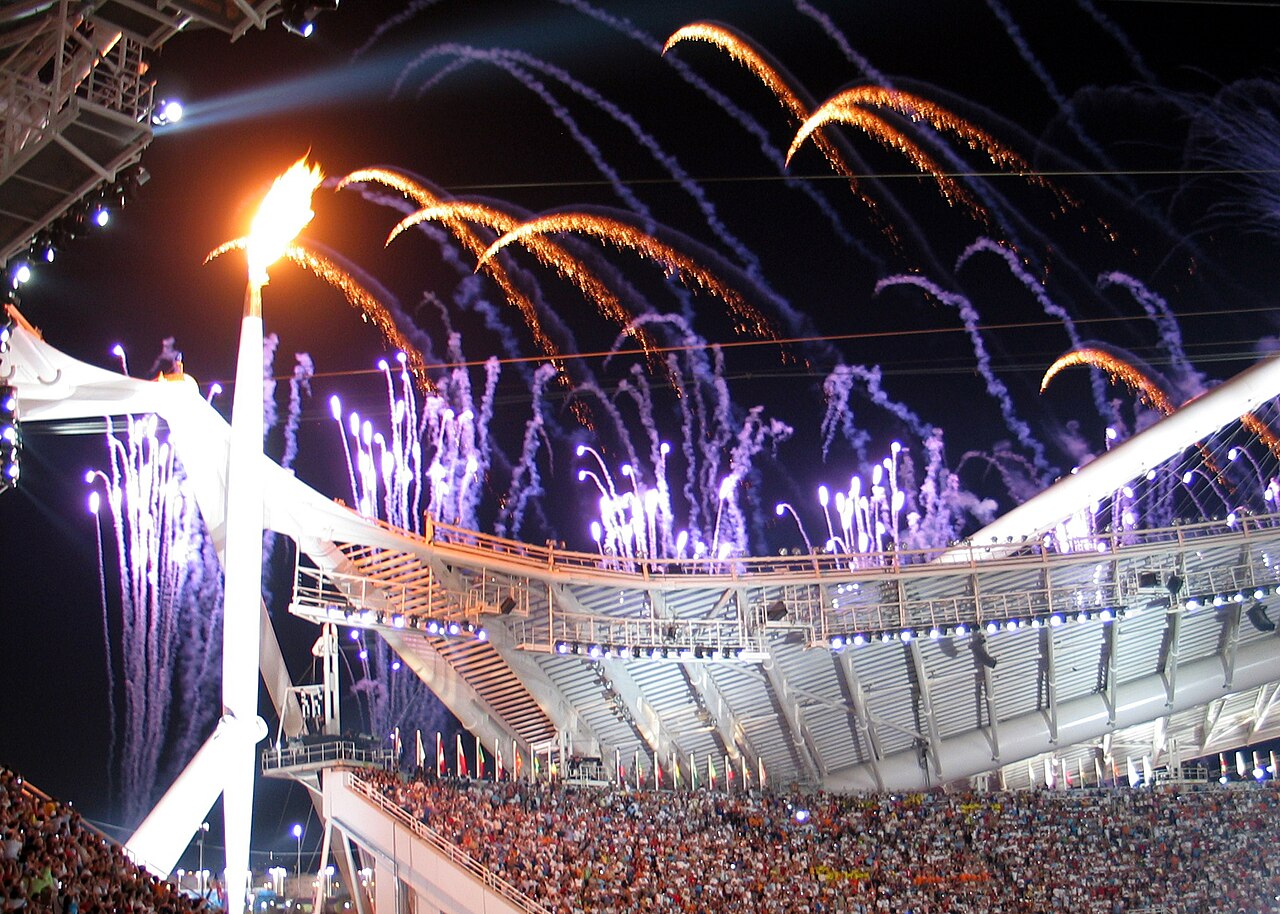
From 13 to 29 August, Athens hosted the Olympic Games, and in September, the Paralympic Games. The event was completed without the major failures many had feared and left behind new infrastructure and international visibility. By the end of 2004, however, the sustainable post-Olympic use of several facilities remained an open question.
The cost of the Games does not have an indisputable figure. Some assessments count only the organisational budget, while others add security, expropriations, transport, or projects that would have been built in any case. It is certain that there were overruns in individual components and that the facilities created long-term maintenance obligations. It is not accurate to retrospectively attribute the entire debt crisis to one event without an analysis of public debt, deficits, and statistical revisions.
During 2004, the new government conducted a fiscal audit, and Eurostat revised previous years' deficits upwards. The discussion became partisan, but the essential issue was institutional: changes in accounting classification, defence spending, and weak statistical control made comparisons difficult. The revisions did not prove by themselves that joining the euro was invalid, nor did they allow for the problems of reliability to be ignored.
On 31 December 2004, Kostis Stephanopoulos remained President and Kostas Karamanlis Prime Minister. Greece was a member of the eurozone, Cyprus a member of the European Union, and the major Olympic infrastructure had just been tested. At the same time, productivity, debt, regional inequalities, the integration of immigrants, transparency, and reliable public accountability remained open issues.
The period is not adequately described either as an uninterrupted "strong Greece" or as a simple preparation for a future collapse. European integration, infrastructure, the expansion of consumption, and digital change were real. Equally real were institutional delays, the unequal distribution of benefits, cheap borrowing, and fiscal risks. 2004 ended with self-confidence, but not with all problems solved.
In the next episode, from 2005 to 2015, we will see how these weaknesses met with the global financial crisis, the bailouts, and the deeper social and political upheaval of the post-junta era.
Find all episodes at ProjectGreece.gr,
along with references, additional material, explanations,
sources, and bibliography.
All episodes of the series are available for free
on Spotify, Apple Podcasts, and YouTube Music.
ProjectGreece.
So the story can continue.
Sources & bibliography
This episode is linked to 45 documentation and rights records.
- Γενική Γραμματεία Νομικών και Κοινοβουλευτικών Θεμάτων, government terms 1990–2004: https://gslegal.gov.gr/kyvernisi/istorika-stoixeia/CITATION_ONLYOpen source
- Προεδρία της Δημοκρατίας, former presidents: Christos Sartzetakis (term carried into 1990), Konstantinos Karamanlis (elected 4.5.1990) and Konstantinos Stephanopoulos (assumed 10.3.1995; re-elected 8.2.2000): https://www.presidency.gr/en/christos-sartzetakis-2/ ; https://www.presidency.gr/en/constantinos-karamanlhs/ ; https://www.presidency.gr/en/konstantinos-stephanopoulos/CITATION_ONLYOpen source
- Βουλή των Ελλήνων, election results/parliamentary periods 1990, 1993, 1996, 2000, 2004, official tables.OFFICIAL_LINK_ONLY
- Ν.2077/1992, κύρωση Συνθήκης Ευρωπαϊκής Ένωσης, ΦΕΚ Α΄136/7.8.1992.PD_TEXT / SCAN_LINK_ONLY
- UN Security Council Resolution 817 (1993), 7 April 1993, and UN General Assembly Resolution 47/225, 8 April 1993: https://undocs.org/S/RES/817(1993) and https://undocs.org/A/RES/47/225CITATION_ONLYOpen source
- UN, *Interim Accord between Greece and the Former Yugoslav Republic of Macedonia*, New York, 13 September 1995, UN Treaty Series 1891, no.32193, especially arts.6–7, 11 and 13.PD_TEXT / SCAN_LINK_ONLY
- UN Security Council Resolution 1101 (1997), Operation Alba, 28 March 1997: https://undocs.org/S/RES/1101(1997)CITATION_ONLYOpen source
- European Council, Helsinki Presidency Conclusions, 10–11 December 1999, enlargement/Turkey and disputes sections: https://www.europarl.europa.eu/summits/hel1_en.htmCITATION_ONLYOpen source
- European Central Bank, *Convergence Report 2000*, Greece and drachma tables: https://www.ecb.europa.eu/pub/pdf/conrep/cr2000en.pdfCITATION_ONLYOpen source
- Council Decision 2000/427/EC of 19 June 2000 on adoption by Greece of the single currency, OJ L167, p.19: http://data.europa.eu/eli/dec/2000/427/ojCITATION_ONLYOpen source
- ECB, *Monthly Bulletin*, January 2001, “Completion of the convergence process of Greece,” and irrevocable rate 340.750: https://www.ecb.europa.eu/pub/pdf/mobu/mb200101en.pdfCITATION_ONLYOpen source
- ECB, “Initial changeover (2002)” and press release 28.2.2002 on sole legal tender: https://www.ecb.europa.eu/euro/changeover/2002/html/index.en.html and https://www.ecb.europa.eu/press/pr/date/2002/html/pr020228.en.htmlCITATION_ONLYOpen source
- Bank of Greece, *Annual Report 1998*, exchange-rate mechanism and monetary policy chapters; *Annual Report 2000*, EMU accession.CITATION_ONLY
- ΠΔ 358/1997 and 359/1997, initial migrant regularization; Ν.2910/2001, entry/residence and naturalization framework.CITATION_ONLY
- Σύνταγμα της Ελλάδας, 2001 revision, art.116(2); Ν.2839/2000, participation quota in collective bodies; Ν.2910/2001, art.75(1), one-third gender quota on municipal and prefectural candidate lists; Ν.3029/2002, social insurance reform.CITATION_ONLY
- European Council, *Thessaloniki Agenda for the Western Balkans*, 19–20 June 2003 conclusions.CITATION_ONLY
- European Union, Treaty of Accession 2003, Cyprus provisions and Protocol 10 on Cyprus: https://eur-lex.europa.eu/legal-content/EN/TXT/?uri=CELEX:12003T/TXTCITATION_ONLYOpen source
- United Nations, *Comprehensive Settlement of the Cyprus Problem* / Annan Plan, final version 31 March 2004; Cyprus election authorities, referendum results 24 April 2004.CITATION_ONLY
- IOC, host-city vote, 106th Session, Lausanne, 5 September 1997; ATHOC, *Official Report of the XXVIII Olympiad*, vols.1–2, 2005, preparation and operations chapters.CITATION_ONLY
- Eurostat, *Report on the Revision of the Greek Government Deficit and Debt Figures*, 22 November 2004, especially pp.3–7 and annex tables: https://ec.europa.eu/eurostat/documents/4187653/5765001/GREECE-EN.PDF/2da4e4f6-f9f2-4848-b1a9-cb229fcabae3CITATION_ONLYOpen source
- EETT, annual electronic communications market reports, 1993–2004 mobile development tables; GSIS, TAXIS implementation reports.CITATION_ONLY
- Athens Exchange, official General Index historical series, 1998–2001; Hellenic Capital Market Commission annual reports 1999–2001.CITATION_ONLY
- Pagoulatos, George. *Greece’s New Political Economy: State, Finance, and Growth from Postwar to EMU*. Palgrave Macmillan, 2003, chs.8–10.CITATION_ONLY
- Featherstone, Kevin, ed. *The Challenge of Modernisation: Politics and Policy in Greece*. West European Politics special issue/book, 2005.CITATION_ONLY
- Featherstone, Kevin, and George Kazamias, eds. *Europeanization and the Southern Periphery*. Frank Cass, 2001, Greece chapters.CITATION_ONLY
- Triandafyllidou, Anna. “Racists? Us? Are You Joking? The Discourse of Social Exclusion of Immigrants in Greece and Italy.” In Russell King, Gabriella Lazaridis and Charalambos Tsardanidis, eds., *Eldorado or Fortress? Migration in Southern Europe*. Macmillan, 1999, pp.186–205; pair with legal/census originals.CITATION_ONLY
- Baldwin-Edwards, Martin. “Immigration into Greece, 1990–2003: A Southern European Paradigm?” Academic report, 2004, tables by status/date.CITATION_ONLY
- Zahariadis, Nikolaos. “Nationalism and Small-State Foreign Policy: The Greek Response to the Macedonian Issue.” *Political Science Quarterly* 109.4 (1994), 647–667.CITATION_ONLY
- Floudas, Demetrius Andreas. “A Name for a Conflict or a Conflict for a Name? An Analysis of Greece’s Dispute with FYROM.” *Journal of Political and Military Sociology* 24.2 (Winter 1996), pp.285–321.CITATION_ONLY
- Athanassopoulou, Ekavi. “Blessing in Disguise? The Imia Crisis and Turkish-Greek Relations.” *Mediterranean Politics* 2.3 (1997), 76–101.CITATION_ONLY
- Heraclides, Alexis. *The Greek-Turkish Conflict in the Aegean*. Palgrave, 2010, retrospective chapters on Imia; used only with contemporary official record.CITATION_ONLY
- Economides, Spyros. “The Europeanisation of Greek Foreign Policy.” *West European Politics* 28.2 (2005), 471–491, 1990s sections.CITATION_ONLY
- Ker-Lindsay, James. *EU Accession and UN Peacemaking in Cyprus*. Palgrave, 2005, referendum/accession chapters.CITATION_ONLY
- Gold, John R., and Margaret M. Gold. *Olympic Cities*. Routledge, 2007, Athens chapter; cost concepts cross-checked to official budgets. See also IOBE, *The Impact of the 2004 Olympic Games on the Greek Economy* (2015), pp.45–58: https://iobe.gr/docs/research/en/RES_05_F_15012015_REP_EN.pdfCITATION_ONLYOpen source
- Flyvbjerg, Bent, Allison Stewart, and Alexander Budzier. “The Oxford Olympics Study 2016.” Said Business School Research Paper, methodological comparison; not used as a direct 2004 fiscal total.CITATION_ONLY
- Karamessini, Maria, and Elias Ioakimoglou. *The Gender Pay Gap in Greece*. European Commission Expert Group on Gender and Employment, 2003; pair with ELSTAT/Eurostat series. See also Research Centre for Gender Equality, *Οι Συνθήκες της Γυναικείας Απασχόλησης στην Ελλάδα: 1980–2000* (2001).CITATION_ONLY
- Hallin, Daniel C., and Paolo Mancini. *Comparing Media Systems*. Cambridge UP, 2004, Mediterranean model chapter, pp.89–142.CITATION_ONLY
- Kassimeris, George. *Europe’s Last Red Terrorists: The Revolutionary Organization 17 November*. Hurst/NYU Press, 2001, supplemented by 2002–03 court record.CITATION_ONLY
- Ελληνικό Υπουργείο Εξωτερικών, «Τουρκικές διεκδικήσεις», ενότητα «Περίπτωση Ιμίων»: https://www.mfa.gr/exoteriki-politiki/eidika-themata-exoterikis-politikis/zitimata-ellinotourkikon-scheseon/tourkikes-diekdikiseis/ ; Republic of Türkiye Ministry of Foreign Affairs, “Background Note on Aegean Disputes”: https://www.mfa.gov.tr/background-note-on-aegean-disputes.en.mfa (official statements of the respective positions).OFFICIAL_LINK_ONLYOpen source
- Πολεμικό Ναυτικό, βιογραφικό σημείωμα Έκτορα Γιαλοψού, μέλους του τριμελούς πληρώματος του ΠΝ-21 που κατέπεσε στις 31.1.1996: https://hellenicnavy.gr/o-stolos-mas/paraktia-peripolika/pp-gialopsos-p-289/CITATION_ONLYOpen source
- Γενική Γραμματεία Ισότητας και Ανθρωπίνων Δικαιωμάτων, «Εθνική Νομοθεσία», entry for Ν.2910/2001 art.75(1): https://isotita.gr/nomothesia/ethniki-nomothesia/CITATION_ONLYOpen source
- ELSTAT, Labour Force Survey and tertiary-education series, sex-disaggregated tables; Eurostat Data Browser, employment by sex and educational-attainment series. Use archived table code, extraction date and covered year in every published chart or number.CITATION_ONLY
- NATO, Secretary-General statement terminating the air campaign, 20 June 1999: https://www.nato.int/en/news-and-events/events/transcripts/1999/06/20/statement-by-the-nato-secretary-general ; Βουλή των Ελλήνων, πρακτικά 23.1.2001 (κυβερνητική δήλωση για ελληνική μη συμμετοχή στους βομβαρδισμούς) και πρακτικά για την απόφαση ΚΥΣΕΑ περί υποστήριξης φιλοξενούντος έθνους: https://www.hellenicparliament.gr/Praktika/Synedriaseis-Olomeleias?sessionRecord=5716800e-a9f2-4e6a-9ade-653045002882 and https://www.hellenicparliament.gr/Praktika/Synedriaseis-Olomeleias?sessionRecord=d6f503cd-a41f-48ca-a386-eabb170fc77bPD_TEXT / SCAN_LINK_ONLYOpen source
- Bank of Greece, *Annual Report 2004*, public-finance chapter and tables: https://www.bankofgreece.gr/Publications/Annrep2004.pdfOFFICIAL_LINK_ONLYOpen source
- Βουλή των Ελλήνων, συζήτηση επί του πορίσματος της Εξεταστικής Επιτροπής για τα πραγματικά δεδομένα της υπόθεσης Οτσαλάν, 18.5.1999: https://www.hellenicparliament.gr/praktika/synedriaseis-olomeleias?sessionRecord=a1239a3a-48c7-407a-b103-256d182fa20aOFFICIAL_LINK_ONLYOpen source