From prosperity to economic crisis
From post-Olympic optimism to debt crisis, bailout programmes, social pressure and the referendum.
Audio will be added after final production.
In this episode
From post-Olympic optimism to debt crisis, bailout programmes, social pressure and the referendum.
Full transcript
The complete English transcript of this episode is available to read.
ProjectGreece.
The History of Greece, from 1800 to today.
A twenty-episode series that narrates the journey of modern Greece with sobriety, composure, and documentation.
Nineteenth episode.
2005–2015: From prosperity to economic crisis.
Welcome to another episode of the series "The History of Greece, from 1800 to today."
In the previous episode, we reached the end of 2004. Greece had joined the euro, completed major projects, and hosted the Olympic Games. The Prime Minister was Kostas Karamanlis and the President of the Republic was Konstantinos Stephanopoulos. Behind the image of success, however, there remained high public debt, fiscal weaknesses, and a production model dependent on consumption, imports, and cheap borrowing.
From 1 January 2005 to the last day of 2015, we will hear the distance between two Greeces: that of growth and easy credit, and that of recession, unemployment, and the bailouts. The crisis does not have a single cause or a single person responsible. Chronic Greek weaknesses, the rules and imbalances of the eurozone, the international financial crisis, and the political choices of governments and creditors all converge.
On 12 March 2005, Karolos Papoulias succeeded Stephanopoulos as President. The Karamanlis government spoke of "mild adjustment" and the refounding of the state. The fiscal audit and revisions by Eurostat showed that previous deficits were larger than originally declared. This does not mean that joining the euro was invalidated; it means that the quality of statistics and surveillance had serious gaps.
The economy continued to grow and consumption was fueled by loans, rising property values, and public spending. At the same time, the current account balance deteriorated, competitiveness declined, and debt remained high. Participation in the euro limited exchange rate risk and reduced borrowing costs, but it did not eliminate productivity differences, nor did it, on its own, impose an effective state and fair taxation.
In August 2007, wildfires in the Peloponnese, Evia, and elsewhere caused dozens of deaths, the destruction of settlements, and immense ecological damage. Precise tallies differ depending on whether all fronts and subsequent deaths are included, which is why we will not use a number without a definition. In the elections of 16 September, New Democracy was re-elected with a smaller majority.
In April 2008, at the NATO summit in Bucharest, no consensus was reached on inviting the then-Former Yugoslav Republic of Macedonia. The Greek government insisted that a mutually acceptable solution on the name must first be found. The other side considered this stance a violation of the Interim Accord. The affair showed that, before the economic crisis dominated, foreign policy continued to be determined by open Balkan disputes.
In the autumn of 2008, the international financial crisis arrived in Europe with momentum. Greek banks did not have the same exposure to complex American products as others, but they depended on interbank financing and a state with little fiscal margin. In October, the government announced a support and guarantee plan for the banking system. Guarantee, liquidity, and actual fiscal expenditure are not the same thing and must be measured separately.
On 6 December 2008, 15-year-old Alexandros Grigoropoulos was killed in Exarcheia by a shot fired by a special guard. The news sparked days of demonstrations, student occupations, clashes, arson, and looting in Athens and many cities. The explosion cannot be explained by a single murder, nor does it legitimize every act that followed. It also expressed anger at police violence, precariousness, and the feeling of a generation that it was not participating equally in the promised prosperity.
In the elections of 4 October 2009, PASOK won with a slogan of social protection, and George Papandreou was sworn in as Prime Minister on 6 October. The new government announced that the 2009 deficit would be much higher than the previous forecast. Consecutive revisions by Greek and European statistical authorities followed. The final size should not be presented as if it were known from the start, nor should the revisions be seen as proof of a single party narrative.
On 3 February 2010, Parliament re-elected Karolos Papoulias as President of the Republic. His second term began on 12 March. Stability in the head of state, however, could not halt the accelerating financial pressure.
As the interest rates on Greek bonds rose, the country effectively lost normal access to the markets. On 23 April 2010, Papandreou requested the activation of the European and international mechanism. In May, a financing program of up to €110 billion was agreed upon by eurozone states and the International Monetary Fund, with terms of fiscal adjustment and reforms. Greece avoided an immediate disorderly default but entered a state of close external supervision.
The first memorandum included cuts to wages and pensions, tax increases, and changes to the social security system, the labor market, and public administration. The government and the creditors argued that without financing and adjustment, the state would not be able to meet its obligations. Opponents replied that the speed and composition of austerity deepened the recession and shifted a disproportionate burden onto wage earners, the unemployed, and small businesses. Both sides described real aspects of the dilemma, not the entire experience.
On 5 May, during a large demonstration in Athens, three workers died from arson at a Marfin bank branch. The tragedy should not be absorbed by a general condemnation of the demonstrations, nor by silencing the criminal act. At the same time, the squares, the strikes, and the "Aganaktismenoi" (Indignants) of 2011 showed a society reacting to austerity, impunity, and the sense of losing national control.
By 2011, the recession was deeper than initial forecasts, and the targets were reset with new measures. A subsequent IMF evaluation acknowledged overly optimistic growth forecasts, delayed debt restructuring, and insufficient adjustment of the program to administrative and political conditions. This does not negate pre-existing Greek imbalances.
On 31 October 2011, Papandreou announced a plan for a referendum on the new European agreement, which was abandoned amidst intense internal and external pressure. He resigned, and on 11 November, Lucas Papademos was sworn in as Prime Minister, heading a transitional government supported by PASOK, New Democracy, and initially LAOS. The goal was the new loan agreement and debt restructuring.
On 5 December 2011, the International Court of Justice ruled that Greece had violated its obligation under the Interim Accord by opposing the neighboring country's accession to NATO under the provisional name. It did not order accession, nor did it resolve the name dispute. The decision showed the legal limits of the Greek stance, while political negotiation remained open.
In March 2012, the PSI (Private Sector Involvement) was completed, the exchange of bonds held by private individuals, with a nominal reduction of approximately 53.5%. It was a very large restructuring, but the net economic loss depended on the new bonds, interest rates, and time. Pension funds and other domestic holders suffered losses, banks required recapitalization, and the debt to official creditors increased in relative weight. A second program was agreed upon, with new funding and new terms.
The elections of 6 May 2012 fragmented the party system. New Democracy and PASOK lost a large part of their strength, SYRIZA rose to second place, and the neo-Nazi Golden Dawn entered Parliament. Exploratory mandates failed. Papademos remained until 16 May, when the President of the Council of State, Panagiotis Pikrammenos, assumed the role of caretaker Prime Minister.
The new elections of 17 June did not provide an absolute majority. On 20 June, Antonis Samaras formed a coalition government of New Democracy, PASOK, and the Democratic Left (DIMAR). DIMAR withdrew one year later, after the sudden closure of ERT (the national broadcaster) on 11 June 2013. Public radio and television ceased broadcasting, workers continued from occupied facilities, and a transitional entity followed. The conflict concerned fiscal adjustment, labor rights, and public control of information simultaneously.
The social cost was heavy. Unemployment, by Eurostat’s harmonized definition, peaked at approximately 27.5% in 2013, while among the young it was much higher. Incomes fell, poverty or social exclusion increased, and thousands of businesses closed. The indicators are not interchangeable: unemployment is one thing, the risk of poverty another, and severe material deprivation another. Behind every average there are unequal impacts by age, gender, region, disability, and family status.
Health was affected by cuts, unemployment, and the loss of insurance coverage. Obstacles to access increased, as did the pressure on hospitals and social clinics. Studies recorded a deterioration in certain mental and public health indicators, but attributing every death or illness exclusively to the memorandum is not scientifically certain. A distinction is needed between correlation, mechanism, and proven causality.
Many Greeks, particularly young graduates, sought work abroad, while immigrants who had settled in Greece returned or moved elsewhere. Net migration became negative in the years of the crisis. Estimates for the so-called brain drain differ because some measure citizenship, others country of birth, and others change of usual residence. A safe formulation is that this was a large and socially selective outflow, not an indisputable total number.
In 2014, the economy showed small real growth and the government announced a primary surplus according to the program's definition. The figure differed from the primary result of the national accounts because the two measurements did not include exactly the same data. Unemployment began to fall slowly but remained extremely high. Social improvement did not automatically follow a positive annual growth rate.
In December, Parliament failed in three ballots to elect a President of the Republic and was dissolved in accordance with the then-Constitution. The presidential election thus became a catalyst for national elections, even though the real political stake was the continuation or reversal of the program strategy.
In the elections of 25 January 2015, SYRIZA came first and formed a coalition government with the Independent Greeks. Alexis Tsipras was sworn in as Prime Minister on 26 January, promising an end to austerity and a new agreement within the eurozone. On 13 March, Prokopis Pavlopoulos succeeded Karolos Papoulias as President.
The new government negotiated with the European Commission, the European Central Bank, the IMF, and other eurozone states. Athens argued that austerity had failed and requested space for growth and debt relief. The creditors asked for credible fiscal measures and reforms, fearing a financing gap, the transmission of the crisis, and a retreat from common rules. The states and institutions did not always have identical positions, nor did "Greece" constitute a single point of view.
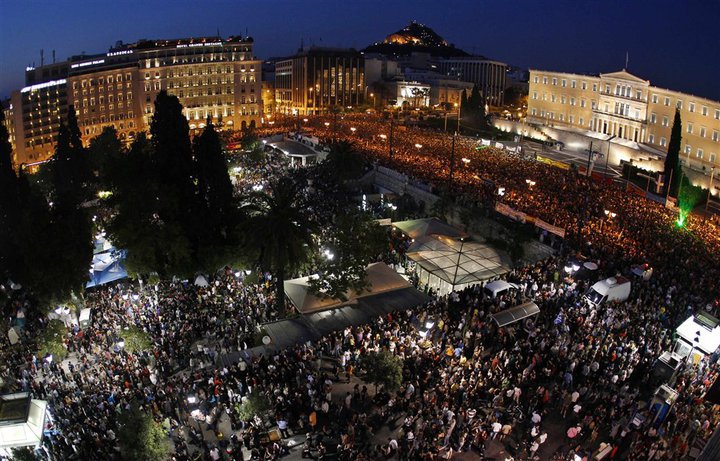
On the night of 26 to 27 June, without a final agreement, Tsipras announced a referendum. The official question began: "Should the draft agreement, which was submitted by the European Commission, the European Central Bank, and the International Monetary Fund at the Eurogroup of 25.06.2015 and consists of two parts, which constitute their unitary proposal, be accepted?" It named the texts "Reforms for the completion of the current program and beyond" and "Preliminary debt sustainability analysis." This, and not legally a straightforward "euro or drachma" question, was the precise subject of the ballot paper.
Political interpretations were competitive. The government presented the "No" as a mandate for stronger negotiation without leaving the euro. The opposition and several European officials warned that, in practice, the country's position in the eurozone was at stake. Furthermore, the previous program expired on 30 June, and the proposal to which the question referred did not remain active in the same legal form. These facts did not invalidate the vote, but they explain why its meaning remained a subject of disagreement.
Following the interruption of talks and the lack of an increase in emergency liquidity, a bank holiday and restrictions on capital movement were imposed from 29 June. ATMs operated with a daily withdrawal limit, while electronic transactions within the country continued under conditions. The capital controls prevented uncontrolled outflow and banking collapse, but they disrupted businesses, imports, and daily life.
On 5 July, "Not approved — No" received 61.31% of the valid ballots, and "Approved — Yes" 38.69%. The following day, Finance Minister Yanis Varoufakis resigned. After new, all-night negotiations, the eurozone summit on 12 and 13 July set prerequisites to open a third program. Supporters considered it a necessary compromise for remaining in the euro; opponents, a reversal or limited implementation of the "No" mandate.
Parliament approved the prerequisites with the votes of the opposition, while a significant segment of SYRIZA disagreed. On 19 August, a three-year financial assistance program of up to €86 billion was approved by the European Stability Mechanism. The amount was a maximum available framework, not necessarily a final disbursement. It included fiscal measures, reforms, bank recapitalization, and commitments regarding public property.
Tsipras resigned on 20 August. On the twenty-seventh, the President of the Supreme Court, Vassiliki Thanou, assumed office as caretaker Prime Minister, the first woman in the post, to lead the country to elections. On 20 September, SYRIZA won again, and on the twenty-first, a second SYRIZA–ANEL coalition government was formed under Tsipras.
That same year, mainly from the summer onwards, the islands of the eastern Aegean received unprecedented arrivals. The UNHCR recorded approximately 856,700 sea arrivals in Greece during 2015, mainly people from countries of war and persecution, but it used the composite term "refugees and migrants." Most sought to continue to other European countries. Residents, volunteers, and organizations offered help, while inadequate infrastructure, shipwrecks, and European disagreements turned the arrivals into a humanitarian and political crisis.
On 31 December 2015, the President was Prokopis Pavlopoulos and the Prime Minister was Alexis Tsipras. The country remained in the euro and was implementing a third program, with capital controls still in effect. The economy had lost approximately one quarter of its real output since the pre-crisis peak, depending on the base year and the revision of accounts. Unemployment had retreated from its peak, but the social trauma remained.
The journey from prosperity to crisis is not a moral tale about a "wasteful people," nor is it a story in which everything was imposed from the outside. It is the convergence of domestic clientelist and fiscal weaknesses, private and public borrowing, European institutional design, international panic, and decisions that distributed the cost unequally. To understand it, we need to listen to the government, the opposition, the creditors, and, above all, the different social experiences.
In the next episode, we move to 1 January 2016 and reach the present: the exit from the programs, the Prespa Agreement, the pandemic, the new crises, and the choices of a Greece that continues to change.
Find all episodes at ProjectGreece.gr, along with references, additional material, explanations, sources, and bibliography.
All episodes of the series are available for free on Spotify, Apple Podcasts, and YouTube Music.
ProjectGreece.
So the story can continue.
Sources & bibliography
This episode is linked to 35 documentation and rights records.
- Γενική Γραμματεία Νομικών και Κοινοβουλευτικών Θεμάτων, «Οι Κυβερνήσεις από το 1909 έως σήμερα», χρονολογικός πίνακας: https://gslegal.gov.gr/kyvernisi/istorika-stoixeia/ — **Rights:** `OFFICIAL_LINK_ONLY`.CITATION_ONLYOpen source
- Προεδρία της Ελληνικής Δημοκρατίας, «Πρόεδροι της Δημοκρατίας»: https://www.presidency.gr/proedria/proedroi-tis-dimokratias/ — **Rights:** `OFFICIAL_LINK_ONLY`.CITATION_ONLYOpen source
- Υπουργείο Εσωτερικών, αρχείο εκλογικών αποτελεσμάτων (16.9.2007, 4.10.2009, 6.5/17.6.2012, 25.1/20.9.2015): https://www.ypes.gr/ekloges/ — **Rights:** `OFFICIAL_LINK_ONLY`; τα αριθμητικά δεδομένα παρατίθενται με attribution, όχι το page design.OFFICIAL_LINK_ONLYOpen source
- Βουλή των Ελλήνων, Πρακτικά Ολομέλειας, προεδρικές ψηφοφορίες και συνεδρίαση δημοψηφίσματος 27–28.6.2015: https://www.hellenicparliament.gr/Praktika/Synedriaseis-Olomeleias — **Rights:** `OFFICIAL_RECORD / LINK_ONLY_FOR_FACSIMILE`.OFFICIAL_LINK_ONLYOpen source
- Προεδρικό Διάταγμα 38/2015, ΦΕΚ Α΄63/28.6.2015, προκήρυξη δημοψηφίσματος — **Rights:** `PD_OFFICIAL_TEXT`; `LINK_ONLY_FOR_FACSIMILE`.CITATION_ONLY
- Υπουργείο Εσωτερικών, «Για το ψηφοδέλτιο»: https://www.ypes.gr/gia-to-psifodeltio/ — **Rights:** `OFFICIAL_LINK_ONLY`.OFFICIAL_LINK_ONLYOpen source
- Υπουργείο Εσωτερικών, *Ψηφοδέλτια Δημοψηφίσματος 5ης Ιουλίου 2015*, γενικό σύνολο p. 8: https://www.ypes.gr/wp-content/uploads/2024/01/ApotelDHMOPSIFISMA2015-20240129.pdf — **Rights:** `OFFICIAL_DATA / LINK_ONLY_FOR_PDF_LAYOUT`.OFFICIAL_LINK_ONLYOpen source
- Βουλή των Ελλήνων, Πρακτικά Ολομέλειας, ΙΒ΄ Περίοδος, Β΄ Σύνοδος, συνεδρίαση ΜΘ΄, 9.12.2008, pp. 3001–3010: https://www.hellenicparliament.gr/UserFiles/a08fc2dd-61a9-4a83-b09a-09f4c564609d/es20081209.pdf — **Rights:** `OFFICIAL_RECORD / LINK_ONLY_FOR_FACSIMILE`.OFFICIAL_LINK_ONLYOpen source
- Βουλή των Ελλήνων, κοινοβουλευτικός έλεγχος 622/10393, 19.5.2010, «Πόρισμα ερευνών σχετικά με τη δολοφονική επίθεση στο υποκατάστημα της Marfin»: https://www.hellenicparliament.gr/Koinovouleftikos-Elenchos/Mesa-Koinovouleutikou-Elegxou?pcm_id=8131e30d-c1df-483b-9827-95d0efadb689 — **Rights:** `OFFICIAL_RECORD / LINK_ONLY`.OFFICIAL_LINK_ONLYOpen source
- ΠΝΠ 28.6.2015, ΦΕΚ Α΄65, άρθρα 1–2, τραπεζική αργία και περιορισμοί αναλήψεων — **Rights:** `PD_OFFICIAL_TEXT`; `LINK_ONLY_FOR_FACSIMILE`.CITATION_ONLY
- Eurostat, *Report on the Revision of the Greek Government Deficit and Debt Figures*, 1.12.2004, §2, Table 1 και Annexes 2–5: https://ec.europa.eu/eurostat/documents/4187653/5765001/GREECE-EN.PDF — **Rights:** `EU_REUSE_WITH_ATTRIBUTION`; έλεγχος τυχόν third-party στοιχείων.CITATION_ONLYOpen source
- European Commission, *Report on Greek Government Deficit and Debt Statistics*, COM(2010)1 final, §§2–3 και Annex 3: https://ec.europa.eu/eurostat/documents/4187653/6404656/COM_2010_report_greek/c8523cfa-d3c1-4954-8ea1-64bb11e59b3a — **Rights:** `EU_REUSE_WITH_ATTRIBUTION`; έλεγχος third-party material.CITATION_ONLYOpen source
- Τράπεζα της Ελλάδος, *Το χρονικό της μεγάλης κρίσης: Η Τράπεζα της Ελλάδος 2008–2013*, Μέρη I–II: https://www.bankofgreece.gr/publications/the%20chronicle%20of%20the%20great%20crisis.pdf — **Rights:** `OFFICIAL_LINK_ONLY`.OFFICIAL_LINK_ONLYOpen source
- IMF, *Greece: Request for Stand-By Arrangement*, Country Report 10/111, §23, p. 38: https://www.imf.org/external/pubs/ft/scr/2010/cr10111.pdf — **Rights:** `CITATION_AND_LINK_ONLY`.CITATION_ONLYOpen source
- European Commission, *The Economic Adjustment Programme for Greece*, Occasional Paper 61, May 2010, pp. 7–22: https://ec.europa.eu/economy_finance/publications/occasional_paper/2010/pdf/ocp61_en.pdf — **Rights:** `EU_REUSE_WITH_ATTRIBUTION`; έλεγχος third-party material.CITATION_ONLYOpen source
- IMF, *Ex Post Evaluation of Exceptional Access under the 2010 Stand-By Arrangement*, Country Report 13/156, Executive Summary και §§31–43: https://doi.org/10.5089/9781484387894.002 — **Rights:** `CITATION_AND_LINK_ONLY`.CITATION_ONLYOpen source
- European Commission, *The Second Economic Adjustment Programme for Greece*, Occasional Paper 94, March 2012, pp. 7–12, 45–49 και Annex 1: https://ec.europa.eu/economy_finance/publications/occasional_paper/2012/op94_en.htm — **Rights:** `EU_REUSE_WITH_ATTRIBUTION`; έλεγχος third-party material.CITATION_ONLYOpen source
- European Commission, “Financial assistance to Greece,” ενότητες “First programme”, “Second programme” και fifth review/2014 disbursements: https://economy-finance.ec.europa.eu/eu-financial-assistance/euro-area-countries/financial-assistance-greece_en — **Rights:** `EU_REUSE_WITH_ATTRIBUTION`.CITATION_ONLYOpen source
- Τράπεζα της Ελλάδος, *Interim Report on Monetary Policy 2015*, κεφ. I–III: https://www.bankofgreece.gr/en/news-and-media/press-office/news-list/news?announcement=00c5371f-c163-4bb6-81da-66d8b777f9de — **Rights:** `OFFICIAL_LINK_ONLY`.OFFICIAL_LINK_ONLYOpen source
- Council of the EU, *Euro Summit Statement*, 12.7.2015, pp. 1–7: https://www.consilium.europa.eu/media/20353/20150712-eurosummit-statement-greece.pdf — **Rights:** `EU_REUSE_WITH_ATTRIBUTION`; έλεγχος third-party material.CITATION_ONLYOpen source
- Council of the EU / ESM, “Timeline: the third financial assistance programme for Greece,” entries 8.7–19.8.2015: https://www.consilium.europa.eu/el/policies/financial-assistance-eurozone-members/greece-programme/timeline/ — **Rights:** `EU_REUSE_WITH_ATTRIBUTION` για Council text· `ESM_LINK_ONLY` για υλικό ESM εκτός αν το item ορίζει αλλιώς.CITATION_ONLYOpen source
- Ν. 3723/2008, άρθρα 1–3, ΦΕΚ Α΄250/9.12.2008· ν. 3845/2010, ΦΕΚ Α΄65/6.5.2010· ΠΝΠ 11.6.2013, ΦΕΚ Α΄139 — **Rights:** `PD_OFFICIAL_TEXT`; `LINK_ONLY_FOR_FACSIMILE`.CITATION_ONLY
- Eurogroup, “Eurogroup statement on Greece,” 20.2.2015: https://www.consilium.europa.eu/en/meetings/eurogroup/2015/02/20/ · και “Eurogroup statement on Greece,” 27.6.2015: https://www.consilium.europa.eu/en/meetings/eurogroup/2015/06/27/ — **Rights:** `EU_REUSE_WITH_ATTRIBUTION`.CITATION_ONLYOpen source
- ESM, “ESM Board of Governors approves ESM programme for Greece,” 19.8.2015, έγκριση FFA/MoU και πλαίσιο έως €86 δισ.: https://www.esm.europa.eu/press-releases/esm-board-governors-approves-esm-programme-greece — **Rights:** `ESM_LINK_ONLY`; citation and paraphrase only unless the item notice permits more.CITATION_ONLYOpen source
- Eurostat Data Browser, datasets `une_rt_a` (Greece, annual 2013), `ilc_peps01` και `nama_10_gdp`: https://ec.europa.eu/eurostat/databrowser/ — **Rights:** `EU_REUSE_WITH_ATTRIBUTION`; καταγραφή extraction date στο publication export.CITATION_ONLYOpen source
- Kentikelenis, Alexander et al., “Greece’s Health Crisis: From Austerity to Denialism,” *The Lancet* 383 (2014), pp. 748–753, DOI 10.1016/S0140-6736(13)62291-6 — **Rights:** `CITATION_ONLY`.CITATION_ONLY
- Filippidis, Filippos T. et al., “Medium-term impact of the economic crisis on mortality, health-related behaviours and access to healthcare in Greece,” *Scientific Reports* 7 (2017), article 46423: https://pmc.ncbi.nlm.nih.gov/articles/PMC5385490/ — **Rights:** `CC_BY_4.0` for the article; verify each third-party figure separately.CITATION_ONLYOpen source
- Kalyvas, Stathis N., “An Anomaly? Some Reflections on the Greek December 2008,” *Constellations* 17:2 (2010), pp. 351–365 — **Rights:** `CITATION_ONLY`.CITATION_ONLY
- NATO, *Bucharest Summit Declaration*, 3.4.2008, §20: https://www.nato.int/cps/en/natolive/official_texts_8443.htm — **Rights:** `OFFICIAL_LINK_ONLY`.CITATION_ONLYOpen source
- International Court of Justice, *Application of the Interim Accord of 13 September 1995*, Judgment 5.12.2011, §§101–113, 168–170: https://www.icj-cij.org/case/142 — **Rights:** `OFFICIAL_LINK_ONLY`.CITATION_ONLYOpen source
- Πυροσβεστικό Σώμα, «Επιμνημόσυνες δεήσεις για τα θύματα των περσινών πυρκαγιών», *Πυροσβεστική Επιθεώρηση* (2008): https://www.fireservice.gr/dynamic/c32847/attach/1/40_el_GR.pdf — **Rights:** `OFFICIAL_LINK_ONLY`; καμία αναπαραγωγή φωτογραφίας ή PDF layout χωρίς item review.CITATION_ONLYOpen source
- Sophia Lazaretou, “The Greek Brain Drain: The New Pattern of Greek Emigration during the Recent Crisis,” Τράπεζα της Ελλάδος, *Economic Bulletin* 43 (July 2016), pp. 31–48: https://www.bankofgreece.gr/Publications/4320160703_en.pdf — **Rights:** `CITATION_ONLY / OFFICIAL_HOST`; παράφραση και σύνδεσμος.OFFICIAL_LINK_ONLYOpen source
- ΕΛΣΤΑΤ, *Εκτιμώμενη μετανάστευση κατά φύλο και ομάδες ηλικιών*, σειρές 2009–15 — **Rights:** `OFFICIAL_DATA_WITH_ATTRIBUTION`; έλεγχος των όρων χρήσης για redistribution του export.CITATION_ONLY
- UNHCR, *Greece — Sea Arrivals 2015*, annual dataset/map, 856.723: https://data.unhcr.org/en/documents/details/46733 — **Rights:** `CC_BY_4.0_DATA`, σύμφωνα με το ODP disclaimer εκτός αν το item δηλώνει διαφορετικά· όχι αυτόματη άδεια για φωτογραφίες.CITATION_ONLYOpen source
- UNHCR, *Greece 2015 Year-End Report Summary*: https://reporting.unhcr.org/greece-2015-year-end-report-summary — **Rights:** `UNHCR_LINK_ONLY`; παράφραση και citation, όχι αναπαραγωγή layout/images.CITATION_ONLYOpen source